





 Portuguese
  English
  Spanish
  7 min of reading
  0 comments


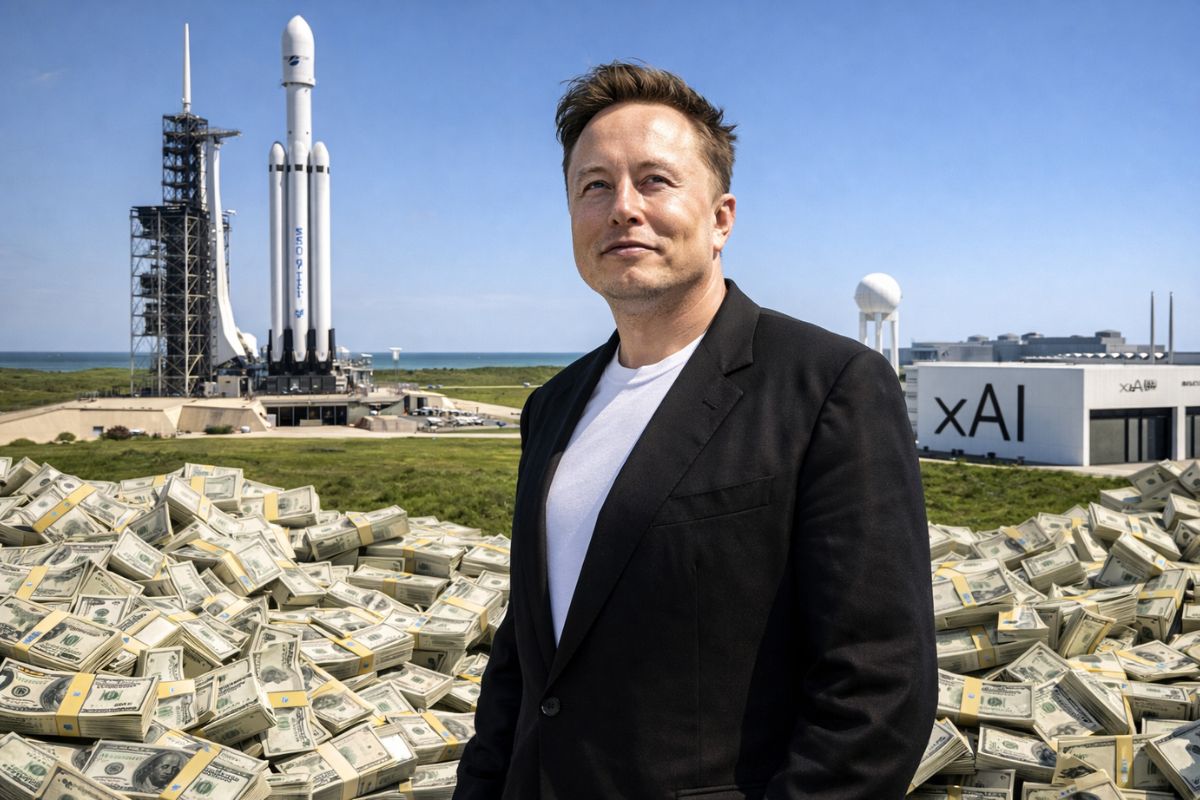
With Elon Musk’s Fortune Estimated at US$ 800 Billion After xAI Joined SpaceX, the Richest Man in the World Is Viewed as the Richest Person in History, and Puts the World’s Billionaires Under a New Comparison.
Elon Musk saw his fortune reach the US$ 800 billion mark, according to recent estimates, after a decisive move: SpaceX incorporating xAI, the artificial intelligence company that was already part of his portfolio. With this leap, he solidifies himself as the richest person in history in nominal wealth, surpassing legendary names such as John D. Rockefeller, Barão de Mauá, and Mansa Musa.
Even without yet reaching the trillionaire level, Musk comfortably leads the contemporary billionaires ranking. At the same time, the idea that he would be the richest person in history raises a complex discussion: after all, comparing fortunes from such different eras requires looking not only at absolute numbers but also at the economic weight each had in their own time.
Why Elon Musk Is Called the Richest Person in History
By the simplest criterion, that of nominal wealth, Elon Musk dominates the competition. The math is straightforward: add the values of stocks, ownerships in companies, assets, and cash, subtract debts, and the result places the entrepreneur at an unprecedented level in current dollars.
-
Mercado Livre has just started selling medications with delivery in up to three hours to your door, and this move could completely change the way Brazilians buy medicines on a daily basis.

-
In Dubai, rising tensions from the war in the Middle East are causing super-rich individuals to leave the Gulf and direct their fortunes to a new financial refuge in Asia.

-
“No one will make us change the Pix,” says Lula after the US report.

-
Lula responds directly to Trump and says that Pix is from Brazil and will not change under pressure from anyone, after a report from the United States pointed out the Brazilian payment system as an American trade barrier.


With an estimated wealth of US$ 800 billion, Musk surpasses any other individual ever recorded in modern wealth calculation bases.
That is why, in terms of gross value in dollars, he is often presented as the richest person in history.
But that is not the only way to measure wealth. Before the digital age and the major billionaire rankings, someone’s economic weight was often assessed by the share they held of a country’s or region’s economy. Here, the story changes.
Nominal Wealth vs. Influence over the Economy

When it comes to the richest person in history, one inevitable question is: are we talking about absolute numbers or relative impact on the economy of their time?
In proportional terms to Gross Domestic Product (GDP), historical figures still rival or even surpass Elon Musk. John D. Rockefeller, for example, controlled between 1.5% and 1.6% of the U.S. economy in 1913, a weight very close to current estimates for Musk’s share relative to the 2025 GDP.
Jakob Fugger, a European banker from the 16th century, would have held about 2% of Europe’s GDP, an impressive number even when adjusted to current values.
Meanwhile, Mansa Musa, emperor of Mali from 1312 to 1337, is often cited as a candidate for the richest person in history, but calculations about his fortune are filled with uncertainties and anecdotal reports, such as the episode where he distributed so much gold on his pilgrimage to Mecca that it devalued the metal in Egypt for over a decade.
Another example is the Roman emperor Augustus Caesar, who controlled directly or indirectly up to 30% of the global economy of his time.
Some estimates suggest this would equate to trillions of dollars today, but experts recognize a high degree of speculation in these numbers, precisely because the economy of the period is difficult to translate into current parameters.
In summary, Musk is the richest person in history in registered nominal wealth, but not necessarily the individual with the greatest economic dominance over his time when we adjust the metric to GDP share.
What the Barão de Mauá Has to Do with Elon Musk
In Brazil, the most natural comparison is with Irineu Evangelista de Sousa, the Barão de Mauá, a great symbol of wealth and modernization in the 19th century.
At his peak, Mauá controlled eight of the ten largest companies in the country, as well as banks, railways, shipyards, and navigation companies. His empire crossed borders, with operations in England, Uruguay, and Argentina, at a time when Brazil was still consolidating its industrial base.
The impact was so great that, in the mid-1867, Mauá’s fortune exceeded the budget of the Empire of Brazil, something equivalent to controlling a significant share of the national economy.
Current estimates suggest something around US$ 80 billion, an impressive amount, but far from Elon Musk in nominal terms.
The central difference lies in the scale. While Mauá operated in an agrarian and forming industrial economy, Musk concentrates wealth in high-tech sectors within one of the largest economies in the world, with publicly traded companies accessible to global investors.
Furthermore, the ultimate trajectories of the two are quite distinct. Mauá’s empire collapsed after financial crises and resistance from the conservative elite of the time, especially after the Paraguayan War.
He ended his life with much fewer resources than he had accumulated, returning to work as a coffee broker. Musk, for his part, is still in the midst of business expansion.
How Wealth Parameters Have Changed Over Time
For much of history, evaluating who was the richest person in history was less about summing assets and more about measuring dominance over the economy. The focus was on the share of GDP of a country or region that was under the direct or indirect control of an individual.
With the consolidation of capital markets, especially from the 20th century onwards, this paradigm has been transforming. Stock markets, financial globalization, and the increase in the number of publicly traded companies made it more relevant to measure fortunes through the market value of stocks and ownerships.
Then, the modern concept of net worth emerged, calculated as the sum of all assets minus liabilities. This metric allows for comparing billionaires in different countries, even if the local GDP is relatively small.
At the same time, GDP has shown its limits as a historical comparison tool. A highly concentrated economy, such as that of the Roman Empire, does not simply translate into current dollars, and GDP only measures annual production, not the accumulation of wealth over time.
That is why today the idea of the richest person in history often divides into two paths:
- Musk leads in registered nominal wealth, based on assets and market evaluations.
- Other names appear as possible leaders in proportional influence over the economy of their time, albeit with a high margin of error in calculations.
How Forbes and Bloomberg Calculate Billionaires’ Fortunes
To determine who the richest billionaire in the world is and fuel discussions about who would be the richest person in history, outlets like Forbes and Bloomberg use their own methodologies, but with similar bases.
The starting point is net worth. Ownership in companies, real estate, land, artworks, planes, yachts, financial assets, and cash are included, whenever there is sufficient data to estimate the market value of those assets.
In the case of publicly traded companies, Forbes considers official documents and stock prices to calculate the value of each billionaire’s stake.
For private companies, the process is more complex: it involves interviews with partners, competitors, financial consultants, and market multiple analyses. After that, debts and other obligations are subtracted.
Bloomberg follows a similar logic, but updates values daily, at a fixed time, based on stock fluctuations.
It also applies discounts related to taxes and estimates of net investment returns, resulting in a number that tries to more closely mirror how much the billionaire would have if they liquidated part of their assets.
In family fortunes, the value is usually attributed to the member who holds direct control of the assets, even if they are formally in the name of other relatives.
Is Musk or Is He Not the Richest Person in History?
In the end, the answer depends on the criteria. If the focus is on adjusted nominal wealth, Musk appears as the richest person in recorded history, leading an era in which technology and space infrastructure companies concentrate unprecedented values in stocks and ownerships.
On the other hand, when the question is about proportional influence on the economy, the scenario becomes murkier.
Names like Rockefeller, Fugger, Mansa Musa, or Augustus Caesar appear as strong candidates, although comparisons depend on historical estimates filled with uncertainties.
What remains unchanged is the fact that Musk symbolizes a new phase of global capitalism, in which a single individual can control electric car companies, reusable rockets, communication satellites, and advanced artificial intelligence projects, all at the same time.
It is this combination that makes many analysts see him not only as the richest in the world today but also a watershed in the discussion about great fortunes.
And you, do you think it’s fair to consider Elon Musk as the richest person in history or should the criteria take more into account the relative economic weight of figures like Rockefeller, Mauá, or Mansa Musa in their own times?







-

-

-

-

-

-

17 pessoas reagiram a isso.