





 Portuguese
  English
  Spanish
  5 min of reading
  0 comments


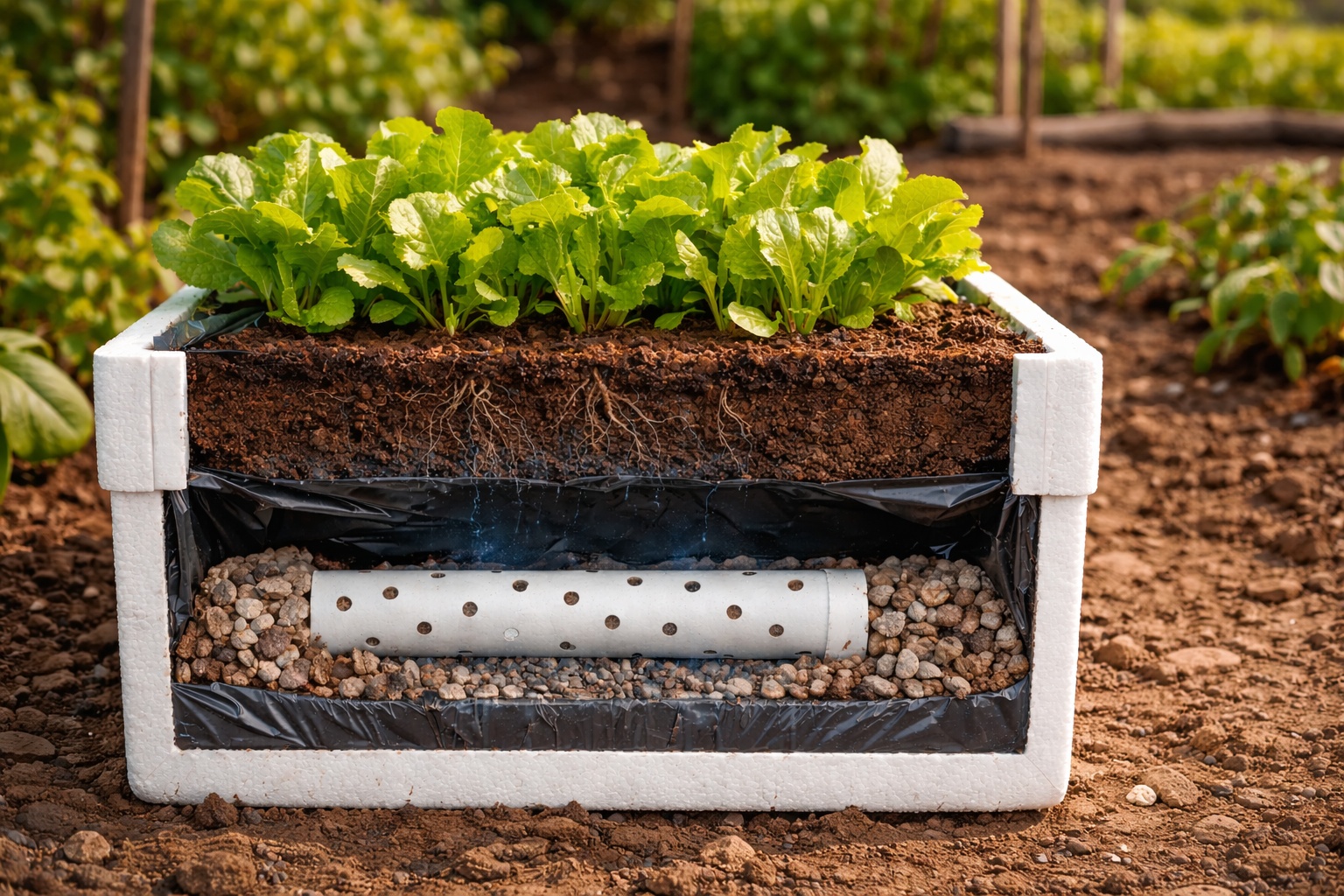
Self-Watering Bed with Styrofoam Box and Perforated PVC Uses Capillary Irrigation to Save Up to 80% of Water and Keep the Garden Moist for Up to Seven Days.
Self-Watering Bed with Styrofoam Box: How the Capillary Garden Works to Save Up to 80% of Water and Keeps the Soil Moist for Up to a Week. The Styrofoam box was found in the supermarket’s trash. The PVC pipe was leftover from construction. The plastic tarp cost less than ten reais at the hardware store. With these three elements, family farmers and urban cultivators assembled a low-cost self-watering bed, based on capillary irrigation — a system that Australian science took decades to formalize and that natural floodplains had demonstrated for millennia: water rises.
It does not run off the surface, does not evaporate under the midday sun, and is not lost to excessive drainage. It rises through the soil, pulled by the roots. This method is internationally known as a wicking bed and, in Brazil, gained popularity as capillary garden in a styrofoam box.
How the Self-Watering Bed Works: Capillary Irrigation in Practice
The self-watering bed — also called a capillary garden or wicking bed system — operates based on a simple physical principle: capillarity.
-
The sugar-energy sector advances with agricultural technology, but agricultural productivity still raises concerns.

-
The eggshell that almost everyone throws away is made up of about 95% calcium carbonate and can help enrich the soil when crushed, slowly releasing nutrients and being reused in home gardens and vegetable patches.
-
This farm in the United States does not use sunlight, does not use soil, and produces 500 times more food per square meter than traditional agriculture: the secret lies in 42,000 LEDs, hydroponics, and a system that recycles even the heat from the lamps.

-
The water that almost everyone throws away after cooking potatoes carries nutrients released during the preparation and can be reused to help in the development of plants when used correctly at the base of gardens and pots, at no additional cost and without changing the routine.

The same force that makes:
- Ink rise through a brush
- Coffee advance through sugar
- Blood travel through a bandage
is the force that moves water from below to above within the bed’s soil.
System Structure
Assembly involves four main layers:
- Sealed Styrofoam Box (no holes in the bottom)
- Perforated PVC Pipe in an “L” Shape
- Layer of Sawdust or Porous Material
- Substrate with Black Soil and Limestone

Garagem Horgânica_vrs
The perforated pipe distributes water horizontally at the bottom of the box. The sawdust acts as a porous medium and reservoir. Water saturates this layer and begins to slowly rise through the substrate by capillarity.
When the soil is moist, the flow reduces. When it dries, it increases. The plant receives water on demand.
Why the Self-Watering Bed Saves Water in the Garden
Traditional irrigation occurs from top to bottom. Capillary irrigation works from bottom to top. This difference completely alters water efficiency. When water is applied to the surface:
- Some evaporates
- Some runs off
- Some infiltrates beyond the root zone
- Some promotes fungi in the surface layer

Garagem Horgânica_vrs
In the self-watering bed with lower reservoir, the water remains protected from the sun and wind. It only moves when the roots need it.
Scientific Data on Water Savings
In a trial conducted in Sydney (2018), a 1.2m × 2.4m bed with capillary irrigation consumed 347.6 liters less than a conventional bed over two months. The reduction was approximately 80% in water volume.

Garagem Horgânica_vrs
Research published in the journal Horticulturae (MDPI), conducted by the University of Queensland, showed:
- Higher water efficiency
- Fewer irrigations (less than 26 compared to 40–50 in the conventional system)
- Higher productivity
- Better fruit quality in tomato plants
Styrofoam Box for Planting: Why It Works Better Than Other Containers
The styrofoam box as a self-watering bed has relevant technical advantages:
Thermal Insulation
Styrofoam reduces sudden temperature variations in the lower reservoir.
Water Stability
Water does not overheat nor cool excessively.
Structural Lightness
Allows installation on balconies, slabs, ledges, and small backyards.
Durability
Does not rot like wood and does not rust like metal.
Therefore, it has become a widely used model in:
- Urban Gardens
- Family Farming
- Municipal Sustainable Cultivation Programs
- Urban Agriculture Projects
The Urban Agriculture Farm of Curitiba uses the system as an official demonstrative technique.
The Role of Roots in Capillary Irrigation Control
One of the most important aspects of the system is that the one regulating water is the plant itself. When the soil dries, moisture tension increases. Water is pulled from the reservoir.
When the soil is moist, flow practically ceases. There is no need for:
- Timers
- Pumps
- Electricity
- Sensors
The plant regulates the irrigation. This allows the garden to remain moist for up to seven days without water replenishment.
Reduction of Diseases and Fungi in the Garden
As the surface remains relatively dry:
- The incidence of fungi is reduced
- The risk of rotting decreases
- Excess surface moisture is avoided
Capillary irrigation is especially advantageous for:
- Lettuce
- Arugula
- Green Onions
- Cilantro
- Basil
- Mint
- Parsley
Nutrient Retention and Reduced Leaching in the Soil
When watering from above, nutrient leaching occurs, and fertilizer is washed down to deeper layers. In the capillary bed, the movement of water is upward. This means:
- Less fertilizer loss
- Greater fertilization efficiency
- Less contamination of the subsoil
- Better use of organic compost
Studies from the University of Queensland (2021) confirmed lower leaching compared to conventional systems.
Origin of the Wicking Bed System: From Australia to Brazil
The system was formalized by Australian engineer Colin Austin to combat water scarcity in arid regions. Australia, one of the driest continents on the planet, needed irrigation solutions with maximum efficiency.
The concept is simple: Remove water from contact with air and place it below the soil.
However, before scientific formalization, riverside peoples had already naturally used the principle — soils near the water table produce more vigorous vegetation.
In Brazil, the system became popular through:
- Experimental Farmers
- Agricultural Fairs
- Rural Extension Programs
- Community Gardens
How to Make a Self-Watering Bed with PVC and Styrofoam Box
Summary of the assembly:
- Sealed Styrofoam Box
- Perforated PVC Pipe in L
- Layer of Sawdust or Fine Gravel
- Substrate with Organic Matter
- Refilling through the vertical pipe
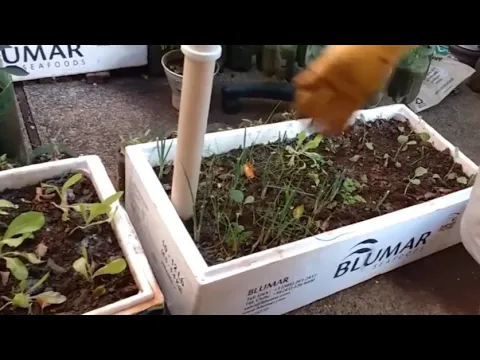

The total cost is low and can be assembled with reused materials. The self-watering bed with styrofoam box and perforated PVC represents one of the most efficient solutions for those seeking:
- Water savings
- Waste reduction
- Lower incidence of diseases
- Better nutrient utilization
- Sustainability in the home garden
The garden starts to water itself. Water rises. And waste decreases.

Garagem Horgânica_vrs










-

-

-

-

45 pessoas reagiram a isso.