





 Portuguese
  English
  Spanish
  4 min of reading
  9 comments


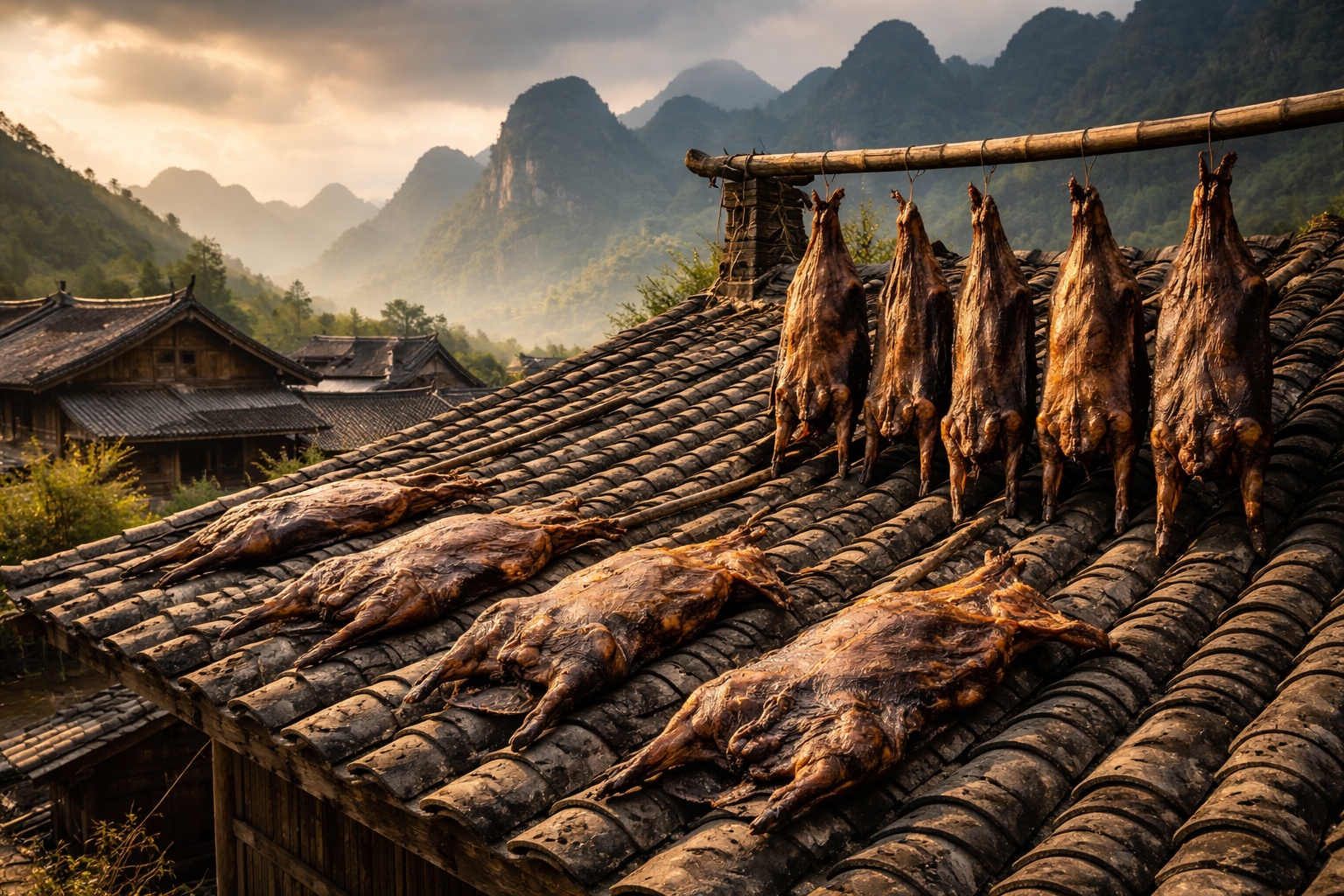


In Yunnan, China, Whole And Dried Pig Carcasses Are Still Placed On Roofs As A Traditional Preservation Method Before Refrigeration.
In Yunnan, China, whole and dried pig carcasses are still placed on roofs as part of a traditional method known as 风干腊肉 (Fēnggān Làròu) — literally “wind-dried cured meat” — a regional variation of Chinese preservation techniques called 腊肉 (Làròu) and 风干肉 (Fēnggān ròu).
In some mountainous regions of Yunnan province, in southwestern China, this ancient practice still draws the attention of visitors and sparks debate on social media: whole pig carcasses, already slaughtered, salted, and dried, are placed on roofs or elevated structures for preservation.
At first glance, the scene may seem unusual or even shocking. However, this is a traditional food preservation technique that emerged long before the existence of refrigerators or modern refrigeration systems. The practice combines intensive salting, natural ventilation, and cold winter weather to ensure that the meat is cured safely and durably.
-
Friends have been building a small “town” for 30 years to grow old together, with compact houses, a common area, nature surrounding it, and a collective life project designed for friendship, coexistence, and simplicity.

-
This small town in Germany created its own currency 24 years ago, today it circulates millions per year, is accepted in over 300 stores, and the German government allowed all of this to happen under one condition.

-
Curitiba is shrinking and is expected to lose 97,000 residents by 2050, while inland cities in Paraná such as Sarandi, Araucária, and Toledo are experiencing accelerated growth that is changing the entire state’s map.

-
Tourists were poisoned on Everest in a million-dollar fraud scheme involving helicopters that diverted over $19 million and shocked international authorities.


Preservation Tradition Before The Refrigeration Era
In rural areas of Yunnan, especially in higher altitude regions, winter is cold and dry. These climatic conditions favor the natural dehydration process of the meat.
After the animal is slaughtered, the pig is cleaned, opened, and subjected to generous salting. Salt plays a crucial role: it reduces the activity of microorganisms by drawing moisture from the tissues, making bacterial proliferation more difficult.

After salting, the carcass is placed in elevated locations — often roofs or high balconies — where it receives constant ventilation and exposure to cold.
This process can last weeks or even months, resulting in cured meat similar to hams and other traditionally preserved meats.
Why Put The Carcasses On The Roofs?
The choice of the roof is not random. Historically, this was one of the safest and most ventilated areas of rural houses.
Placing the carcasses in elevated locations helped to:
- Reduce the risk of contact with domestic animals.
- Avoid direct contamination from the ground.
- Ensure constant airflow.
- Take advantage of indirect solar incidence and the cold of the night.
The elevation also makes it difficult for insects to access, especially during colder periods. In mountainous regions, the combination of altitude and dry climate creates ideal conditions for natural drying.
Cured Meat Is Part Of Local Cultural Heritage
In Yunnan, pork has historical importance in rural diets. The slaughter of a pig often represents a community event or preparation for winter periods.
As there was no refrigerated storage in the past, preserving large quantities of meat was a practical necessity.

The technique of air-drying has evolved over centuries into a cultural tradition. Some communities continue to use it as a way to preserve regional identity.
Although modern methods are widely available, in more remote areas the practice is still observed.
Does The Practice Still Exist Today?
Yes, although in a more restricted form.
With the expansion of electrical infrastructure and modern refrigeration in China, the practical need has significantly diminished.
However, in isolated rural villages or in cultural tradition contexts, the technique remains active.
Moreover, cured meat from traditional methods is valued for its characteristic flavor. The dehydration process alters texture and concentrates flavor, making the final product appreciated in regional cuisine.
Modern Debate And Questions
The practice also generates controversies, especially when images circulate on social media without historical context.
To outsiders, the presence of carcasses on roofs may seem unsanitary. However, the traditional method includes specific stages of salting and drying aimed precisely at preventing deterioration.
Modern health authorities require strict standards for food marketing, and the formal sale of meats must adhere to current regulations.
Thus, the practice tends to remain restricted to domestic consumption or very specific contexts.
Salting As An Ancient Technique
The method used in Yunnan is not exclusive to China.
Various cultures around the world have developed similar techniques before electric refrigeration. Examples include:
- Cured hams in Europe.
- Beef jerky and charque in Latin America.
- Salted fish in Northern Europe.
The principle is the same: remove moisture and create an environment hostile to bacterial proliferation. The difference in Yunnan lies in the visual scale of the practice, with whole carcasses placed in elevated areas.
Climate Is A Determinant Factor
Yunnan has mountainous terrain and high altitudes in many regions. The cold winter climate is crucial for the safety of the process.
In warm and humid environments, the method would be riskier due to increased microbial proliferation.
Therefore, the practice is strongly associated with specific areas of the province, where natural conditions favor adequate drying.
Between Tradition And Modernity
The contrast between ancestral techniques and modern infrastructure highlights cultural transformation.
Today, major Chinese urban centers feature advanced food preservation technology.
Still, rural communities preserve practices inherited from previous generations. In many cases, continuity is not only an economic necessity but also a cultural affirmation.
A Tradition That Spans Centuries
The presence of dried pig carcasses on the roofs of Yunnan villages may be surprising, but it represents a historical solution to a universal problem: preserving food without electricity. The method combines empirical knowledge, climatic adaptation, and community tradition.
Although less common in the contemporary world, the practice still endures in some rural areas, reminding us that, before modern technology, survival depended on human creativity and intelligent use of the natural environment.
And even in a highly industrialized country like China, fragments of this past remain visible on the roofs of mountainous villages.










Nossa que matéria em.. lixo de matéria desse vc ganha vida ainda está empregado
Foi exatamente em Yunan que o vírus da COVID 19 surgiu, devido a estas maluquices que estes chineses fazem com animais domesticados e selvagens como: porcos, macacos, ratos, morcegos etc, desidratados para comer. Com isto mataram 6 milhões de humanos no mundo, incluindo minha mãe, que não voltará. Pediram desculpas? Pediram perdão?
nao foi porco que matou sua mae com virus, foi o governo que criou o virus pra mata sua mae
Eles são fodas, matam mesmo
Eles são fodas, matam mesmo, admiro!
Não foi em Yunnan foi wuhan que o vírus foi criado, que Deus conforte você e seus parentes por tamanha perda, concordo que a China em si tem culturas que colocam em risco vidas que vão além das fronteiras
Não, você confundiu
A cidade onde apareceu o vírus foi cidade de Wuhan
E preciso entender como a fome é capaz de moldar os hábitos alimentares
Na Amazônia é comum comer macacos e aranhas e, sabe Deus, os vírus que uma floresta esconde
Na verdade tem uma matéria que mostra que o vírus já estava circulando se não me engano nas águas da Argentina e também já tinha um casal do Rio ou de São Paulo que já estaria com esse vírus, sem eles ter viajado para outro lugar. Sinto muito pelos seus familiares.
Mas quando teve outros tipos de doenças e surtos no passado ninguém culpou nenhum país ou qualquer lugar, querendo ou não na China milhares de pessoas morreram também, aliás no mundo inteiro, todos nós sofremos e por outra parte tem as pessoas que não quiseram seguir regras e passaram vírus para seus parentes e familiares, muitas vezes com resultado de óbitos na família isso também impactou no números de vítimas da COVID
Parabéns pela matéria. A China sabe combinar a vanguarda do futuro com a tradição e a cultura do passado.