





 Portuguese
  English
  Spanish
  7 min of reading
  0 comments


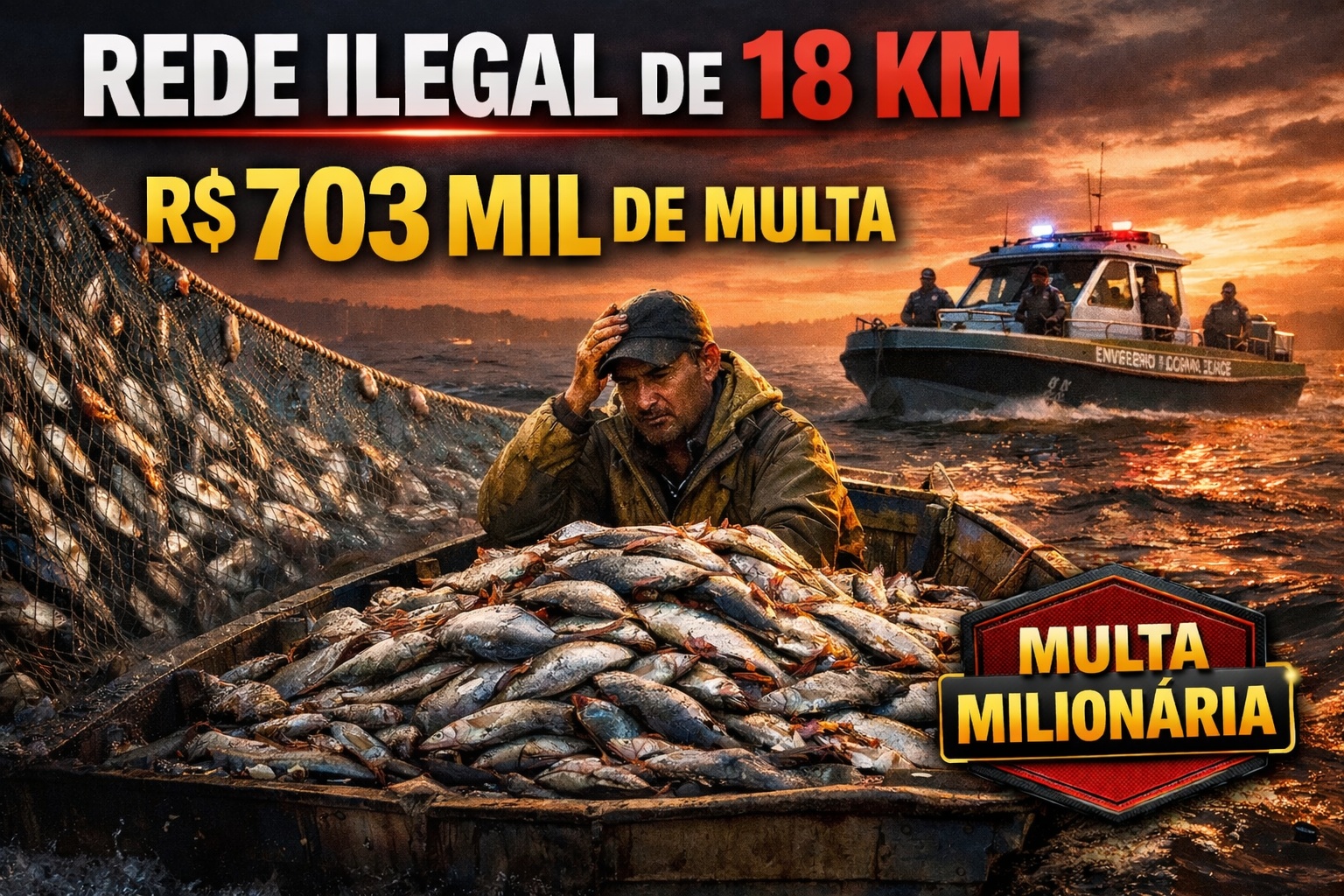
Fisherman With 18 Km Net Receives Fine of R$ 703 Thousand for Causing Loss of R$ 2.1 Million to the Marine Ecosystem: Environmental Police Seized 3 Tons of Fish in Praia Grande With Equipment 6 Times Above the Legal Limit, Operation Exposes Damage to Sustainable Fishing That Moves R$ 8 Billion Annually in Brazil and Threatens 2.4 Million Artisanal Fishermen Dependent on the Activity
Environmental Military Police fined a group of fishermen R$ 703.2 thousand after a flagrant case of predatory fishing in Canto do Forte in Praia Grande on the coast of São Paulo. The operation carried out on February 15, 2026, by the 5th Marine Company seized a gillnet measuring 18 kilometers in length, six times larger than the legal limit of 3 kilometers. The seized material included 2,875 kilograms of various fish and 5 kilograms of white shrimp, totaling almost 3 tons.
The illegal net functioned as an underwater wall indiscriminately capturing marine fauna without allowing schools or non-target species of commercial fishing to escape. Equipment without mandatory identification required by law constitutes an environmental crime outlined in Article 34 of Federal Law 9,605 of 1998. The estimated loss to the marine ecosystem reaches R$ 2.1 million considering damage to the food chain and the population of commercial species threatening the sustainability of regional fishing activities.
Record Fine Reflects the Dimension of Environmental Crime
Six environmental violation notices were issued against the group totaling R$ 703,200 according to current environmental legislation. This amount represents one of the largest fines recently applied on the São Paulo coast, signaling a tightening of enforcement against predatory fishing. The penalty calculation considers the net length six times above the legal limit, absence of mandatory identification, the volume of fish captured, and damage to the ecosystem.
-
Friends have been building a small “town” for 30 years to grow old together, with compact houses, a common area, nature surrounding it, and a collective life project designed for friendship, coexistence, and simplicity.

-
This small town in Germany created its own currency 24 years ago, today it circulates millions per year, is accepted in over 300 stores, and the German government allowed all of this to happen under one condition.

-
Curitiba is shrinking and is expected to lose 97,000 residents by 2050, while inland cities in Paraná such as Sarandi, Araucária, and Toledo are experiencing accelerated growth that is changing the entire state’s map.

-
Tourists were poisoned on Everest in a million-dollar fraud scheme involving helicopters that diverted over $19 million and shocked international authorities.

Decree 6.514 establishes a base fine between R$ 700 and R$ 100 thousand with an additional R$ 20 per kilogram of seized fish. In this specific case, 2,880 kilograms seized generated an additional R$ 57,600 added to the penalty for the illegal net length. Equipment and vessel used were also seized as prescribed by law, resulting in total loss of the investments made by the offenders.

Seized fish in proper conditions for consumption were allocated to previously registered institutions ensuring social use of the material. This practice avoids waste while penalizing offenders, preventing the commercialization that would generate an estimated profit between R$ 15 thousand and R$ 25 thousand considering the average price of fresh fish in the wholesale market of Santos.
The operation occurred during routine nautical patrols, demonstrating the importance of systematic enforcement. The Environmental Military Police reported that maritime enforcement remains intensified with a focus on preserving natural resources and combating illegal practices that compromise the sustainability of fishing activities on the São Paulo coast.
Illegal Fishing Causes Annual Global Losses of US$ 36.4 Billion
Predatory fishing generates a global loss of US$ 36.4 billion per year according to UN estimates. In Latin America and the Caribbean, illegal activity directly affects 2.4 million people who depend on fishing for their livelihood and product commercialization.
Brazil faces a critical situation with 80% of fish stocks exploited beyond their natural regeneration capacity according to studies from IBAMA.
A study conducted by the University of British Columbia quantifies annual losses of up to US$ 26 billion for the global economy due to overfishing. The World Wildlife Fund (WWF) attests that over 75% of the world’s fish population is threatened by predatory fishing where the amount removed exceeds the capacity of marine ecosystems to recover.

The Brazilian fishing sector generates R$ 8 billion annually in the national economy, formally employing 45 thousand direct workers.
This activity also supports hundreds of thousands of artisanal fishermen who depend on the maintenance of fish stocks to survive. Predatory fishing directly threatens the economic viability of entire coastal communities.
The Ministry of the Environment counts 19 species of marine fish threatened with extinction and 32 species in a phase of over-exploitation in Brazil. Absence of updated data makes it difficult to accurately measure the problem since the most recent government records date back to 2015. Researchers warn that the real impact could be significantly greater than official statistics indicate.
Illegal Net Indiscriminately Captures Commercial and Protected Species
The 18-kilometer net functions as a physical barrier preventing the escape of any marine organism that comes into contact with its mesh. The technique known as trawling captures indiscriminately juvenile fish, threatened species, and incidental bycatch without commercial value. Approximately 40% of all captures are discarded dead back into the sea, representing absurd waste of natural resources.
About 4 million tons of marine animals are discarded annually for being considered without economic value according to data from the Akatu Institute. The practice known as bycatch results in the deaths of 300 thousand whales and dolphins every year, along with 12 million sharks and rays caught accidentally. Fishing with giant nets dramatically intensifies this problem.
A study by the ReefSyn group with nine Brazilian public universities analyzed a database from 1950 to 2015 revealing a drastic reduction in fish volumes along the Brazilian coast. Reef fish that inhabit coral reefs represent around 400 key species as a food source for human populations and perform essential functions in the marine ecosystem.
The North and Northeast coasts have suffered the greatest impact from predatory fishing with the collapse of several commercial stocks. Professor Tito Lotufo from the Institute of Marine Sciences at UFC explains that large predators essential for the functioning of marine ecosystems are in a more critical situation. The loss of these top-chain animals destabilizes the ecological balance with unpredictable consequences.
Ghost Nets Kill 100 Thousand Marine Animals Annually
Every year, 640 thousand tons of ghost nets are abandoned in the oceans capturing more than 100 thousand animals according to the UN.
In Brazil, there are reports of discarded fishing equipment in 12 of the 17 coastal states representing 70% of the national coast. Abandoned nets continue to fish indefinitely, killing thousands of marine organisms without any utilization.
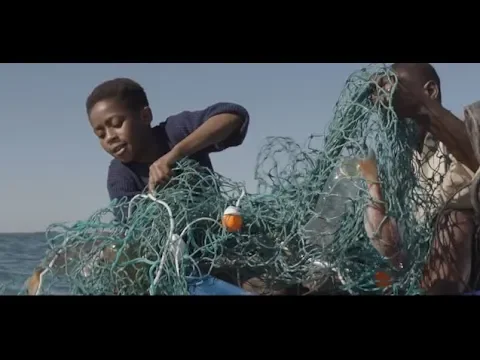

When illegal fishermen evade enforcement, they often abandon equipment at sea to avoid seizure. Nets without identification, like the one captured in Praia Grande, make tracing responsibilities difficult when found later. Discarded material gets entangled in coral reefs, marine animals, and vessels, causing multiplied damage over decades.
Coral reefs are particularly vulnerable to predatory fishing. Herbivorous fish maintain balanced ecosystems by eating algae and keeping corals clean for healthy growth. Excessive capture of herbivores weakens reefs, making them susceptible to extreme weather events and climate change. Fishing equipment can physically destroy fragile corals that form the foundations of the reefs.
About 55% of the oceans were used for fishing between 2012 and 2016 according to UN data. This area corresponds to almost four times the surface used for land agriculture and continues to increase annually. Half of this area would be sufficient to meet population demands, demonstrating a systemic waste of marine resources.
Enforcement Faces Structural Challenges in Combating Illegality
The effectiveness of enforcement remains almost nonexistent according to experts, despite robust legislation. The vast stretch of the Brazilian coastline of 7,367 kilometers complicates systematic monitoring of suspicious vessels. Lack of financial resources and adequate equipment limits the capacity of environmental agencies to carry out effective preventive patrols.
Foreign vessels illegally operate in Brazilian territorial waters without adequate penalties. Reports indicate the use of nets spanning dozens of kilometers harming competition with national fishermen who follow regulations. The absence of effective international treaties allows industrial fleets to exploit fishing resources without coordinated enforcement.
Government subsidies to the fishing industry continue to fuel overfishing. A global survey found that in 2018 nations spent R$ 114 billion on harmful subsidies that encourage excessive fishing, representing a 6% increase compared to 2009. Contradictory public policies simultaneously protect and destroy fish stocks.
Implementation of protected areas and marine reserves represents a fundamental measure for the recovery of stocks. Strengthening enforcement with strict compliance with laws and regulations related to fishing can reverse the trend of collapse. Certifications like Marine Stewardship Council (MSC) ensure traceability of products caught sustainably, encouraging a responsible market.
Operation Serves as a Warning for the Regional Fishing Sector
The fine of R$ 703 thousand applied in Praia Grande signals a change in the approach of environmental authorities. This exemplary penalty aims to discourage illegal practices, demonstrating that environmental crime has a high financial cost. The loss of the vessel and equipment represents an additional loss exceeding the amount of the imposed fine.
Artisanal fishermen who follow the law suffer unfair competition from illegal operations. Predatory capture quickly depletes stocks, reducing the productivity of those who fish within sustainable limits. Effective enforcement protects both the ecosystem and the economic viability of legalized fishing.
Consumers can contribute by choosing certified products with traceable origins. The Aquaculture Stewardship Council (ASC) certifies sustainable production ensuring that consumption helps maintain marine ecosystems. Market pressure for legalized products encourages the sector to adopt responsible practices.
The case in Praia Grande demonstrates that when enforcement is present and well-equipped, it effectively identifies and penalizes environmental crimes. The continuity and intensification of similar operations along the entire Brazilian coast are essential to reverse the trend of collapse in fish stocks. Protecting the oceans ensures food security and economic sustainability for millions of Brazilians.










Seja o primeiro a reagir!