





 Portuguese
  English
  Spanish
  4 min of reading
  0 comments


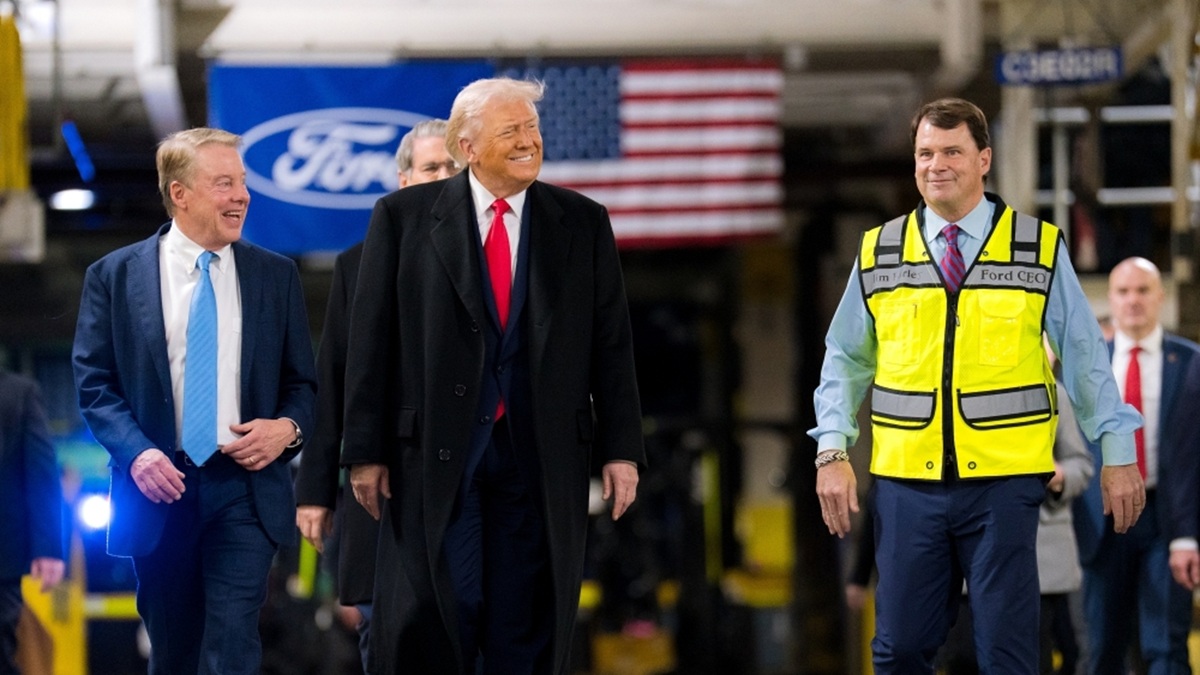
Ford’s Move Comes After BYD Surpasses 4.6 Million Vehicles Sold in 2025, Compared to 4.4 Million from the American Automaker, While China Records Nearly 3 Million Registrations in the Last Quarter and Increases Competitive Pressure on the U.S. Market
Ford has entered the center of trade tensions by proposing to the Trump administration authorization to use BYD technology in its electric vehicles, amid the Chinese advance which reached almost 3 million registrations in the last quarter of 2025 and 4.6 million global units.
Ford’s CEO, Jim Farley, defended the possibility of allowing American manufacturers to establish partnerships with Chinese brands to produce vehicles on American soil. The proposal arises amid diplomatic and trade tensions that impact the automotive sector.
According to the plan presented, the collaboration would seek to circumvent the barriers imposed by tariffs and security concerns that currently limit the operation of Chinese companies in the United States. Ford intends to access technology considered to be market-leading in the global electric vehicle market.
-
Motorola launched the Signature with a gold seal from DxOMark, tying with the iPhone 17 Pro in camera performance, Snapdragon 8 Gen 5 that surpassed 3 million in benchmarks, and a zoom that impresses even at night.

-
Satellites reveal beneath the Sahara a giant river buried for thousands of kilometers: study shows that the largest hot desert on the planet was once traversed by a river system comparable to the largest on Earth.

-
Scientists have captured something never seen in space: newly born stars are creating gigantic rings of light a thousand times larger than the distance between the Earth and the Sun, and this changes everything we knew about stellar birth.

-
Geologists find traces of a continent that disappeared 155 million years ago after separating from Australia and reveal that it did not sink, but broke into fragments scattered across Southeast Asia.

The stated goal is to offer more affordable and advanced electric cars, preserving industrial sovereignty, creating local jobs, and sharing profits with foreign partners through joint structures.
Ford and the Dilemma of Competitiveness Against China
Ford believes that collaboration may be the fastest path to face Chinese expansion. China has consolidated itself as the largest electric vehicle market in the world, with nearly 3 million registrations just in the last quarter of 2025.
This volume has propelled global sales to over 4 million units for the first time in history. Given this scenario, Ford executives understand that remaining isolated may widen the competitive gap.
The proposal involves creating joint ventures in which technology and profits would be shared. The model would allow Chinese brands to manufacture and market vehicles in the United States, provided they meet the requirement to hire local workers.
The condition was recently suggested by Trump at the Detroit Economic Club. The measure would seek to align industrial and political interests while keeping production on American soil.
Ford Loses Ground as BYD Surpasses 4.6 Million Units
The year 2025 marked a turning point for Ford. For the first time, BYD sold more vehicles globally than the American automaker.
The Chinese company surpassed 4.6 million units, including electric and hybrid crossovers. During the same period, Ford reported 4.4 million units sold globally.
The difference of 200,000 vehicles highlights the loss of market share and pressures Ford’s leadership to seek alternatives outside its traditional markets.
Jim Farley has already held talks with Transportation Secretary Sean Duff and EPA Administrator Lee Zeldin. The central argument is that, without opening to cooperation, the U.S. economy might fall behind a “trade iron curtain.”
Alliances with BYD, Geely, and LFP Battery Production in Michigan
Ford’s moves include negotiations with BYD and Geely. With BYD, the focus is on purchasing batteries for hybrid vehicles outside the United States.
In the case of Geely, the partnership could involve transferring underutilized factories in Europe for joint production and sharing technological developments.
At the same time, Ford will begin this year the production of lithium iron phosphate batteries in Michigan. The technology is licensed from CATL and will be applied in the future Universal Electric Vehicle platform.
This platform will serve as the basis for a new electric pickup truck scheduled for 2027. LFP batteries are considered essential to enable lower costs in the new generation of models.
Goal of US$ 30,000 and Pressure on the Market
Ford estimates that its future midsize electric pickup truck could hit the market at around US$ 30,000, approximately € 28,000.
This positioning would place the model at a competitive level, even below the ownership cost of a Tesla Model Y, according to estimates presented by the company itself.
The price is seen as a central factor to expand access to electric vehicles and recover lost ground in recent years.
However, there is resistance in the sector. General Motors has expressed opposition to the entry of Chinese brands, citing the risk of destroying the American supply chain and irreparable market share losses.
Decision Depends on Washington and Meeting Between Trump and Xi Jinping
Despite Ford’s maneuvering, the political scenario remains uncertain. Trump signaled an opening conditioned on manufacturing on American soil, but national security experts remain alert to risks of espionage and technological dependence.
The next meeting between Donald Trump and Xi Jinping is seen as pivotal in defining the course of trade policy between the two countries.
The discussion takes place in an international context where Canada has reduced tariffs on Chinese vehicles from 100% to 6.1%, seeking to encourage accessible electric mobility.
For Ford, the decision could redefine its industrial and commercial strategy in the coming years. The automaker hopes that cooperation can avoid a stagnation scenario and preserve its global relevance amid the rapid transformation of the electric market.








-

-

-

-

6 pessoas reagiram a isso.