





 Portuguese
  English
  Spanish
  5 min of reading
  0 comments


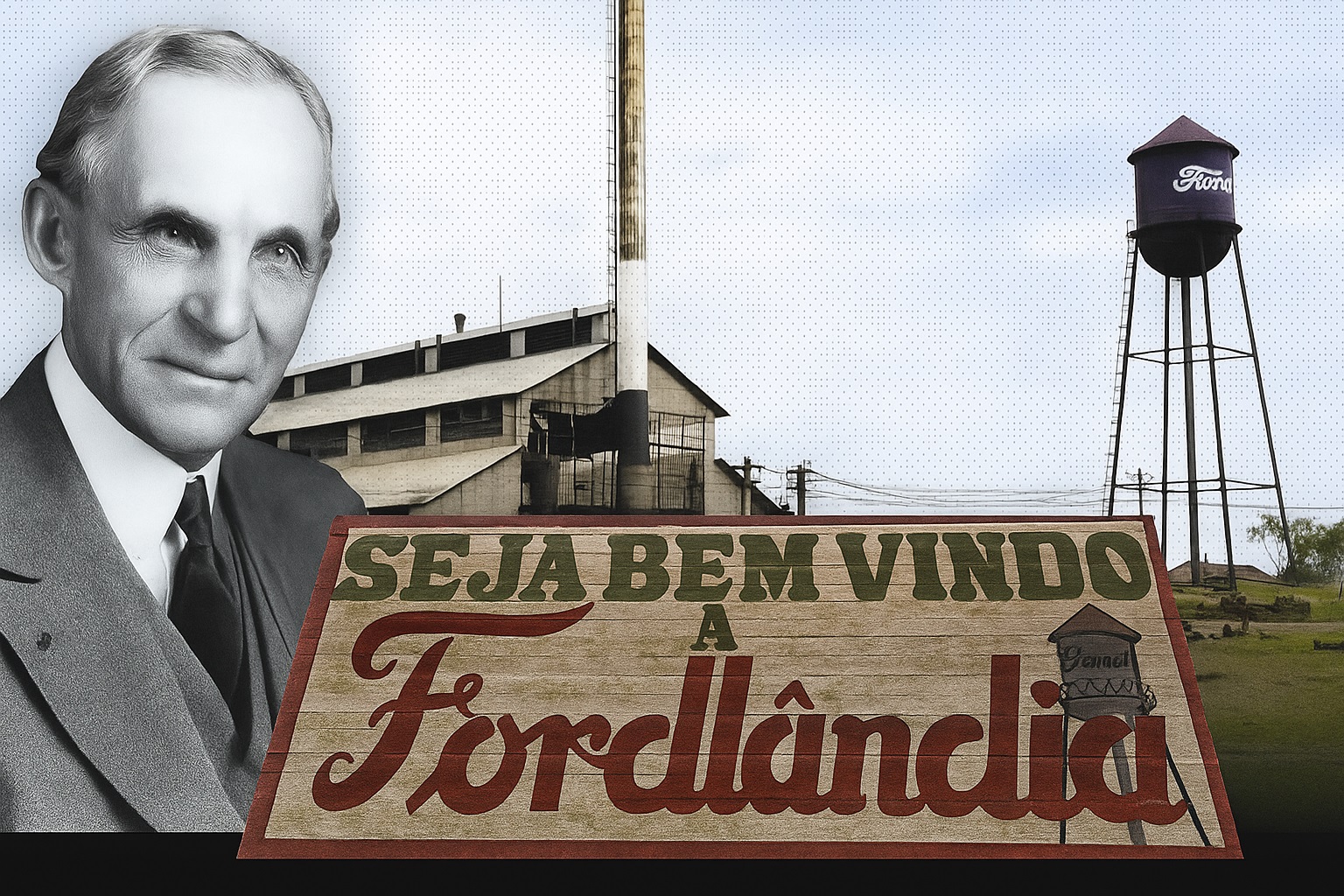
Raised By Henry Ford In 1928 In The Middle Of The Amazon, Fordlandia Promised To Be The Capital Of The Future, But Ended Up Abandoned And Swallowed By The Forest.
In the heart of the Amazon rainforest, surrounded by rushing rivers and dense vegetation, there are wide streets, lined sidewalks, and ruins of buildings that seem to be from an American city in the 1930s. Wooden houses, schools, hospitals, social clubs, and even a golf course still resist the passage of time — but without the sound of engines, without the movement of people, and without the shine of the dream that gave birth to it. This place exists, and its name is Fordlandia, one of the most ambitious and frustrated urban projects in modern history.
Created in 1928 by magnate Henry Ford, founder of the Ford Motor Company, the city was designed to be the heart of the company’s rubber production, ensuring autonomy for the automotive empire and freeing it from British control over producing colonies in Asia. The idea was bold: to build, in the middle of the Amazon, a self-sufficient American city, with standardized houses, paved streets, schools, churches, and even a cinema.
But what started as a symbol of progress turned, a few decades later, into one of the greatest failed utopias of modern industry.
-
Friends have been building a small “town” for 30 years to grow old together, with compact houses, a common area, nature surrounding it, and a collective life project designed for friendship, coexistence, and simplicity.

-
This small town in Germany created its own currency 24 years ago, today it circulates millions per year, is accepted in over 300 stores, and the German government allowed all of this to happen under one condition.

-
Curitiba is shrinking and is expected to lose 97,000 residents by 2050, while inland cities in Paraná such as Sarandi, Araucária, and Toledo are experiencing accelerated growth that is changing the entire state’s map.

-
Tourists were poisoned on Everest in a million-dollar fraud scheme involving helicopters that diverted over $19 million and shocked international authorities.


Henry Ford’s Dream In The Middle Of The Brazilian Jungle
In the 1920s, rubber was an essential input for the global automotive industry. The problem was that the main plantations were under British dominance in Southeast Asia, making prices volatile and supply uncertain. In search of independence, Henry Ford made a deal with the Brazilian government to explore an area of 10,000 square kilometers along the banks of the Tapajós River, in Western Pará.

The Ford Motor Company invested about US$ 20 million at the time (equivalent to more than US$ 300 million today) to build the city. Ships left Michigan carrying tractors, tiles, nails, light poles, machinery, and even pre-fabricated houses disassembled. The project promised to employ thousands of Brazilians, introduce modern technology, and transform the forest into an agro-industrial rubber hub.
The enterprise was named Fordlandia, a mixture of the magnate’s name with the idea of an American “new world” in the heart of the Amazon.
An American City In The Tropical Brazil
In no time, the Amazon landscape began to change. The streets were laid out in a grid pattern, with names like Michigan Avenue and Ford Street. The houses followed the American suburban model — small, wooden, with porches and gardens. The city gained a school, hospital, store, club, cinema, bakery, and even a radio station.
But the cultural shock was immediate. Henry Ford imposed a strict code of moral and dietary conduct on the workers. Alcohol was prohibited, work followed the American industrial standard, and meals, based on canned meat and oatmeal, contrasted with local habits. Soon, the Brazilian workers revolted. In 1930, a rebellion known as the “canteen riot” led American managers to flee by boat down the Tapajós River.
The Biological Error That Sealed The Fate Of Fordlandia
If the cultural conflict was a problem, the biological disaster was even worse. The rubber tree plantations, the basis of rubber production, were organized in compact rows — a common practice in the United States, but disastrous in the Amazon. The dense humidity and the presence of fungi devastated the trees. The botanist James Dempsey, hired by Ford himself, warned in reports of the time:
“Monoculture in a tropical environment is unsustainable. The rubber tree needs the diversity of the forest to survive.”
In just a few years, the Microcyclus ulei plague, known as “leaf blight,” destroyed the plantations and made production impossible. The industrial dream turned into an early ruin.
The Transfer And The End Of The Project
After years of losses and attempts to adapt, the Ford Motor Company decided to transfer the project to a new area closer to Belterra, where the climatic conditions were slightly better. Still, failure persisted.

In 1945, after almost two decades of failed attempts, the company definitively abandoned Fordlandia and returned the lands to the Brazilian government. Of the thousands of workers, few remained. The jungle reclaimed the space, and what was left of the city began to be swallowed by vegetation.
What Is Left Of The City Of The Future
Today, nearly a century later, Fordlandia still exists — but as a shadow of what it intended to be. The ruins of wooden houses, the hospital, the power plant, and the old water tower with the Ford logo still rise amidst the green. Some families continue to live there, totaling around 3,000 inhabitants, according to data from IBGE (2022).
They live from fishing, agriculture, and, in part, historical tourism. Visitors arrive by boat from Santarém to see up close what remains of Henry Ford’s dream. The old sawmill, the rusty boilers, and the abandoned cafeteria remind of a chapter in history where industrial ambition tried to tame the forest — and failed.
Fordlandia And The Symbol Of Industrial Utopia
Researchers from the Federal University of Western Pará (UFOPA) and the Smithsonian Institute study Fordlandia as an emblematic case of “industrial colonization.” According to anthropologist Greg Grandin, author of the book Fordlandia: The Rise And Fall Of Henry Ford’s Forgotten Jungle City, the failure was more than economic — it was cultural and environmental:
“Ford believed he could recreate the American model of work and morality anywhere. But the Amazon does not bend to engineers; it obeys its own laws.”
The city became a global symbol of technological arrogance and human limitation in the face of nature. In 2017, the government of Pará began projects to preserve the site as historical heritage and a route for sustainable tourism, and there are discussions for its registration by the IPHAN.
A Monument To What Could Have Been
Fordlandia continues to intrigue historians, urban planners, and travelers. It is a city that was born with the promise of being the “model of the future” and ended up as a silent reminder that progress, when ignoring the environment and local culture, turns into ruin.
Amidst the echoes of empty factories and the sounds of Amazonian birds, the city retains an air of melancholy and fascination — a utopia that crumbled but never disappeared.










-

-

2 pessoas reagiram a isso.