





 Portuguese
  English
  Spanish
  5 min of reading
  1 comment


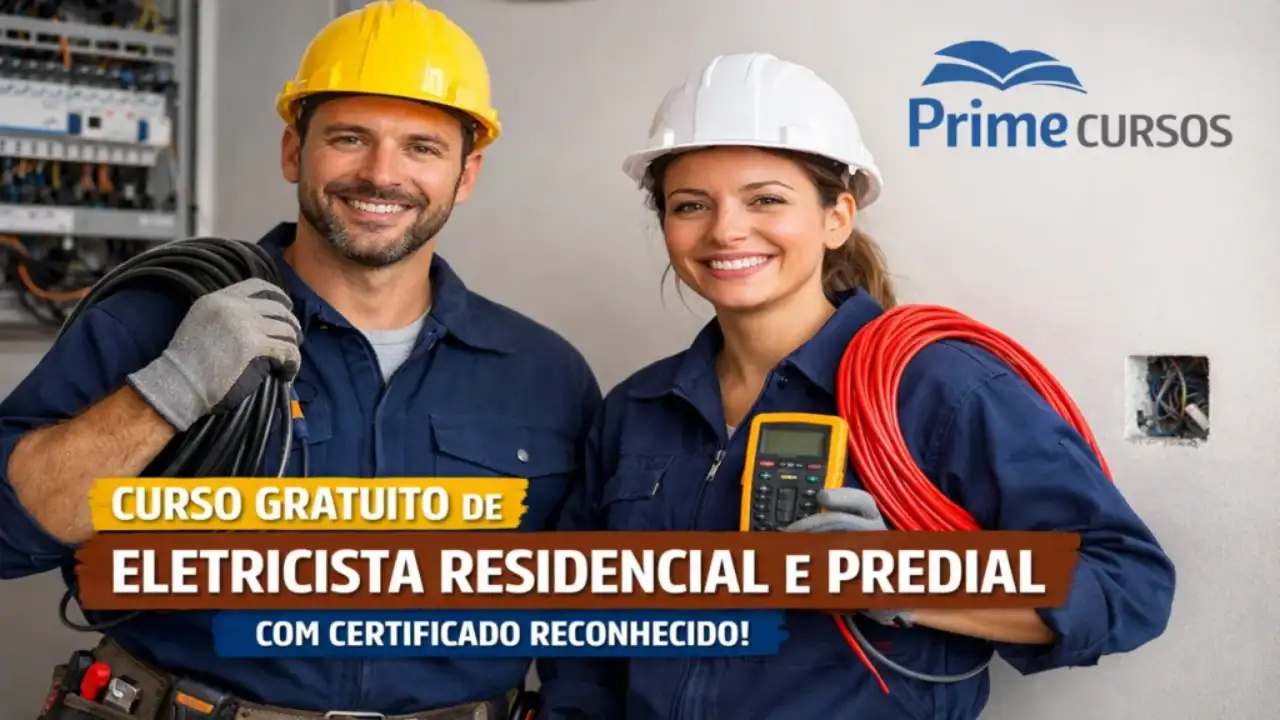


Free Online Residential and Building Electrician Course, Is Free of Tuition and Provides an Organized Path for Those Who Want to Position Themselves Better in the Market, Either in Construction, Maintenance, or Freelance Services.
The free course for residential and building electricians from Prime Cursos has unlimited spots and draws attention for bringing together, in one place, the knowledge that most frequently appears in the daily lives of those who want to work with electrical installation in homes and small buildings.
The student starts from the basics, progresses to project reading, learns conduit sizing and grounding, masters the installation of outlets, switches, and lamps, and at the same time, understands safety standards, electrical shock risks, and first aid.
Additionally, the course is free of tuition and provides an organized path for those who want to position themselves better in the market, either in construction, maintenance, or freelance services.
-
Federal Institute opens over 700 vacancies in free technical courses in Civil Engineering, Mechanics, Electrotechnics, Computer Science, and Nursing; see how to enroll and study at IFPB.

-
Become a professional in logistics, mechanics, computer science, chemistry, or gastronomy at the Federal Institute: Ifes opens more than 1,000 spots in free technical courses with selection without an exam.

-
Take a 100% online and free course at Itaú: Foundation releases 156 options with certificates, registrations open for all of Brazil, unlimited access, areas such as technology, education, and management, and a flexible schedule without tutoring.

-
Senai will pay up to R$ 700 per month for those who take free technical courses: there are 12,000 open positions across Brazil and training with access to the technology market.


Who Can Sign Up?
Enrollment is targeted towards different profiles and this helps the course serve as a starting point or practical reinforcement.
This group includes individuals interested in starting in the field of electrical installations, construction professionals looking to expand their skills, students of technical courses and vocational training related to electricity, and also property owners seeking knowledge for small repairs with more safety.
Regarding requirements, there is no formal requirement to participate. Nevertheless, there is a recommendation: to have completed high school, without obligation.
This makes access more democratic and fits well with those who want to learn from scratch, but also with those who are already working and need to organize their knowledge.
What Does the Course Teach?
The content is designed to build a foundation and then lead to real installation routines. First, the fundamentals of electricity and its practical applications are presented.
Then, essential concepts such as voltage, current, resistance, and electrical power are introduced, along with resistivity, circuits, conductors, insulators, and resistors.
From there, the path advances to capacitors, transformers, and types and classes of conductors used in installations.
The focus falls on the part that usually separates curiosity from profession: reading and interpreting electrical projects, electrical installations and their elements, in addition to essential electrician tools.
The multimeter gains attention with definitions, readings, and measurements, reinforcing the diagnostic and verification aspects. Soon after, the course addresses what most frequently appears in residences:
- sizing and installation of conduits and grounding,
- installation of thermal magnetic circuit breakers,
- switches, dimmers, timers, and electrical outlets,
- lamps and their specifications.
There are also techniques for the correct splicing of wires and conductors and a topic that many people seek in practice: installation of electric faucets and showers.
To top it off, it covers single-phase electric motors, operation of pump motors and float switches, in addition to the safety block, which is treated as a central part of the content.
The course addresses electrical shocks, types, effects and causes, electric arcs and electromagnetic fields, direct and indirect causes of accidents, use of personal protective equipment, and first aid in case of an electrical accident.
Along the way, it introduces the NBR 5410/2004 standard and also ABNT regulations related to electrical installations, as well as bibliographies and links for further study.
What Courses Are Available?
The reported offer is for one course, with free access and a complete proposal for initial training.
- Basic Online Free Residential Electrician Course
Is There a Certificate?
Yes. The certificate has a40-hour workload. The course proposal is for professional qualification and the information sheet presents the legal basis based on Presidential Decree No. 5,154 and methodology aligned with the regulations of the MEC under CNE Resolution No. 04/99.
In practice, this certificate often helps in common aspects of daily life: updating the resume, increasing chances for promotion in the current job, fulfilling hours in extracurricular activities required by colleges, supporting functional progression for civil servants, and serving as a prerequisite for contests and other courses.
How Does the Selection Process Work?
The announced format works with open enrollment since the course is free and has unlimited spots. In practice, this tends to function as access through registration, without competition for points, qualifying tests, or cuts due to the number of spots.
Thus, those who register can study according to their own availability, following the modules and sequence of the program content.
The course does not depend on a tight calendar to start. Thus, it does not require the student to wait for a class to close. In other words, learning can begin at the pace of those who need to balance work, home, and study.
Job Market and Why This Course Is Successful?
The job market for electricians is expanding, driven by construction and, mainly, by renovations and maintenance in existing buildings.
In this scenario, training focused on safety and project reading usually reinforces confidence in performing services.
Regarding salary, the material indicates an average electrician’s salary in Brazil between R$ 1,500 and R$ 3,000. There is potential for higher values for professionals with experience and qualifications.
Additionally, many electricians work as freelancers, which expands avenues for work and income, especially in residential services and maintenance.
Ultimately, a course that covers NBR 5410/2004, grounding sizing, use of multimeters, circuit breakers, and accident prevention practices brings the student closer to what is demanded in practice and further away from dangerous improvisations.
How to Register?
The course is advertising unlimited spots and there is currently no deadline specified for enrollment.
Registration link: https://www.primecursos.com.br/eletricista-residencial-basico/
Did you like the idea of learning electrical work more safely and systematically? What aspect weighs most in your decision: certificate, content, or income opportunity? Comment here or share with someone who keeps saying they want to enter the field.










Muito bom esse curso.