





 Portuguese
  English
  Spanish
  4 min of reading
  11 comments


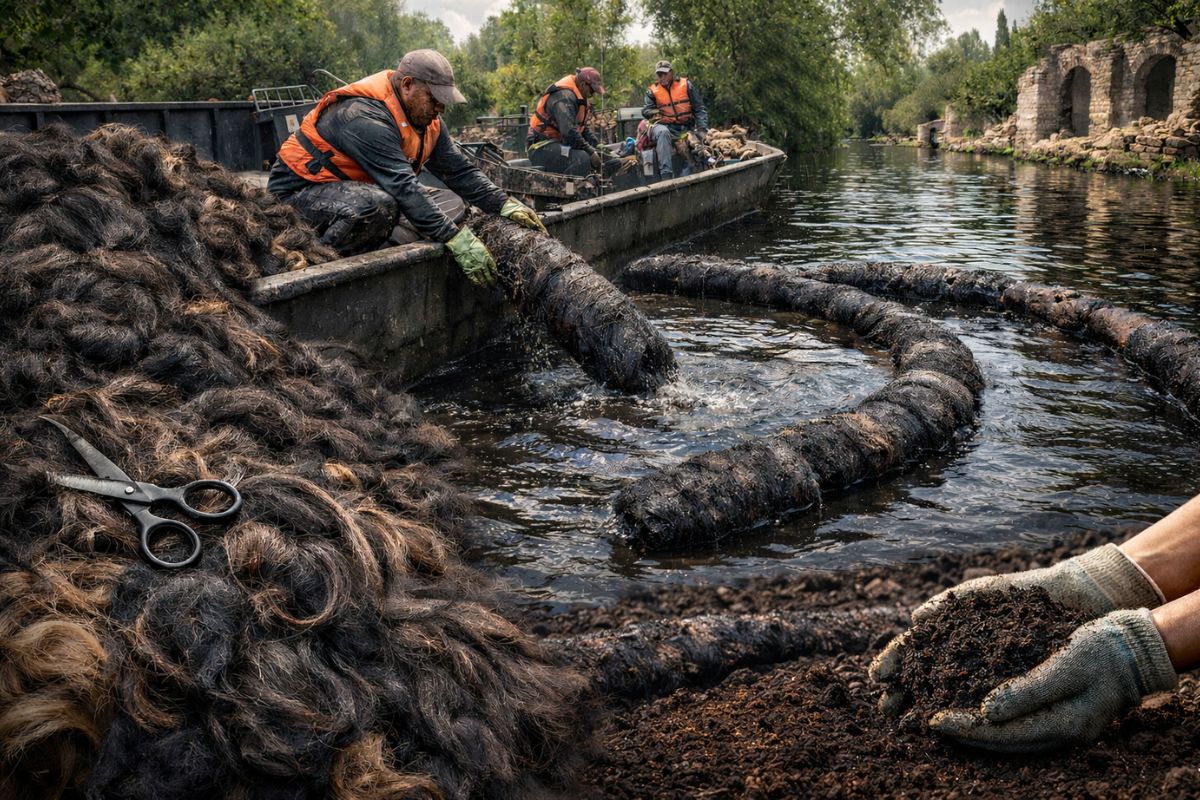


In Xochimilco, tonnes of hair collected from salons are placed in submerged networks to absorb oil, fats, fecal coliforms, and heavy metals in channels pressured by urbanization; afterward, the same material begins to protect vegetables, reduce evaporation, and enrich the soil for years in the local production of traditional agricultural communities.
The tonnes of hair that once ended up in salon trash are now part of an environmental strategy in Xochimilco, in southern Mexico City, where historic canals support cultivation and tourism but also accumulate contamination caused by urban expansion and human activities over decades.
At the center of this initiative are local farmers, environmental organizations, and beauty professionals who transform waste into input: the hair is submerged to capture pollutants and, afterward, repurposed into the land. The proposal combines water decontamination, support for traditional agriculture, and reduction of urban waste in a single cycle.
Xochimilco Between Agricultural Heritage and Environmental Pressure

Xochimilco keeps the chinampas alive, artificial islands of pre-Hispanic origin where residents continue to cultivate flowers and vegetables.
-
Motorola launched the Signature with a gold seal from DxOMark, tying with the iPhone 17 Pro in camera performance, Snapdragon 8 Gen 5 that surpassed 3 million in benchmarks, and a zoom that impresses even at night.

-
Satellites reveal beneath the Sahara a giant river buried for thousands of kilometers: study shows that the largest hot desert on the planet was once traversed by a river system comparable to the largest on Earth.

-
Scientists have captured something never seen in space: newly born stars are creating gigantic rings of light a thousand times larger than the distance between the Earth and the Sun, and this changes everything we knew about stellar birth.

-
Geologists find traces of a continent that disappeared 155 million years ago after separating from Australia and reveal that it did not sink, but broke into fragments scattered across Southeast Asia.

This agricultural system directly depends on water quality, because the canals are not just a landscape: they structure transport, irrigation, and local productivity.
With the advance of urban sprawl, the dynamics have changed. Chemicals, bacteria, and waste have become part of the routine in the canals, pressuring endemic species and limiting the productive potential of cultivation areas.
The phrase from farmer Agustín Galicia summarizes this effect: if the water were in better condition, production could be greater.
How Hair Enters the Water and Captures Pollutants
The operation works by collecting strands in salons and filling fine nets that are submerged for about two months.
During this period, the material acts as a retention barrier for contaminants present in the water. Hair stops being a passive waste and becomes an environmental intervention tool.
According to those responsible for the initiative, the natural adherence of the strands favors the capture of oil, fats, hydrocarbons, fecal coliforms, and heavy metals.
The method does not appear as an isolated solution for the entire crisis, but as a practical response to reduce part of the pollutant load while other structural measures do not advance at the same pace.
From Filtration to Soil: The Second Life of the Material
After completing the first stage in the canals, the hair returns to agricultural production. Instead of final disposal, it is applied as compost around the vegetables, in a use that connects water cleaning and soil management in the same territory.
It is a model of short-chain reuse, with direct local impact.
The reported results include a 71% reduction in direct evaporation, lower water demand for irrigation, and gradual incorporation of nutrients into the soil.
The expectation indicated by those involved is an improvement in land quality over a horizon of 10 to 20 years, which reinforces the medium- and long-term character of the initiative.
Who Sustains the Initiative on a Daily Basis
In the field, farmers like Agustín Galicia, 74, have been cultivating in chinampas for decades and live with the concrete effects of contaminated water.
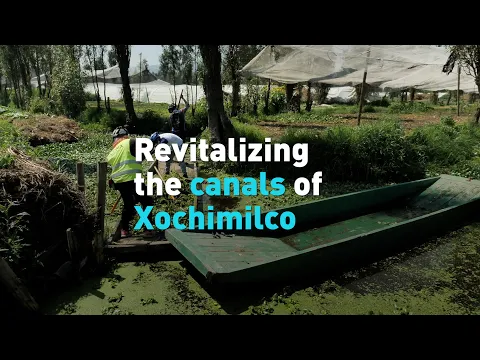
The movement through the canals in simple boats, with engines prohibited because of pollution, shows that local logistics already imposes limits and demands solutions adapted to the territory.
In the city, the participation of salons closes part of the cycle. Rebecca Serur, founder of a salon network, collected over 100 kilograms of hair in 2025, showing urban-scale collection to supply the project.
The articulation between the beauty sector, environmental organization, and traditional agriculture creates a continuous flow of material that was previously discarded without utilization.
What This Experience Reveals About Real Circular Economy

The strength of the case lies in transforming a daily passive into a technical resource with two functions: filtering contaminants and supporting agricultural management.
This is not an abstract promise of sustainability; it is a visible operational chain, with defined steps, identifiable actors, and observable effects in the territory.
At the same time, the experience exposes important limits. Without broader control of urban pollution, hair alone does not solve the degradation of the canals.
The initiative gains strength when integrated into sanitation policies, environmental monitoring, and protection of productive areas. In other words, the method works best as part of a package of solutions, not as a single answer.
Xochimilco shows that tonnes of hair can stop being waste and start serving a technical role in two critical points: contaminated water and pressured agricultural soil.
The experience also raises a central question for large cities: what is today’s waste can become an environmentally useful input when there is coordination among communities, the private sector, and local organizations?
In your neighborhood, is cut hair from salons still treated only as waste? Would you support a project that used this material to recover water and strengthen food production? And, in practice, which stage do you think is the most challenging: urban collection, treatment in the canals, or agricultural application in the soil?








Claro.
Cê loko que noia é essa?
Em que momento que cabelos contaminados com metais pesados e coliformes fecais podem ser usados na compostagem de hortaliças???
Essa I.A. delirou …