





 Portuguese
  English
  Spanish
  7 min of reading
  0 comments


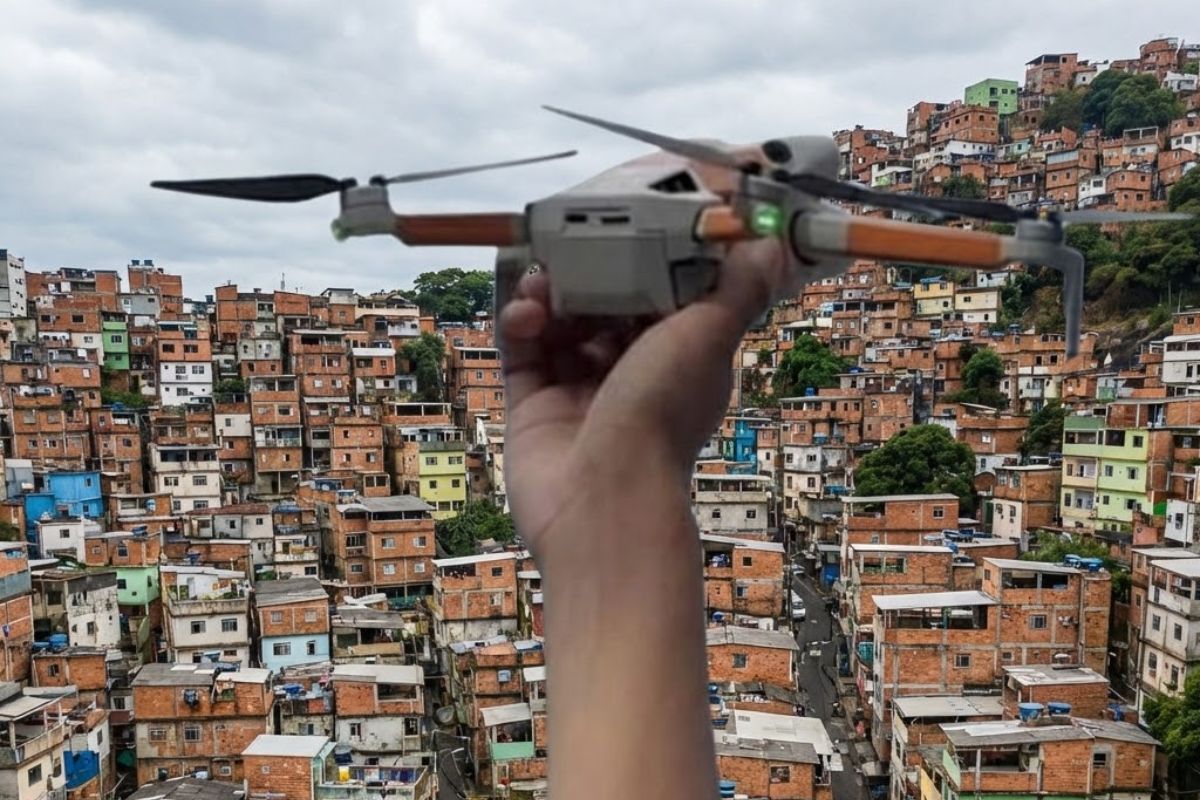
With Drones from Three Models, Betour Took Tourists to Terraces Like Porta do Céu and Mirante Rocinha, Selling 30 to 40-Second Videos for R$ 150 to R$ 200 and Drawing Up to 40% More Revenue, in Rio, from the End of 2025 to the Beginning of 2026 with Waiting Lines.
What started as an old desire to work with drones turned into a real engine of tourism demand within Rocinha, in Rio de Janeiro: Carlos Alberto Soares da Silva, 37, known as Betour, began recording tourists on slabs with panoramic videos that went viral and changed the rhythm of his own business.
According to Globo Magazine, between the end of 2025 and the beginning of 2026, the jump of up to 40% in revenue came alongside a new type of “fully booked agenda”: waiting lines that can reach two hours, visitors from various nationalities, people paying up to R$ 200 for the recording, and a video format so replicable that it started being imitated outside Brazil.
From the Hotel Door to the Terrace: Who is Betour and Why Did Rocinha Join This Route

The story doesn’t start with the viral aspect, but with daily work. Carlos Alberto began his tourism career on September 25, 2011, when he worked as an agency driver.
-
Friends have been building a small “town” for 30 years to grow old together, with compact houses, a common area, nature surrounding it, and a collective life project designed for friendship, coexistence, and simplicity.

-
This small town in Germany created its own currency 24 years ago, today it circulates millions per year, is accepted in over 300 stores, and the German government allowed all of this to happen under one condition.

-
Curitiba is shrinking and is expected to lose 97,000 residents by 2050, while inland cities in Paraná such as Sarandi, Araucária, and Toledo are experiencing accelerated growth that is changing the entire state’s map.

-
Tourists were poisoned on Everest in a million-dollar fraud scheme involving helicopters that diverted over $19 million and shocked international authorities.


Then came the opportunity to work independently, offering tours at hotel doors, building a clientele through “face-to-face” interactions and understanding how valuable a tourist’s time is when each stop competes with another.
Years later, the shift to audiovisual found a perfect setting: Rocinha was already a well-known territory for viewpoints, intense circulation, and tourist curiosity, but lacked a scaling trigger.
When drones entered the routine, the slab stopped being just a viewpoint and became a stage, with the tourist at the center of the scene and the community as a living backdrop, recorded in a way that a cellphone camera can’t always reproduce.
The Format That “Pulls Back” and Becomes a Hit: How a Simple Video Changes the Queue
The model that exploded in engagement was not presented as a “strategy” from the beginning. It emerged in 2023, during a practical situation, on a tour with two photographers from Recife, on the slab Porta do Céu. The instruction was clear: open a door, enter, and have the drone pull back while framing the arrival.
This movement created a narrative in seconds — beginning, passage, and revelation of the scenery, which helped explain why so many people want to repeat the experience.
The aesthetics also rely on space. There are slabs where chairs are positioned close to the edge, and the video enhances the contrast between the foreground (the tourist) and the open plane (the city and the community around).
The result is a short recording, lasting 30 to 40 seconds, but with the “feel” of a complete experience. And experience, when it becomes a social reference, turns into a wait: two hours of waiting for a video of less than a minute is not just about the image, it’s about status, memory, and the desire to participate in something that “everyone is doing.”
Equipment, Costs, and Behind the Scenes: What Sustains Drone Operations in Practice
To maintain quality and consistency, Betour invested heavily in technology. The agency’s collection includes three drones: DJI Avata 2, DJI Air 3S, and DJI Mavic 4 Pro, as well as cameras and an Insta360. At the price practiced in Brazil, he states that the investment exceeds R$ 100,000, which helps explain why maintenance, replacement, and operational care are factored into the service calculation.
The price charged today for capturing a video on the slab is set at R$ 150 per person, and there are cases where visitors pay up to R$ 200 for the recording.
This amount is not “clean” for the operator: there is a commission for the owner of the slab (an example cited is something like 10%), app fees, and other internal divisions.
In the guide’s own account, around 50% to 60% remains after the deductions, which reveals a central point of the model: it’s not just about “flying the drone,” it’s about sustaining a chain of work and platform.
The Engine Behind the Viral: Team, App, and Process Standardization
Viralization may seem spontaneous, but here there is organization. The increase of 30% to 40% in revenue required task division: while Betour operates the drones, guides groups, and edits the videos, his wife handles billing and customer service; his brother is also part of the team.
In total, there are five permanent staff members and support from freelancers — an operational design aimed at not stalling when demand spikes.
Another axis is the Na Favela Turismo app, which standardizes local operations. The platform requires guides to register and monitors the number of tourists, schedules, and routes.
Besides control, there is a training component: improvements to the system, recovering unemployed people to serve as monitors, guiding and language courses funded.
Betour himself — this package of organization helped the “hype” and the boom: when the flow is monitored and the experience becomes predictable, more people feel comfortable entering the route.
From Engagement to the Real World: Followers, Reduced Seasonality, and the Challenge of Tourist Time
Betour’s profile has reached 188,000 followers, and the growth strategy also shows pragmatism: paid traffic only until 6,000, then focus on editing and the format that performs.
From there, the content crossed borders, with clients reporting imitations of the model in other locations — a sign that the “viral” here is not just about audience, it’s about replicating the image script.
The impact appears in the calendar. Traditionally weaker months, like March, have started to register similar volume to January and February, reducing typical tourism seasonality.
However, the increased demand comes with an operational cost: the guide reports routines that start early (like leaving home at 3:30 AM), service in different locations on the same day (Cristo Redentor and Rocinha), and varying group sizes that can go from 10 to 50 people.
In this scenario, transparency becomes a tool: if the line at Porta do Céu hits two hours, the visitor’s schedule can go off track, and aligning expectations avoids frustration.
When the City “Hires” the Viral: Carnival 2026 and the Credibility of Drone Material
The quality of drone work opened doors beyond the tour. During Carnival 2026, Betour was hired for the official coverage by the City Hall of Rio de Janeiro and reports that most of the drone images published on the city’s Instagram and TikTok channels came from him.
This type of hiring changes the status of the service, because it connects content to an institutional demand, with a need for delivery, standard, and volume.
At the same time, the operation remains anchored in the territory: the slab Porta do Céu, the main recording point, belongs to Betour’s family and is managed by a cousin after the death of an uncle the previous year.
In addition to it, other terraces used in the circuit include Portal Jonas Brasil, Vista Show, and Bela Vista.
The whole set forms a small ecosystem: space, guide, platform, team, tourist, and drones stitch everything together with a final product that fits into a few seconds, but carries the feeling of “I was here.”
What’s Coming in 2026: Expansion, Confidential Project, and the Idea of Training New Pilots
For 2026, Betour talks about increasing the number of permanent staff and keeping a new project confidential for Rocinha.
Alongside this, he plays a reference role within the community: he acts as an informal mentor and shows intent to expand education, bringing young people in to understand the profession linked to drones.
This point closes an interesting cycle: the viral starts as a video, turns into a line, becomes income, forms a team, creates a method, and can lead to training.
When a trend stops being just a “fad” and begins to generate a professional path, it shifts the conversation about what local tourism is: not just consumption of scenery but the production of work, technique, and opportunity.
The story of drones on the slabs of Rocinha shows how a short format can reorganize an entire business: it increases revenue, changes audience profile, creates waits, demands a system, and places the territory on the radar in a way that mixes curiosity, logistics, and image.
In the end, the drone is just the tool; what sustains it is the well-operated and repeatable experience.
If you were a tourist, would you face two hours of waiting for a 30 to 40-second video to take “the perfect scene” home?
And, looking at the perspective of those who live and work there, what do you think is fairer: limiting demand to reduce impact or taking advantage of the boom to open more slots and train new people in the drone profession?










Seja o primeiro a reagir!