





 Portuguese
  English
  Spanish
  5 min of reading
  0 comments


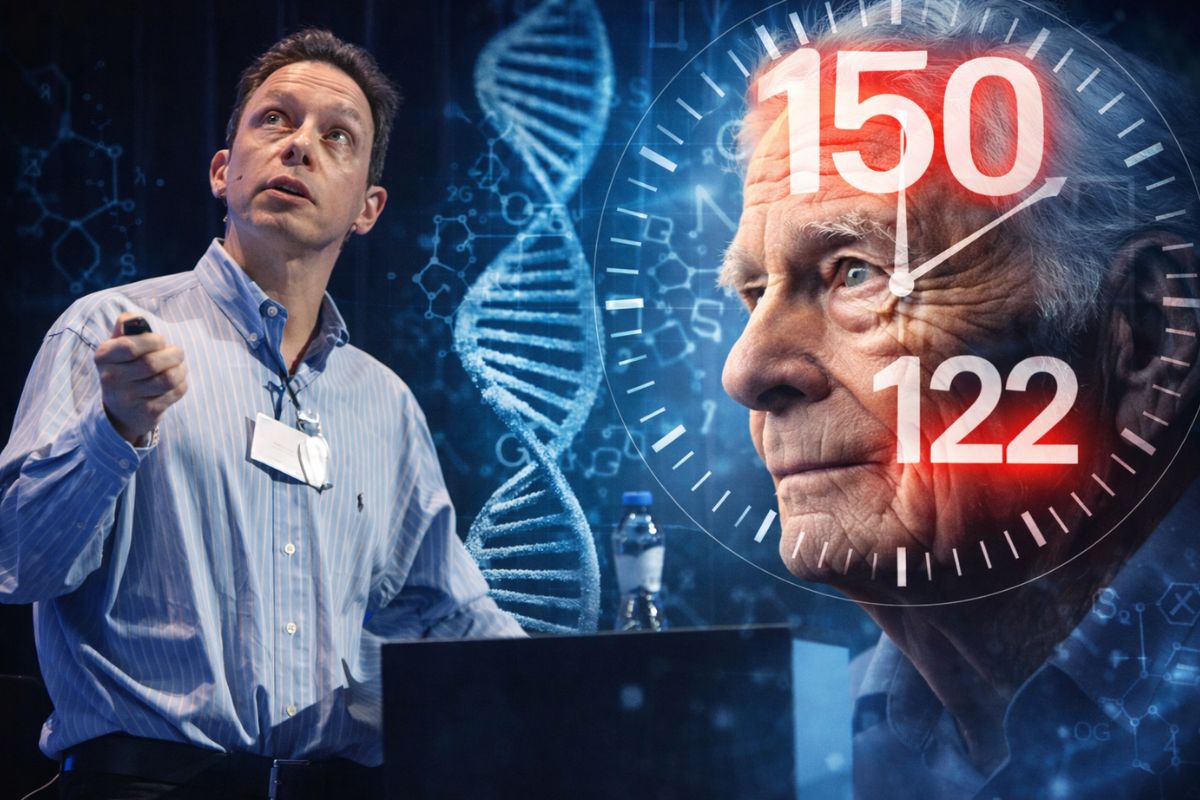
In an interview, geneticist Steve Horvath from Altos Labs Cambridge Institute of Science in the United Kingdom claims that longevity could reach 150 years, supported by DNA methylation clocks, biological age, and biological aging, aiming to surpass the record of 122 years already registered in the future in decades.
Geneticist Steve Horvath argues that science can push human longevity to nearly 150 years, even with the official record still stuck at 122 years. His bet does not stem from empty optimism, but from advances in biological aging measured by DNA methylation.
The statement does not come with a date and does not eliminate uncertainties. The geneticist Steve Horvath himself acknowledges that the big leap depends on decades of research, validating interventions, and understanding why the biological age of some people ages at such different rates.
From the 122-Year Record to the 150-Year Target

To this day, the mark that concentrates the discussion is that of Jeanne Louise Calment, who lived 122 years and 164 days, recorded in 1997. This number became a reference because it is the ceiling observed in accepted records, and any argument about 150 years needs to explain why the current limit of 122 years can be surpassed without collapsing the organism’s resilience.
-
Friends have been building a small “town” for 30 years to grow old together, with compact houses, a common area, nature surrounding it, and a collective life project designed for friendship, coexistence, and simplicity.

-
This small town in Germany created its own currency 24 years ago, today it circulates millions per year, is accepted in over 300 stores, and the German government allowed all of this to happen under one condition.

-
Curitiba is shrinking and is expected to lose 97,000 residents by 2050, while inland cities in Paraná such as Sarandi, Araucária, and Toledo are experiencing accelerated growth that is changing the entire state’s map.

-
Tourists were poisoned on Everest in a million-dollar fraud scheme involving helicopters that diverted over $19 million and shocked international authorities.


Geneticist Steve Horvath treats 150 years as a plausible horizon, not as an immediate promise.
The difference between talking about 122 years and 150 years is enormous, because it involves reducing the speed of accumulated damage and, at some level, measurably altering biological aging.
Part of the studies cited in the basis material suggests a biological ceiling close to 150 years, when cellular resilience would collapse and damage recovery would become extremely difficult. Horvath, on the other hand, bets that better understanding the mechanisms could slow the process and, perhaps, partially reverse biological aging at specific stages.
What DNA Methylation Clocks Really Measure
Horvath’s name gained prominence in the early 2010s when he developed the so-called aging clock, based on DNA methylation.
The logic is straightforward: over a lifetime, chemical patterns in genetic material change, and these changes can be used as a marker of cellular wear.
In practice, the tool estimates biological age, which can differ from chronological age. The described test evaluates molecular changes in tissues such as blood, skin, and saliva, generating an objective reading of biological aging, something that was previously discussed more in terms of late clinical signs than fine measurement.
The leap here is methodological: if you measure, you can compare. When a DNA methylation clock indicates that biological age is advancing faster, science has a thermometer to test interventions and observe whether they change the trajectory, instead of waiting decades to see who lives longer.
Biological Age, Chronology, and the New Dispute Over Cause and Effect
The idea of biological age changes the conversation about longevity because it shifts the focus from the calendar to the state of the organism. Two people of the same chronological age may display different biological ages, and this opens the door to explain why some accumulate diseases earlier, while others maintain function longer.
When geneticist Steve Horvath talks about 150 years, he is relying on this ability to measure biological aging with greater accuracy.
Without a gauge like biological age, research becomes hostage to studies that are too long and results that take too long to appear, which hinders the validation of any intervention.
This gauge, however, also creates a challenge. If the DNA methylation clock changes, this does not automatically guarantee that the risk of death has decreased in the same proportion. Scientific utility depends on consistent correlation and understanding which components of biological aging are cause, consequence, or merely signal.
Where the Organism Breaks and Why 150 Years Became a Recurring Number
The hypothesis of a ceiling close to 150 years is linked to the idea of cellular resilience collapsing. In simple terms, the body accumulates damage, and there comes a point when repair fails to keep up with destruction. This is the argument that attempts to explain why 122 years remains a difficult record to surpass.
Horvath does not dismiss limits, but believes that the ceiling can be pushed if science better understands the gears of biological aging.
The focus, in this view, is not to turn everyone into supercentenarians, but rather to slow the rate of decline, so that more people reach advanced ages with less deteriorated biological age.
Global life expectancy has been increasing, and the basis material cites projections linked to the World Health Organization, such as the idea that by 2030 one in six people will be over 60 years old. This backdrop matters because it puts pressure on health systems and increases interest in interventions that not only extend years but also postpone fragility, which puts biological age and DNA methylation back at the center of public debate.
What Still Separates the Hypothesis from the Result and the Risk of Selling Certainty
Even though geneticist Steve Horvath claims to have no doubts that 150 years is possible, the very basis recognizes that he does not indicate when this would become reality.
This temporal gap is what prevents turning speech into conclusion, because biological aging science relies on trials, replication, and long-term safety.
There is also a risk of confusing advancement in measurement with advancement in treatment. DNA methylation clocks help measure biological age, but measuring is not the same as controlling. The transition to interventions that alter the course of biological aging could take decades, exactly as Horvath suggests.
The researcher himself, according to the material, has had more extreme dreams, such as imagining humans living a thousand years, and today works with more realistic projections. This change in tone helps read 150 years as a bet on a plausible ceiling, not as a market promise.
The debate over 150 years gained strength because there is a concrete record of 122 years, a new gauge called biological age, and a measurement tool based on DNA methylation. Geneticist Steve Horvath bets that this combination will push the limit, but there is still a distance between accurately measuring biological aging and broadly and safely altering the process.
When you think about living much longer, what seems more important to you, increasing years beyond 122 years, reducing suffering throughout biological aging, or seeing biological age decrease with proven interventions, and why?










-

Uma pessoa reagiu a isso.