





 Portuguese
  English
  Spanish
  3 min of reading
  2 comments


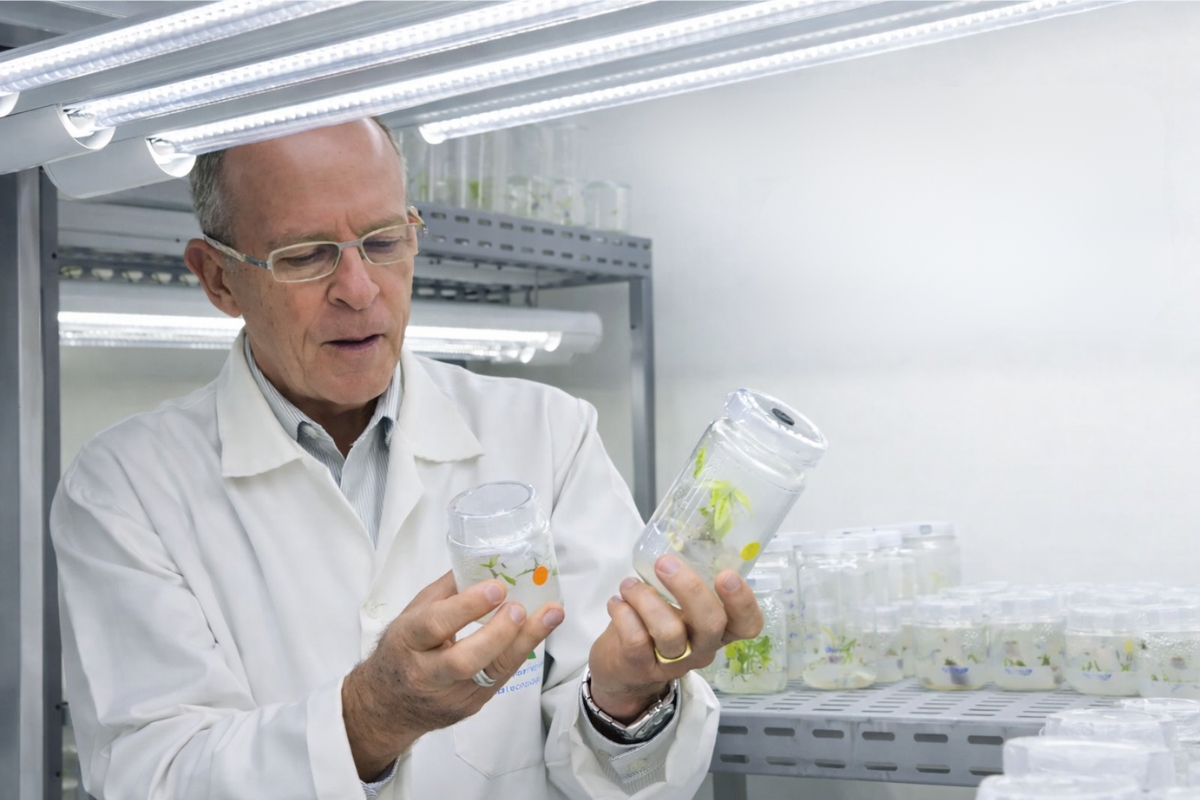


In Munich, Researchers at the Technical University of Munich Produced the Amino Acid L-Alanine from CO2 with a Multi-Step Process to Create Protein Sustainably, Reducing Agricultural Land Use and Drawing Attention from the Biotechnology and Animal Feed Sectors.
Ensuring food for a constantly growing global population has always been a challenge. When this mission intersects with the urgent need to reduce environmental impacts, the scenario becomes even more complex.
Now, a discovery made in Germany may change this equation. Researchers have managed to transform CO2, one of the main greenhouse gases, into an essential amino acid for protein production.
What seemed impossible is starting to take concrete shape within laboratories. And the detail that caught the most attention is that the new method requires much less area than traditional agriculture.
-
Motorola launched the Signature with a gold seal from DxOMark, tying with the iPhone 17 Pro in camera performance, Snapdragon 8 Gen 5 that surpassed 3 million in benchmarks, and a zoom that impresses even at night.

-
Satellites reveal beneath the Sahara a giant river buried for thousands of kilometers: study shows that the largest hot desert on the planet was once traversed by a river system comparable to the largest on Earth.

-
Scientists have captured something never seen in space: newly born stars are creating gigantic rings of light a thousand times larger than the distance between the Earth and the Sun, and this changes everything we knew about stellar birth.

-
Geologists find traces of a continent that disappeared 155 million years ago after separating from Australia and reveal that it did not sink, but broke into fragments scattered across Southeast Asia.

Production of Amino Acid from CO2 Takes Center Stage in Germany
The discovery was made by researchers at the Technical University of Munich, at the Straubing Campus of Biotechnology and Sustainability.
The group led by Professor Volker Sieber managed to produce L-alanine, one of the main building blocks that form proteins, by utilizing CO2 extracted from the atmosphere.
The innovation is noteworthy because the protein used in animal feed, as well as in meat substitute products, typically depends on large agricultural areas, especially in the southern hemisphere. This traditional model requires vast land and may generate negative impacts on biodiversity.

How the Artificial Photosynthesis Process Works in Practice
The method developed uses a concept known as artificial photosynthesis.
First, the CO2 captured from the atmosphere is converted into methanol. This stage uses green electricity and hydrogen.
Then, the methanol undergoes a multi-step process with synthetic enzymes, which transform the compound into L-alanine. The system is called a cell-free enzymatic process.
According to researchers, the yield obtained is very high. This means greater efficiency in conversion and less waste.
Less Land, More Efficiency and Reduced Environmental Impact
One of the most relevant points of the discovery lies in the comparison with traditional farming.
To produce the same amount of L-alanine, the artificial method requires much less physical space, provided that the energy used comes from renewable sources such as solar or wind.
The impact can be significant. With less land occupied for protein production, the pressure on agricultural areas decreases. This paves the way for a reduction in the ecological footprint of food production.
In a scenario of global population growth, this efficiency could make a difference in the coming years.
Bioeconomy and Hydrogen Economy Gain Strength Together
The production of L-alanine is only the first step.
Scientists state that the goal now is to produce other amino acids from CO2 using renewable energy. The aim is to scale up the process and further increase efficiency.
This advancement is seen as a concrete example of the integration between bioeconomy and hydrogen economy. The combination of these two areas could accelerate sustainable solutions for the food and energy industries.
The research was published on January 23, 2023, in the scientific journal Chem Catalysis, with DOI 10.1016 checat 2022 100502.
The development shows that transforming greenhouse gas into protein is not just theory. The technology is already in practice and could change the way the world produces food, reducing environmental impacts and increasing production efficiency.
Do you believe that protein production from CO2 could replace part of traditional agriculture in the future? Leave your opinion in the comments.








Tenho mestrado em Biotecnologia e não desmereço estas novas tecnologias. Porém sou sul americana, brasileira, um dos maiores países produtores de grãos para ração e de animais de corte para o mundo , e NÃO acredito que estas tecnologias possam substituem a agricultura. A alimentação de um organismo exige muito mais que proteínas e carbohidratos. Necessita dos micro e micronutrientes, vitaminas, fibras, gorduras, etc. Além de que a pressão sobre o uso do solo não ocorre por causa da demanda de alimentos, mas sim por causa da má gestão de terras: desmatam-se florestas consumidoras de CO2 para agricultura e pecuária em larga escala, mas se abandonam terras degradadas inutilizadas pelo manejo incorreto. A solução está na recuperação de áreas degradadas e utilização/desenvolvimento de técnicas mais eficientes de manejo da agricultura. Tanto para alimentação quanto para o agronegócio.
Infelizmente o artigo não permite que consigamos avaliar se as informações podem ter verossímilidade ou não, pois são omitidas muitas informações essenciais tais como de onde vem o “N” e “S” para a “construção” da proteína, quanto de energia é gasta por unidade produzida e custo dessa produção, dizer que a mesma é viável e resgata carbono mas não considera que a forragem resgata C da atmosfera (de forma mais eficiente e sem custos para a humanidade), e pelo que coloca deixa claro que se usarmos a energia de fontes tradicionais torna-se muito mais emissora de CO2!