





 Portuguese
  English
  Spanish
  3 min of reading
  0 comments


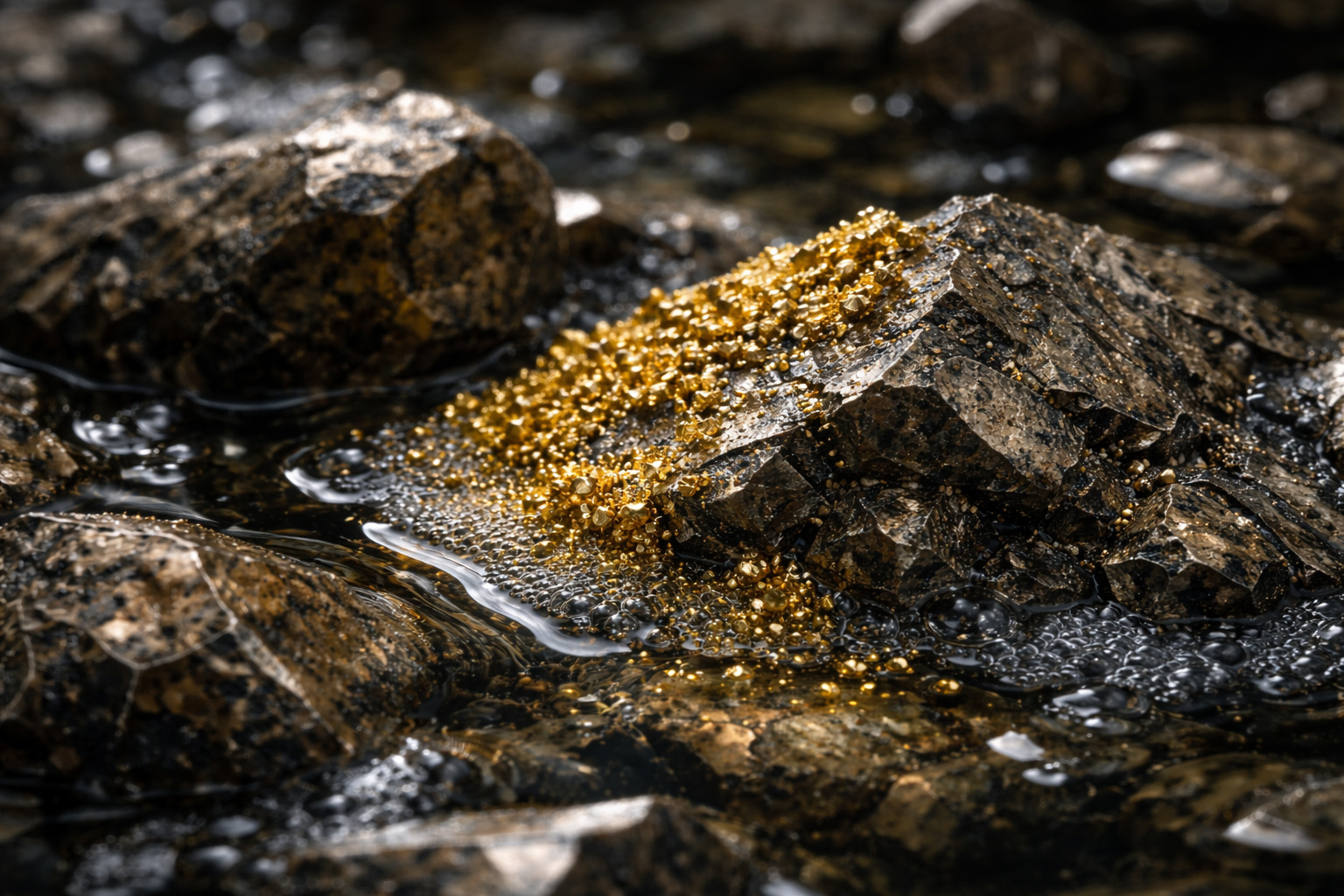
Study Published in the Proceedings of the National Academy of Sciences Reveals, in Real Time, How Gold Concentrates from Minimal Traces Dissolved in Water
A significant scientific discovery for mineral geology was recently presented by Chinese researchers, attracting attention from the international academic community.
The study, published in 2024 in the Proceedings of the National Academy of Sciences, directly documented the formation and accumulation of gold from extremely diluted solutions in water.

Until then, this process was largely treated as a theoretical hypothesis, as analyses were mainly based on samples examined after the reactions had finished.
-
ZCC 11000 crane lands at the port of Vitória and heads to Ceará in a convoy with 64 trailers: Zoomlion, founded in 1992, builds a monster that lifts over 600 compact cars to 93 m.

-
The biggest drama of being born on Mars is not breathing: Rice biologist says that colonists’ children may cease to be Homo sapiens, shaped by low gravity, radiation, and isolation that divides humanity.

-
With no separate outdoor unit and designed to fit in the window, monoblock air conditioners used in Japan emerge as an alternative for those who cannot install a split system in a rented apartment.

-
China prepares a 78,000-ton pilotable floating island for deep-sea research: it accommodates 240 people for months, withstands category 17 typhoons and 9-meter waves, and uses metamaterials that dissipate nuclear explosions.


Now, with continuous observation in real time, scientists have demonstrated that gold can gradually concentrate even when present at nearly imperceptible levels in the natural environment.
Technical Investigation Reveals Decisive Microscopic Mechanism
The research focused on the interaction between pyrite, a mineral abundant in the Earth’s crust, and water containing minimal traces of dissolved gold.
Traditionally known as “fool’s gold,” pyrite has long been associated with the presence of the precious metal. However, the detailed mechanism of this interaction had not been visually observed directly.
During the experiments, as soon as pyrite came into contact with the aqueous solution, a microscopic structure quickly formed on its surface.
This structure was described as a dense liquid layer, which emerged within minutes and created a highly favorable environment for capturing gold atoms.
Even when the solution contained only 10 parts per billion of the metal, the layer was able to attract and retain gold effectively.
About 13 minutes after the reaction started, the interface was fully established. Around 20 minutes in, gold nanoparticles began to emerge within this layer.
Over time, these nanoparticles grew and multiplied progressively, evidencing a continuous process of mineral concentration.
Impact on the Understanding of Gold Deposits
This finding is considered crucial because the precipitation of gold associated with pyrite is seen as a key step in the formation of exploitable deposits.
Until now, many traditional theories argued that the origin of gold deposits mainly depended on extremely hot and deep fluids coming from the Earth’s interior.
However, the new evidence indicates that gold can also concentrate from very diluted solutions, under relatively common conditions.
Thus, large reserves may result from slow, repetitive microscopic processes, occurring over geological time.
This shift in perspective redefines scientific understanding of the formation of one of the most valuable metals in the history of the global economy.
Scientific Rigor and Editorial Review
The information presented strictly follows the data described in the study published in 2024 in the Proceedings of the National Academy of Sciences.
Furthermore, the content has been reviewed to ensure technical accuracy, avoid exaggerated interpretations, and ensure compliance with strict editorial guidelines.
As such, the discovery contributes to expanding understanding of how economically relevant gold deposits may arise from minimal concentrations in the natural environment.
In light of this new scientific scenario, how might this more detailed understanding of gold formation influence future research on mineral resources?









-

-

5 pessoas reagiram a isso.