





 Portuguese
  English
  Spanish
  4 min of reading
  1 comment


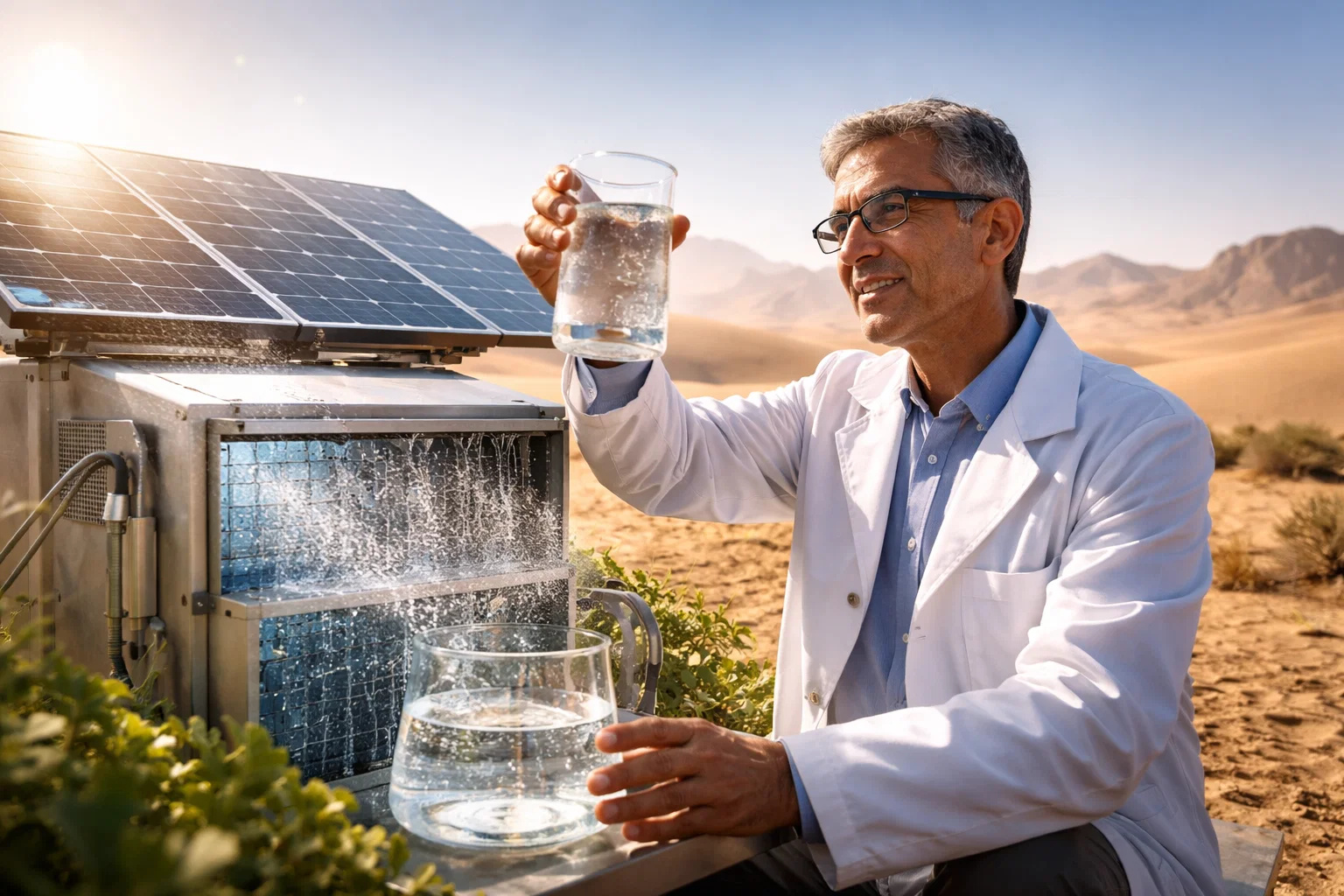


Omar Yaghi, Awarded in 2025, Develops a Machine That Produces Water From Air Using Solar Energy, With Less Than 20 Percent Humidity and Presents an Alternative to the Traditional Desalination Model and Centralized Infrastructure
A machine that produces water from air on an industrial scale is no longer a distant promise. It exists, works, and can generate up to 1,000 liters per day even in locations with extremely dry air.
The driver is Omar Yaghi, a professor at the University of California, Berkeley, and the winner of the 2025 Nobel Prize in Chemistry. The technology was developed by his company, Atoco, and stands out for operating solely with solar heat.
In a scenario where more than 2 billion people lack safe access to drinking water, according to UN alerts, the proposal goes beyond scientific curiosity. It is firmly on the radar of the industry, environmental engineering, and the energy sector.
-
Motorola launched the Signature with a gold seal from DxOMark, tying with the iPhone 17 Pro in camera performance, Snapdragon 8 Gen 5 that surpassed 3 million in benchmarks, and a zoom that impresses even at night.

-
Satellites reveal beneath the Sahara a giant river buried for thousands of kilometers: study shows that the largest hot desert on the planet was once traversed by a river system comparable to the largest on Earth.

-
Scientists have captured something never seen in space: newly born stars are creating gigantic rings of light a thousand times larger than the distance between the Earth and the Sun, and this changes everything we knew about stellar birth.

-
Geologists find traces of a continent that disappeared 155 million years ago after separating from Australia and reveal that it did not sink, but broke into fragments scattered across Southeast Asia.

The Race for Solutions in the Face of Global Scarcity Places the Machine That Produces Water From Air at the Center of a New Market
Water scarcity has ceased to be a regional problem. Prolonged droughts, hurricanes, and infrastructure collapses expose the fragility of centralized systems.
Desalination has gained ground in coastal countries but requires high energy consumption and generates saline waste that affects the environment. This creates a billion-dollar market seeking more efficient alternatives.
It is at this point that the machine that produces water from air begins to compete with traditional models. Instead of relying on rivers, aquifers, or the sea, it uses the atmosphere itself as a source.
And the impact can be immediate in isolated regions or those devastated by natural disasters.
The Industrial Secret Is in a Microscopic Material Capable of Capturing Invisible Water
The heart of the system is made up of structures known as Metal Organic Frameworks, or MOFs.
These synthetic materials are designed at the molecular level to have an enormous internal area. According to researchers, a few grams can achieve an area equivalent to that of a sports arena when analyzed from within.
The operation follows a straightforward logic.
The air passes through the equipment. The MOFs thus capture the water molecules present in the atmosphere. Then, the heat from the sun releases this moisture in the form of vapor. The vapor is condensed and transformed into liquid water ready for use.
Unlike traditional atmospheric generators, which require large electricity consumption to cool the air, this technology operates off the conventional power grid.
This detail may, therefore, redefine operations in regions where energy is limited.
A Container Capable of Supplying Entire Communities Without Relying on the Electric Grid
The structure is similar in size to a 20-foot container, making transportation and installation easier.
In Caribbean islands affected by severe storms, such as Hurricane Beryl, equipment of this type could provide water immediately, even when the power grid is compromised.
Producing 1,000 liters daily in areas with less than 20 percent humidity changes the logic of emergency supply.
Instead of waiting for water trucks or the reconstruction of stations, the unit itself generates resources on-site.
For infrastructure engineering, this represents a paradigm shift.
The Silent Dispute Between Desalination and Atmospheric Capture Begins to Gain Momentum
For decades, desalination has dominated the debate in arid regions near the coastline.
Now, an alternative emerges that utilizes only solar heat and advanced materials. If industrial expansion confirms the performance of the prototypes, experts point out that the supply sector may undergo reconfiguration.
Yaghi himself speaks of a future of personalized water, similar to the concept of distributed solar generation.
Houses could then produce their own water, reducing dependency on vulnerable and centralized systems.
This scenario creates tension in the water infrastructure and energy market, as it shifts the axis of production to decentralized units.
From Scarcity Lived in Childhood to Nobel, the Personal Motivation Behind the Machine That Produces Water From Air
The project has personal roots. Yaghi grew up in a refugee community in Jordan and lived without running water.
He thus recounts the rush of residents when trucks arrived with limited supplies.
Decades later, the same science that earned him the Nobel Prize may offer solutions for millions still living in similar situations.
The machine that produces water from air does not solve the global water crisis by itself. But it places a new piece on the board of the energy and sanitation industry.
If large-scale production advances, the impact may extend beyond laboratories and directly affect the daily lives of vulnerable communities.
Do you believe this technology can replace traditional supply systems in the coming years? Share your opinion in the comments.








Muito importante pois a seca é um grande problema que atinge a todos ser vivo, espero que o inventor coloque logo a venda essa máquina maravilhosa pois quero comprar uma, tenho roça e quero ver meus tanques cheios de água sem depender de chuvas