





 Portuguese
  English
  Spanish
  3 min of reading
  0 comments


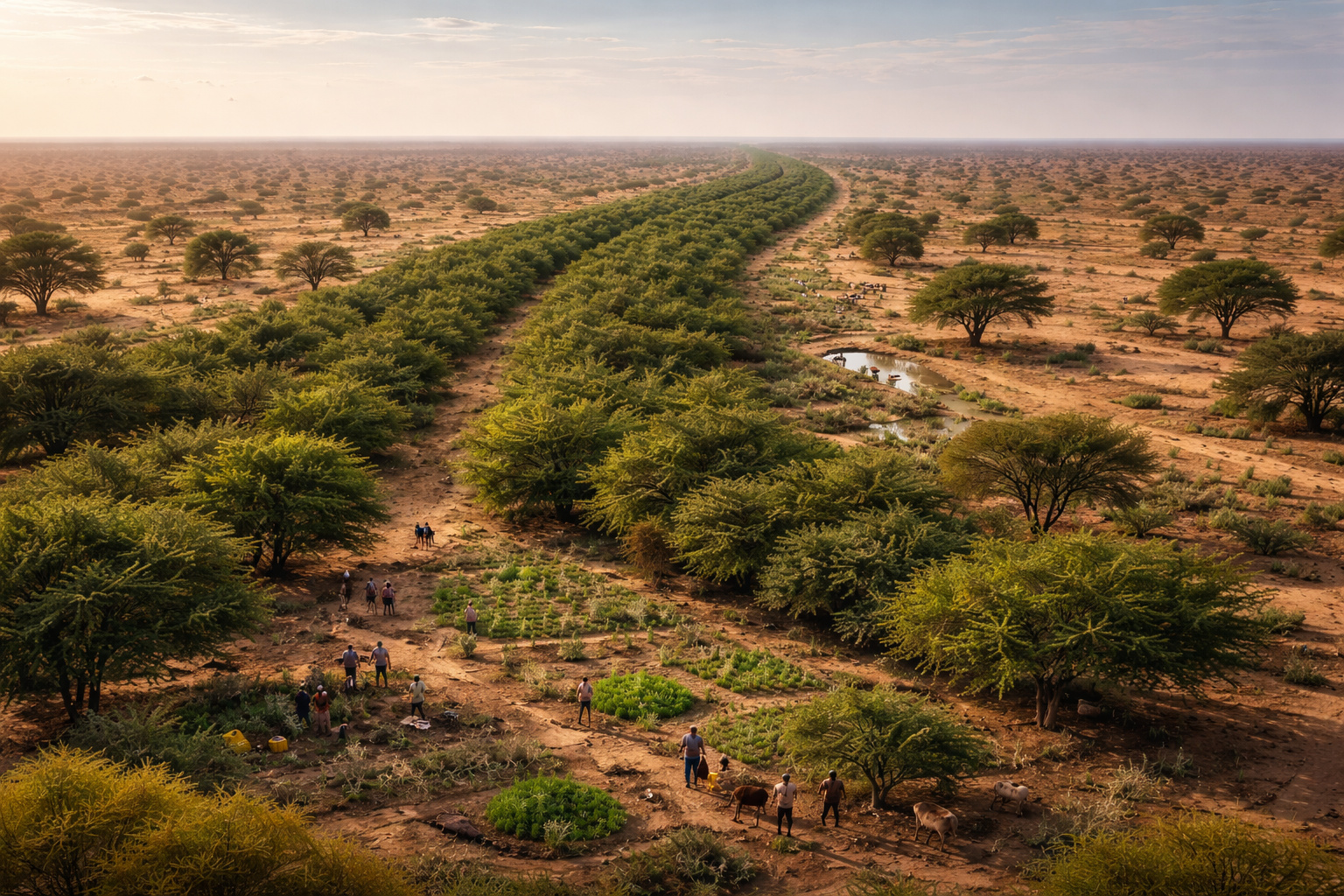
Project Led by the African Union Aims to Halt the Advance of the Sahara, Restore Degraded Lands, and Generate Green Jobs in One of the Most Vulnerable Regions on the Planet
One of the largest environmental initiatives in the world is advancing on the African continent, combining climate goals with large-scale social impact. The Great Green Wall stretches approximately 8,000 kilometers, from the Atlantic Ocean to the Red Sea, traversing the Sahel with the goal of halting the advance of the Sahara Desert and restoring degraded areas.
The African Union officially launched the project in 2007, in partnership with the United Nations Convention to Combat Desertification (UNCCD). Since then, the program has established clear targets for 2030 and consolidated one of the largest global strategies to combat desertification.
Environmental and Social Goals by 2030
From the beginning, the participating countries defined measurable objectives to guide actions in the Sahel. The project aims to restore 100 million hectares of degraded land, sequester 250 million tons of carbon, and create 10 million green jobs in the region.
-
Motorola launched the Signature with a gold seal from DxOMark, tying with the iPhone 17 Pro in camera performance, Snapdragon 8 Gen 5 that surpassed 3 million in benchmarks, and a zoom that impresses even at night.

-
Satellites reveal beneath the Sahara a giant river buried for thousands of kilometers: study shows that the largest hot desert on the planet was once traversed by a river system comparable to the largest on Earth.

-
Scientists have captured something never seen in space: newly born stars are creating gigantic rings of light a thousand times larger than the distance between the Earth and the Sun, and this changes everything we knew about stellar birth.

-
Geologists find traces of a continent that disappeared 155 million years ago after separating from Australia and reveal that it did not sink, but broke into fragments scattered across Southeast Asia.

Although the name suggests a continuous barrier of trees, the coordinators have redefined the model over the years. Currently, countries implement a mosaic of environmental interventions adapted to the ecological and social conditions of each territory.
Participating Countries and Implemented Actions
The initiative includes Senegal, Mauritania, Mali, Burkina Faso, Niger, Nigeria, Chad, Sudan, Eritrea, Ethiopia, and Djibouti. Each country executes actions such as reforestation of native vegetation, recovery of degraded pastures, and sustainable land management, always adjusting strategies to their climatic and productive characteristics.
This decentralized approach allows nations to adopt solutions compatible with their local realities while maintaining a common focus on land restoration and strengthening vulnerable communities.
Climate Challenges in the Sahel
The Sahel faces recurring droughts, rising average temperatures, and irregular rainfall, factors that reduce agricultural productivity and increase food insecurity. About 250 million people live in areas affected by environmental degradation in this part of the African continent.
In light of this scenario, governments and institutions consider the restoration of degraded lands an essential strategy to reduce social vulnerabilities, improve economic stability, and strengthen climate resilience.
Progress and International Funding
Since 2007, countries have reported the restoration of tens of millions of hectares, although numbers vary depending on the calculation methodology used. In 2021, international partners announced financial commitments of approximately €19 billion to accelerate the actions planned through 2030.
These resources expand the scale of interventions and strengthen coordination among participating countries, under the institutional monitoring of the African Union and the UNCCD.
An Integrated Long-Term Strategy
By integrating environmental recovery, carbon capture, and the generation of green jobs, the Great Green Wall consolidates itself as a strategy for climate adaptation and sustainable development. With targets set until 2030, the project maintains focus on land recovery and improving living conditions in the Sahel.
Faced with growing climate challenges and pressure on natural resources, the success of these goals could redefine the environmental and social future of the African region.
Do you believe that continental initiatives like this can become global benchmarks in combating desertification?








-

4 pessoas reagiram a isso.