





 Portuguese
  English
  Spanish
  3 min of reading
  3 comments


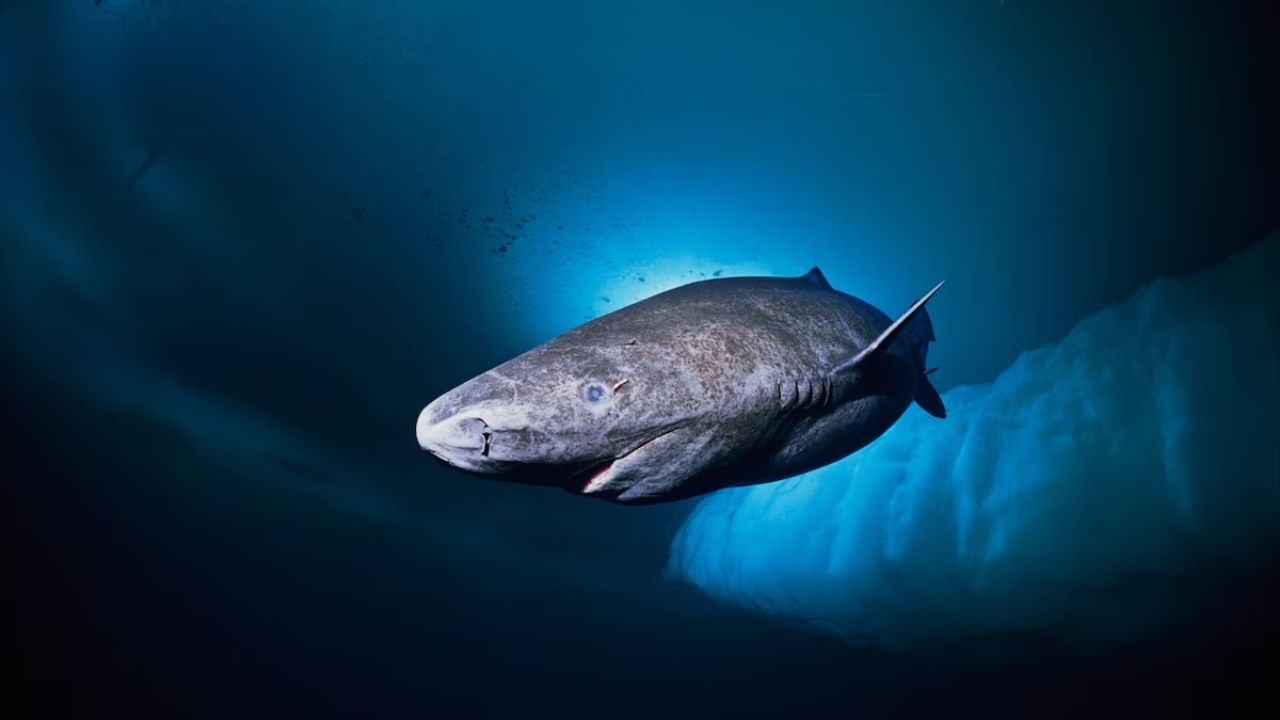


A Giant of Cold Waters Can Live Up to 392 ± 120 Years and Exposes How Slow Living Impacts Species Conservation
The Greenland Shark has become one of the most impressive animals ever studied for a simple reason: the estimated age can reach 392 ± 120 years.
This number places the species as the longest-lived vertebrate ever documented, with a biology that challenges the normal pace of the animal world.
The combination of very slow growth, late maturity, and living in cold waters helps explain why this shark spans centuries and why conservation has become a critical point.
-
Motorola launched the Signature with a gold seal from DxOMark, tying with the iPhone 17 Pro in camera performance, Snapdragon 8 Gen 5 that surpassed 3 million in benchmarks, and a zoom that impresses even at night.

-
Satellites reveal beneath the Sahara a giant river buried for thousands of kilometers: study shows that the largest hot desert on the planet was once traversed by a river system comparable to the largest on Earth.

-
Scientists have captured something never seen in space: newly born stars are creating gigantic rings of light a thousand times larger than the distance between the Earth and the Sun, and this changes everything we knew about stellar birth.

-
Geologists find traces of a continent that disappeared 155 million years ago after separating from Australia and reveal that it did not sink, but broke into fragments scattered across Southeast Asia.

What Happened and Why It Drew Attention
The age was estimated using radiocarbon dating of lens proteins in the eye, a tissue that forms early and is not renewed throughout life.
The analysis considered 28 females and pointed to a minimum lifespan of 272 years in one of the individuals evaluated.
The largest measured animal was about 502 cm, with an estimated birth much earlier than the modern period, which increases the margin of uncertainty but keeps the result within the range of centuries.
How the Shark Can Live So Long

The body operates at an extremely economical pace, with a low metabolism and growth often described as only 1 cm per year.
Cold water slows the speed of chemical reactions and tends to reduce energy expenditure, favoring a long life in stable conditions.
Longevity is also linked to a slow life strategy, with less urgency to grow, mature, and reproduce.
What Science Has Measured About Metabolism and Energy
Published estimates have managed to quantify the animal’s metabolic rate, including values for resting and active routine, using oxygen consumption measurements in field conditions.
These measurements help transform the idea of a slow life into physiological parameters, connected to the cost of keeping the body functioning at low temperature.
The results reinforce the image of a shark adapted to spend little, move economically, and survive for long periods with reduced energy demand.
What Is Known About Heart, Blood Pressure, and Pulse
The circulation draws attention due to the estimated blood pressure in the ventral aorta, in the range of 2.3 to 2.8 kPa, considered very low compared to other sharks.
This pattern aligns with a cardiovascular system designed to operate steadily and at low cost over long periods.
The heart rate appears in the literature as very low at rest, with mentions of 4 to 6 beats per minute, and also as a possible physiological ceiling around 12 to 20 beats per minute under certain conditions.
Why Reproduction Becomes a Critical Point for Conservation
The estimated sexual maturity of females is 156 ± 22 years, one of the most important data points for understanding population fragility.
When an animal takes over a century to reach the reproductive phase, any additional mortality weighs heavily for decades, because the replenishment of individuals happens very slowly.
This pace makes the species especially vulnerable to population declines and increases the need to reduce impacts over time.
Where This Species Lives and What It Changes Practically
The Greenland Shark lives in cold, deep environments of the North Atlantic and Arctic, with common records in the range of 400 to 700 m.
Its presence also appears across a broader depth range, reaching 100 to 1,200 m, which complicates direct observations and continuous measurements.
This deep lifestyle favors low activity and helps explain why many physiological data still depend on estimates and indirect methods, without changing the central fact that the species operates on a timescale of centuries.

The Greenland Shark brings together rare numbers in any vertebrate, with an estimated age of 392 ± 120 years and sexual maturity at 156 ± 22 years.
In practice, this means a species that lives long but recovers slowly, with a biology that requires constant attention to avoid losses that can take decades to reverse.








Buenos días, Es excelente lo que hace EEUU Acabar con las dictaduras de esos países ****. Lo qué hace el comunismo es empobrecer el pais y obligar a las personas a que vivan bajó sus leyes. Un país comunista no prospera y no dejan prosperar a las personas ni el país prospera., dónde llega el comunismo el país se estanca se devuelve 100 años atrás . Viven bueno los mandatarios.
Yo estoy en Vietnam un país comunista. Sin apenas delincuencia sin paro apenas , donde se vive muy tranquilo y bastante bien, con un nivel cultural que ya quisieran muchos países capitalistas , y una industria floreciente .
Que espantosa traducción mí Dios!!!!