





 Portuguese
  English
  Spanish
  8 min of reading
  2 comments


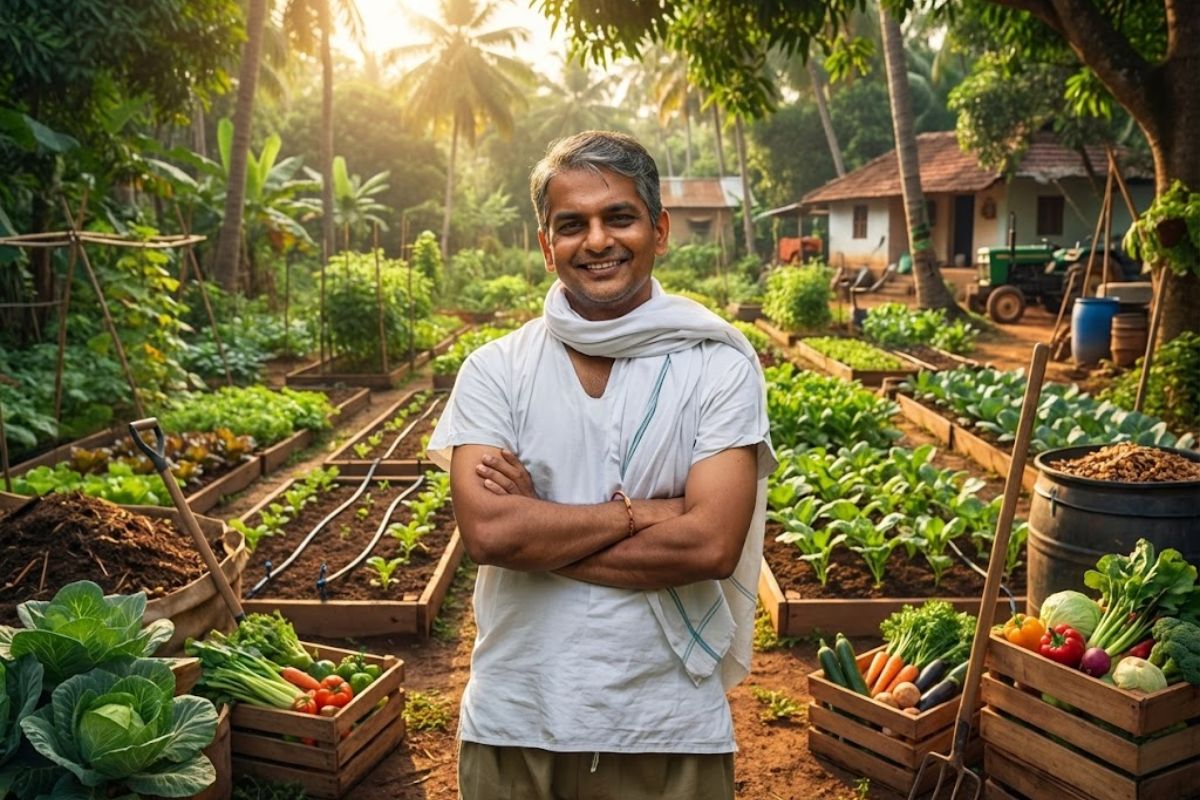


Without Being Born in the Countryside, Farmer Naveen Kumar Swapped the Stability of Engineering for a 8,500 m² Lot in Mysore, Started Chemical-Free Banana Farming, Adopted ZBNF, Created a Seedling Nursery, and Organized the Land into Four Blocks. Now He Observes Shade, Mulch, Micro-Irrigation, and Increasing Annual Productivity as Concrete Signs
Instead of Following the “Apartment Path” Chosen by Many Friends, a Farmer Decided in 2014 to Buy 8,500 Square Meters in Mysore and Start from Scratch, Even Without Being Raised in the Countryside. What Seemed Like a Risky Exchange Turned into a Life Experiment, With Chemical-Free Bananas and a Routine Built on Practice.
The Turning Point Was Not Just a Career Change. Over Time, the Farmer Began to Measure “Success” by Uncommon Criteria for Outsiders: Family Health, Soil Health, and a Spongy Structure Underfoot, Along with a Harvest That Grows Year After Year.
The Decision That Changed the Course: Why Leave Engineering

After More Than 14 Years Working as an Engineer in Companies, He Describes a Simple Yet Persistent Discomfort: He Had No Interest in Turning Stability into an Automatic Consumption Pattern. While Friends Bought Apartments and Invested in “Things,” He Chose a Plot of Land and the Idea of Learning Agriculture from Scratch.
-
Friends have been building a small “town” for 30 years to grow old together, with compact houses, a common area, nature surrounding it, and a collective life project designed for friendship, coexistence, and simplicity.

-
This small town in Germany created its own currency 24 years ago, today it circulates millions per year, is accepted in over 300 stores, and the German government allowed all of this to happen under one condition.

-
Curitiba is shrinking and is expected to lose 97,000 residents by 2050, while inland cities in Paraná such as Sarandi, Araucária, and Toledo are experiencing accelerated growth that is changing the entire state’s map.

-
Tourists were poisoned on Everest in a million-dollar fraud scheme involving helicopters that diverted over $19 million and shocked international authorities.


The Key Point is That the Change Did Not Happen Because He “Already Knew” How to Produce. The Decision Came Despite That.
He Acknowledges That He Started Without Experience, and That the First Barrier Was Not the Harvest: It Was Understanding How to Start an Entire System, from Planting Seedlings to Daily Management, Without Repeating the Dependency on Chemicals That He Viewed as Common Among Those Who Live Exclusively from Agricultural Income.
The First Test: Chemical-Free Banana as an Entry Point

When He Started, He Opted to Grow Bananas Naturally, Without Chemicals. The Choice, As He Relates, Has a Practical Side: It Was a Beginning That Would Allow Him to Observe Results and At the Same Time Generate Some Return to Sustain the Continuity of the Project.
This First Cycle Had an Important Effect on the Farmer’s Trajectory: Motivation. The Result “Brought in Good Money” and Worked as Validation, Not as an End.
From There, He Connects the Experience to a Natural Farming Method Associated with the Name of Subash Palekar, Which Becomes the Guide for the Rest of the Transition and Subsequent Decisions on the Land.
ZBNF in Practice: “Zero Budget” as a Strategy for Autonomy

When He Mentions ZBNF, He Explains the Acronym as “Zero Budget Natural Farming,” a Natural Farming Method with Zero Budget. In Practice, This Appears Less as Discourse and More as an Attempt to Reduce Dependencies: Enabling the Area to Function Without Having to Buy Inputs at Each Stage and Without Being at the Mercy of Third Parties.
In the Farmer’s Logic, Having Cows and Bulls Changes the System’s Axis. It’s Not Just About “Having Animals,” But About Reducing the Need to Look Outside for What Sustains Part of the Management.
The Proposal is That Soil Preparation, Land Routine, and Certain Maintenance Stages Stay Within the Cycle Itself, Making the Work More Predictable and Less Dependent on Purchases.
The Own Nursery: Starting with Seedlings, Not the Market
For Someone Who Was Not Born a Farmer, He Points Out a Crucial Detail: The Initial Stage Often Requires Investment, Especially When Relying on Purchased Seedlings.
The Solution He Found Was to Set Up His Own Nursery, Taking Seedlings from Seeds When Possible, and Reducing the Need to “Invest Almost Nothing” During This Phase to Nearly Zero.
This Point is Not Small: For a Farmer Entering the Activity, The Initial Cost is Often One of the Factors That Impede Continuity. By Moving the Nursery to the Land, He Transforms the First Barrier into Routine, Making Learning a Part of the Process, Not an Inevitable Expense.
When Work Changes Shape: From “Manual” to Monitoring
A Recurring Aspect in His Account is the Idea That, After the Land “Is Ready” and the System Engages, the Work Ceases to Be Heavy All the Time.
He Describes a Critical Window: Managing Weeds in the First Months, While Shading and Soil Coverage Are Not Yet Established.
Then, According to the Farmer, Factors Come Into Play That Reduce the Pressure: Shade, Mulch, and the Plants’ Own Growth, Which Makes It Harder for Weeds to Explode.
What Remains Becomes Minimal Monitoring, with Occasional Interventions, Instead of a Daily Correction Routine with Inputs.
He Illustrates the Change in Physical Effort with a Direct Image: Once the Area Is Structured, “It’s Like Picking and Eating.”
The Phrase Carries a Didactic Exaggeration, But the Meaning is Clear: The Goal Is to Build a System Where the Harvest is the Consequence of a Well-Thought-Out Arrangement, Not a Daily War Against the Land.
Inputs and Interventions: Less Spraying, More Environmental Cycle
The Farmer Also Describes a Concrete Change Over the Years: In the Beginning, There Were Spraying and Other “Spray” Practices That Were Later Abandoned.
The Movement Was to Leave the System Increasingly “To Nature,” Reducing Interventions and Betting on the Stability of the Land’s Own Environment.
This Does Not Mean the Absence of Any Action. He Mentions, for Example, Applying “Manu” (an Organic Input, Cited as Something Applied Once a Year by a Worker) as One of the Few Moments of Planned Management.
The Emphasis is on Low Frequency and Predictability, Not on the Inexistence of Work.
Water at the Right Point: Micro-Irrigation and Summer Routine
Even in a System That Seeks to Reduce External Dependency, Water Remains a Variable That Requires Decision.
The Farmer Reports the Installation of Micro-Irrigation to Use When Necessary, Especially During Summer Months When Irrigation Needs to Be Activated.
The Way He Presents This is Consistent with the Rest of the Method: Irrigation Enters as a Precision Tool, Not as a Constant Routine.
Turns On When Needed, Turns Off When Resolved, Maintaining the Logic of Minimal Intervention and Maximum Benefit, Focusing on Fruit Quality and Cultivation Stability.
Four Areas to Avoid Relying on a Single Bet
One of the Most Technical and Organizational Aspects of the Case is the Division of the Land into Four Parts. He Describes an Area for Fruits, an Area for Spices, an Area for Growing Pulses (As He Indicates), and a Commercial Area Where He Grows a Crop He Calls “ARA.”
The Reasoning Behind This Division is Strategic: Not Relying on “Everything” in a Single Axis, Nor Becoming Dependent on the Market for Every Need. For the Farmer, Having Production Focused on Family Consumption While Also Having a Commercial Area Creates Balance.
Diversification Becomes a Way to Reduce Risk, Learn Faster, and Sustain the Project Without a Specific Failure Undermining the Whole.
Increasing Harvest and Diversity: Over 25 Varieties in the Same Space
He Reports Having Planted More Than 25 Varieties of Fruits and Already Starting to Harvest from Some Plants, with the Routine of “Going There, Harvesting, and Eating.”
This Diversity Has an Effect That Goes Beyond the Plate: It Expands Observation, Distributes Production Cycles, and Helps View the Land as a System, Not as a Rigid Monoculture.
The Farmer Also Provides a Concrete Example of Increased Productivity in a Specific Fruit: Plants That Previously Produced About 4 to 5 kg Are Now Yielding Up to 8 kg, With Expectations of Reaching 10 to 12 kg This Year.
The Central Point is Not the Isolated Number, But the Annual Increasing Trend, Which He Associates with the Maturation of the System and the Soil Health Over Time.
What He Calls “Success”: Family Health, Soil Health, and Spongy Soil
Instead of Closing the Account Only by Money, the Farmer Proposes Three Metrics: His Health, Family Health, and Soil Health. This Choice Changes the Way to Look at Work: The Result is Not Just What Goes into the Cash Register, But What Remains in the Land and the Body.
A Detail He Repeats as a Physical Sign of This Change is the Sensation When Walking: He Observes a “Spongy” Soil Structure, as if the Ground Responded Differently Underfoot.
For Him, This Type of Indicator Serves as Daily Proof, Because It Connects Management to Something Visible and Tangible, Not Just What Is Calculated at the End of the Month.
From Farm to City Without Intermediaries: A Direct Agreement Between Those Who Plant and Those Who Eat
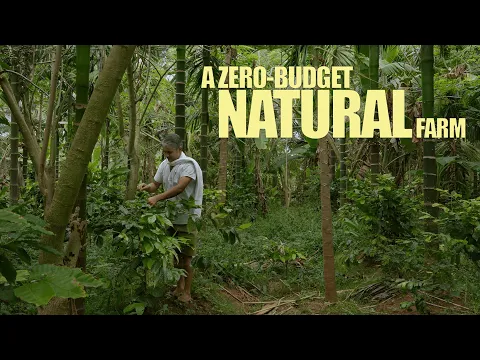

In a More Social Segment of the Narrative, He Envisions a Direct Relationship Between Urban Consumers and Farmers.
The Idea is That a Group He Mentions, for Example, Residents of Buildings and Apartments, “Adopts” a Small Village and Starts Requesting Specific Items Directly from the Farmer, Without Intermediaries.
In This Model, the Farmer Would Receive Payment in Advance and, According to Him, Something Like 10% to 15% More Than in the Direct Market, Precisely Because It Involves Chemical-Free Production.
The Argument is One of Transparency and Control: The Consumer and Farmer Would Have “100% Control” Over the Source, While the Producer Would Have Predictability to Plan and Sustain the System.
A Final Message That Circles Back to the Beginning: The Soil as Heritage
The Farmer Concludes the Logic with a Long-Term Concern: “Saving the Soil for the Future.”
He Suggests That Even Those Who Do Not Want to Live Off Agriculture Can Start Small, with a Piece of Land Focused on Their Family’s Consumption, Learning the Pros and Cons Before Expanding.
The Idea of Heritage Appears Reversed: It Is Not the Land He Received Because He Claims He Was Not Born a Farmer, But the Land He Wants to Leave Behind.
If One Generation Delivers Destroyed and Sterile Land, the Next One Is Left with Nothing to Eat; If They Deliver Living Soil, They Deliver the Possibility of Longer Life.
This Farmer’s Story in Mysore Is Not Just About Trading Engineering for a Hoe.
It Exposes a Rare Type of Decision: Building a System That Seeks to Reduce Dependencies, Learning from the Land Itself, and Measuring Results by Signs of Health of Body, Family, and Soil Without Abandoning the Discipline of Organizing the Area, Dividing Risks, and Monitoring Productivity.
And So the Question Stands, Quite Direct and Personal: If You Had 8,500 m² (Or Much Less), What Would Be Your First Step to Produce Something Chemical-Free for Your Home?
Do You Measure “Success” More by Money, Health, or the Quality of What You Eat? And, As a Consumer, Would You Be Willing to Pay a Little More for Direct Purchase, Without Intermediaries, Knowing Exactly Who Planted?










É uma esperança de melhorar o cuidado com a natureza, porque dependemos dela cada vez mais.
Maravilhoso.