





 Portuguese
  English
  Spanish
  7 min of reading
  0 comments


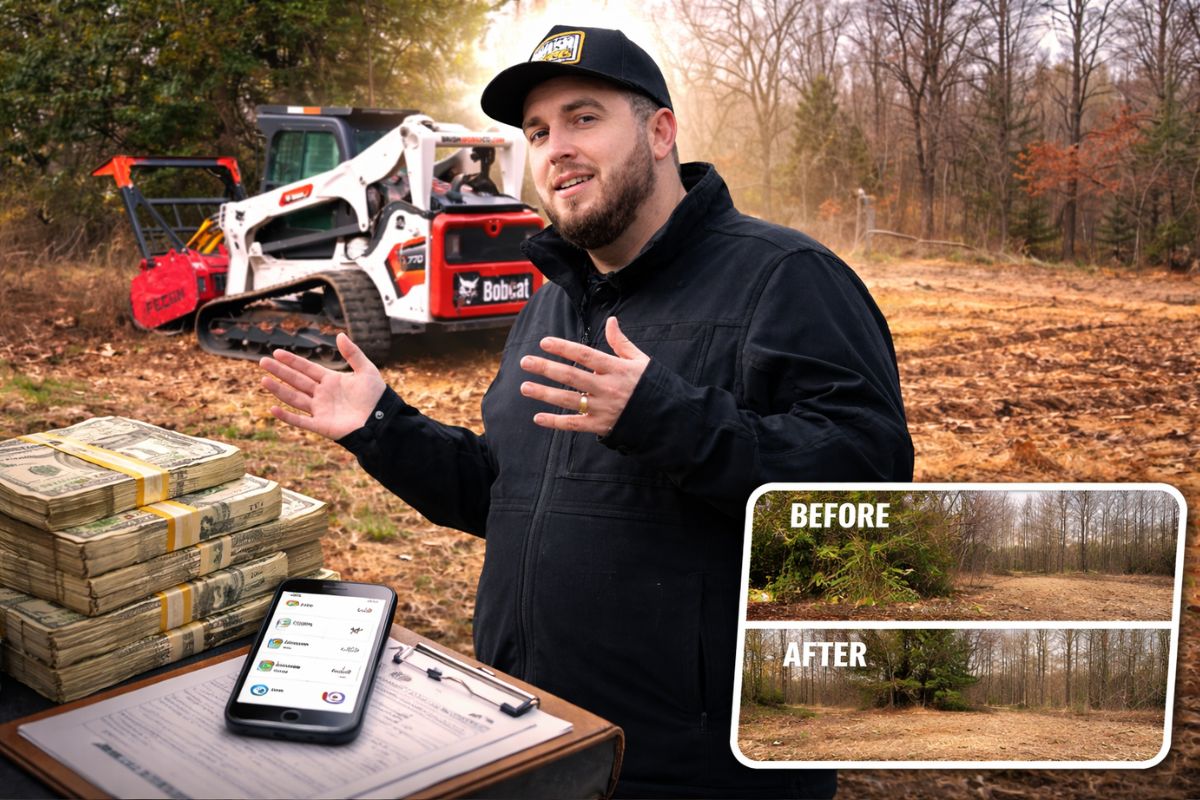
With a Financed Machine and a 5 Thousand Dollar Down Payment, Alex Set Up a Forestry Chipping Service in Cincinnati to Clean Lots, Using Before and After Video to Generate Leads at 20 Dollars and Close 49% of Budgets, with High Profit on Jobs of 6 to 7 Thousand Alone
The bet started with a machine and a simple discomfort: watching land “disappear” every year due to an invasive plant and, at the same time, realizing that almost no one offered a quick solution in the Cincinnati area. Alex reports that he invested 5 thousand dollars, chose financing, and treated each visit as a practical demonstration.
The plan was not to set up a large operation right away. It was to prove that a well-chosen machine, a repeatable budgeting process, and a filming routine of before and after could sustain jobs of 6 to 7 thousand dollars, with profit of 4 to 5 thousand, even without a fixed team.
The Invisible Demand That Transforms the Machine into a Service

The starting point was local and very specific. Alex says that near Cincinnati, landowners deal with invasive honeysuckle and end up losing usable areas due to lack of management, year after year.
-
Friends have been building a small “town” for 30 years to grow old together, with compact houses, a common area, nature surrounding it, and a collective life project designed for friendship, coexistence, and simplicity.

-
This small town in Germany created its own currency 24 years ago, today it circulates millions per year, is accepted in over 300 stores, and the German government allowed all of this to happen under one condition.

-
Curitiba is shrinking and is expected to lose 97,000 residents by 2050, while inland cities in Paraná such as Sarandi, Araucária, and Toledo are experiencing accelerated growth that is changing the entire state’s map.

-
Tourists were poisoned on Everest in a million-dollar fraud scheme involving helicopters that diverted over $19 million and shocked international authorities.

He saw a mismatch: pruning companies were doing the service manually, for weeks, pushing the budget into tens of thousands.
The turning point came when he found forestry chipping as an alternative. The machine comes in, maps what will be cleared, and reduces dense vegetation to a thin layer of wood, which stays on the ground and decomposes in 12 to 18 months.
The benefit perceived by the client is not just “looking nice” : it’s about regaining circulation, safety, and use of the land without waiting for a long construction.
Before selling to others, he tested it in his own area. Living in Cincinnati, with about 5 acres, he describes that three were practically unusable after years of uncontrolled growth.
The first “before and after” was not a trick: it was operational proof that the machine delivered a clear result.
This test also helped define a limit: the service is visual, but it is not “magic.” There are species of very hard wood in the region, and certain areas require more time, more diesel, and more wear and tear.
When perception becomes expectation, the budget needs to be technical — and this is resolved before turning on the machine.
Financing, Risk and the True Cost of Keeping the Machine Running

The chosen path was to start with little and finance the machine. Alex reports a down payment of 5 thousand dollars and a monthly payment of around 1,400, including the main accessory.
In addition, he cites support costs: a trailer for about 11 thousand and a used truck for around 8 thousand to safely tow the set.
Financing acts as a lever, but also as pressure. Even in a “one guy and one machine” model, the clock runs every month: insurance, maintenance, and fuel do not wait for the schedule to fill up.
He mentions monthly insurance around 150 and liability coverage around 225. These numbers do not break the service on their own, but punish disorganization.
There’s also the legal and operational layer. He describes the decision to formalize the operation to separate personal risk from service risk, before spending significantly on advertising and equipment.
In a job that involves land, rocks, and hidden objects, there’s a chance of damage, and the cost of error is usually high.
This is the kind of detail that many people ignore when they only see the “satisfying video.” The machine does not operate in a vacuum: it operates on someone else’s property, with neighbors, fences, barbed wire, and old trash.
The safety margin starts before the first budget, and this is part of the method — along with the financing that needs to fit into the calendar.
The Lead Funnel and the Role of Video in Client Confidence
The acquisition engine was organized into three stages: capture, educate, and sell. Alex says he uses video ads — short, vertical — to stop the scroll and directs the interest to a channel of longer videos.
The idea is simple: the client arrives knowing what the machine is, what the result looks like, and what to expect on the service day.
The practical consequence appears in the number he repeats: the lead costs an average of 20 dollars. He states that almost every lead turns into an on-site budget visit and that about 49% of budgets are closed. When conversion is high, acquisition cost stops being a mystery and becomes a metric.
The video also works as a filter. Those who reach out after watching the “before and after” tend to accept the price, logistics, and execution time better.
He describes that, in many cases, the sale is already on track when he arrives to measure and define the service — because the client has already visualized the machine in action.
And there’s an operational lesson hidden in this: it’s not about an expensive camera. He reports that it’s possible to record with a cell phone, a cheap tripod, and simple editing.
What matters is consistency: documenting the problem, showing the process, and proving the result. In a physical service, trust is image and repetition — and every lead becomes part of this validation.
How the Machine Becomes a Spreadsheet: Pricing by Density, Terrain, and Extras
To escape the “guess,” Alex describes a pricing model based on area unit and two technical axes: vegetation density and terrain difficulty. He talks about three levels of density and three levels of terrain, with multipliers applied to the base price per quarter acre. In practice, this allows for quick quotes without losing coherence.
An example he cites: a job of about 3 acres, with intermediate density, can take about 3 days and result in a price in the range of 6 to 7 thousand dollars.
The cost account appears in blocks: diesel between 80 and 100 dollars per day, operator payment in the range of 250 to 300 per day, and a reserve for repairs of about 8% (he says he has already used 10% as a more conservative rule).
When he operates without hiring someone, the profit shifts to a new level. He points to jobs of 6,000 dollars with profit of 4,000 and, when he does it alone, profit of 5,000. In some cases, he adds an extra service — operating a claw — for 750. The “extra” does not save a bad budget, but boosts a well-calculated budget.
There are also rules to protect cash flow. For jobs above 10,000, he mentions a 20% deposit. It’s not a whim: it’s about controlling the schedule, fuel, and wear and tear on the machine. The higher the ticket, the greater the risk of cancellation turning into immediate loss — even for those paying for financing.
The Hard Side of the Machine: Protection, Wear, and What Can Go Wrong
The machine he uses includes a protection kit for falling objects and a 19 mm polycarbonate door, designed to operate in a forest environment. He emphasizes that not every common rental meets this standard and that this explains why certain rental companies avoid offering the complete set.
The equipment is heavy: about 5,443 kg. This changes logistics off the property, requiring a more robust truck for towing and appropriate licensing. The chipping is also aggressive on parts: hydraulic hoses, teeth, and couplings suffer more when the vegetation is dense and the ground hides rocks.
Alex also details the accessory. A used model would have cost 15,000, while a new one is around 40,000. The new machine he mentions, from the T86 category, can reach 115,000. Purchase price is just the first line of cost, because wear and tear comes every week — and does not respect financing or calendar.
There is also the invisible risk: metal. Barbed wire, tires, construction debris, and scrap can destroy teeth and cause breakdowns. He says he tries to guide the client to clean the area, but accepts that part of this work becomes billable time. The correct calculation does not romanticize: he describes that the final cover stays on the ground and that removing it is generally worse than letting it decompose.
Seasonality, Schedule, and How the Same Machine Earns All Year Round

In regions like Cincinnati, the weather plays a big role. Alex reports that his second year started slow, with months practically without chipping, and that rains delayed the pace. The response was logistical: organizing large rural properties for winter, offering a 10% discount to fill in calendar “gaps.”
The machine then ceases to depend on a single demand. He describes snow removal as an alternative, with billing of 10 to 11 thousand per snow event, concentrated in about 20 hours of operation. In this scenario, the bridge with general contractors is decisive: they capture the contract and outsource part of the service when they underestimate capacity.
This type of diversification changes the business risk. The same financing that tightens can become lighter when the schedule does not zero out in winter. Alex also points out that there are hundreds of possible accessories for the machine, and the key is to combine local demand with actual execution capability.
In the end, the case shows a pattern: he did not need a large team to start, but he needed a system. Lead, budgeting, execution, maintenance, and seasonal planning. The machine is the center, but control is the differentiator — and the profit appears when the method becomes routine.
In your city, what “annoying” problem do you see repeating every year that seems to call for a machine to solve? Would you pay for a lead at 20 dollars or would you only trust referrals? And if the profit depended on filming the before and after, would you have the courage to show your work without “perfect” editing?










-

-

-

3 pessoas reagiram a isso.