





 Portuguese
  English
  Spanish
  6 min of reading
  1 comment


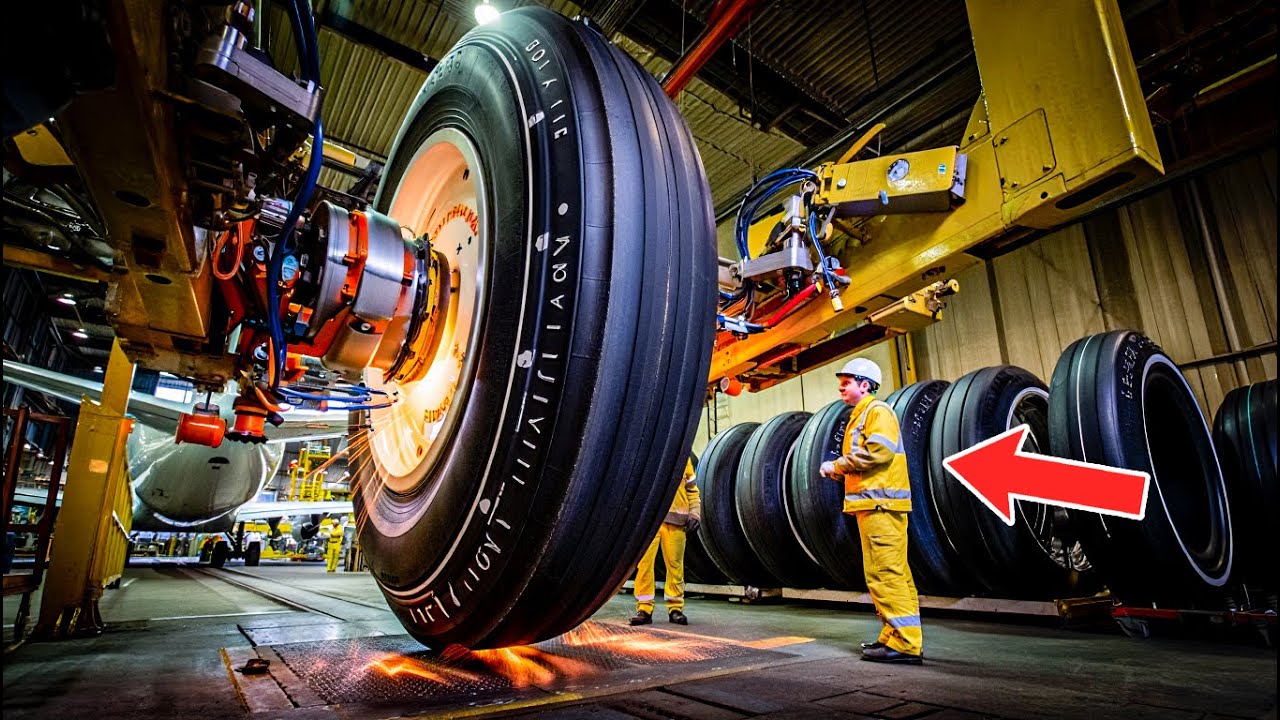


Airplane Tires Operate Above 200 PSI, Support Dozens of Tons Per Wheel and Withstand Impact and Extreme Heat on Landing. Understand the Engineering Behind This Critical Component.
When a commercial airplane touches down, it can weigh over 200 tons and be traveling at speeds close to 250 km/h. The event is violent and instantaneous: in fractions of a second, the tire goes from zero rotation and needs to “catch” the aircraft’s speed, spinning at thousands of revolutions per minute. The white smoke that appears on initial contact is not a malfunction or a sign of emergency. In most cases, it is simply the result of initial friction between the rubber and the asphalt as the tire accelerates violently to synchronize with the ground.
Even under extreme load and instantaneous acceleration, tires do not explode as people imagine. This happens because aviation tires are not “big tires”: they are engineered components designed to operate in conditions that car tires never face — with extremely high internal pressure, multi-layered structure, and direct integration with the landing gear system, which absorbs a critical part of the impact.
Internal Pressure Above 200 PSI: The Secret of the Rigidity That Supports Weight
The basis of airplane tire resistance is pressure. While automobile tires typically operate around 30 to 35 PSI, commercial aircraft tires often operate above 200 PSI and can exceed 300 PSI in some models and applications.
-
Friends have been building a small “town” for 30 years to grow old together, with compact houses, a common area, nature surrounding it, and a collective life project designed for friendship, coexistence, and simplicity.

-
This small town in Germany created its own currency 24 years ago, today it circulates millions per year, is accepted in over 300 stores, and the German government allowed all of this to happen under one condition.

-
Curitiba is shrinking and is expected to lose 97,000 residents by 2050, while inland cities in Paraná such as Sarandi, Araucária, and Toledo are experiencing accelerated growth that is changing the entire state’s map.

-
Tourists were poisoned on Everest in a million-dollar fraud scheme involving helicopters that diverted over $19 million and shocked international authorities.


This difference completely changes the structural behavior: high internal pressure reduces excessive deformations, increases the rigidity of the assembly, and makes the tire function as a real load-bearing element, not just as a “rubber shock absorber.”
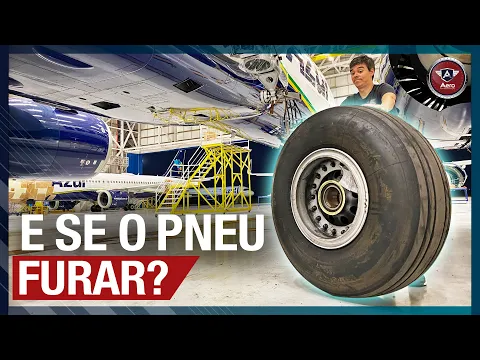

In large airplanes, weight is distributed across multiple sets of wheels to dilute the load, but still, each tire supports impressive individual load values, often in the order of dozens of tons in operation.
It is this rigidity that prevents the carcass from collapsing upon impact. Without high pressure, the rubber would deform too much, generate heat even faster, and the internal structure would be pushed to its limit much more easily.
Multi-Layer Construction: Inside, An Airplane Tire Is a Structural Piece
The aviation tire is built to withstand dynamic forces, not just static weight. Therefore, it uses a reinforced internal architecture, combining special rubbers with structural layers that distribute tension, control deformation, and withstand repeated impacts over landing cycles.
The logic is simple, but the execution is complex: when the aircraft touches down, the energy of the impact needs to be absorbed and redistributed. A “too hard” tire could fail due to shock, and a “too soft” tire would collapse and heat up to the point of losing integrity.
What works is a balance: deformation exists, but it is planned, controlled, and momentary. The tire is designed to absorb energy stably, not to resist like a rigid block.
The Most Aggressive Moment: Zero Rotation to Thousands of Revolutions Per Minute
The shock of landing is not only vertical. There is a brutal rotational acceleration force. At the instant it touches the asphalt, the tire is still “stationary.”
The asphalt, on the other hand, is “running” beneath it at the same speed as the airplane. In this micro-interval, the most aggressive stage for the rubber occurs: the tire surface experiences intense friction as it instantly accelerates to achieve the rotation that matches the ground speed.
It is here that the smoke many people see from the window arises. It is usually more noticeable during firm landings and on runways where initial contact generates more friction. The phenomenon is expected and is part of the system’s behavior. Even so, the tire does not work alone.
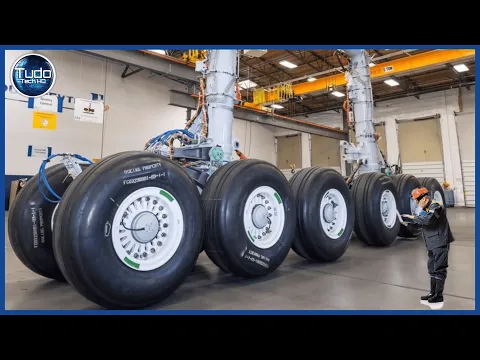
The vertical load and landing dynamics are shared with the landing gear, especially with the hydraulic shock absorbers (oleo-pneumatic), which transform a good part of the shock into controlled dissipation.
Landing Gear and Shock Absorbers: Why the Tire Does Not Absorb Everything Alone
The airplane tire is a critical part, but it integrates into a system. The landing gear is designed to absorb descending energy, reduce load spikes, and stabilize the aircraft upon contact with the runway. That is why, even when the aircraft is coming in “heavy,” the structure does not transfer everything directly to the rubber.
In firmer landings, the dynamic load can temporarily exceed the static weight. This amplification occurs because vertical deceleration and impact generate force spikes.
The landing gear assembly works to reduce these spikes and keep load distribution within design parameters. In other words: the tire can take a lot, but it was designed to operate alongside the damping of the landing gear, not in isolation.
How Much Each Tire Supports In Practice: Real Load and Safety Margins
The question “how many tons can each tire hold?” does not have a universal fixed number because it depends on the airplane, the wheel arrangement, the landing weight, and the load distribution.
Wide-body intercontinental aircraft can exceed 250 tons, and this is diluted across multiple axles and multiple tires. Even so, each tire operates under very high load, subject to dynamic factors and variations in distribution due to center of gravity, wind, runway slope, and impact intensity.

Engineering considers the real scenario, not the ideal one: dynamic load, deformation, heating, repeated cycles, and damage tolerance. The result is a component that operates very close to the physical limit of rubber, but with calculated safety margins, traceability, and constant inspection.
Maintenance, Inspection, and Retreading: Why Aeronautical Tires Do Not “Age” Improvisationally
Unlike automotive tires, aircraft tires undergo rigorous inspections and cycle control. They are examined in routines that check for wear, cuts, damage, deformations, and structural conditions.
And they can be retreaded multiple times: the structural carcass is preserved while the tread is replaced, as long as the internal structure remains within standards.
The important point is that safety does not come only from design. It comes from the complete package: design, operation within parameters, and maintenance with traceability. Each tire has a history, usage limit, and technical condition monitoring.
Why They Do Not Explode Even with Such High Pressure
The resilience of airplane tires is a direct result of three pillars that work together: high internal pressure for rigidity, multi-layer construction to withstand tension and absorb energy, and rigorous inspection/maintenance to prevent small damages from becoming large failures.
When failures occur, they are generally related to conditions outside the envelope: significant external damage, extreme overheating, operation with inadequate parameters, or situations where the braking and wheel systems have reached critical limits.
Even so, airplanes use redundancy by design: multiple wheels and multiple tires exist to maintain support and stability even in case of a component failure.
The “Piece of Rubber” That Functions as a High Engineering Structural Piece
Airplane tires withstand landings of aircraft over 200 tons because they operate with internal pressures far exceeding those of common vehicles, use reinforced multi-layer structural construction, and are part of an integrated system with landing gear and hydraulic damping.

They survive impacts, instantaneous rotational acceleration, and intense heat from braking because they are designed to operate at the physical limits of materials — with safety margins and maintenance controls that do not exist in the automotive world.
What seems like mere rubber is, in practice, one of the most critical components of modern commercial aviation: a piece that needs to function reliably, repeatedly, under maximum stress — with no margin for error.










Muy bien explicado y fidedigno.
Aún así llegan a sufrir falla explosiva debido al debilitamiento de su estructura causada durante su operacion al pisar objetos extraños en las pistas de aterrizaje o de rodaje. También suelen desinflarse “automáticamente” por sobre temperatura en eventos de frenado excesivo durante abortos de despegue o aterrizajes forzosos, evitando así que exploten y los fragmentos grandes de hule que saldrían disparados dañen las alas o el fuselaje del avión.
Saludos