





 Portuguese
  English
  Spanish
  4 min of reading
  0 comments


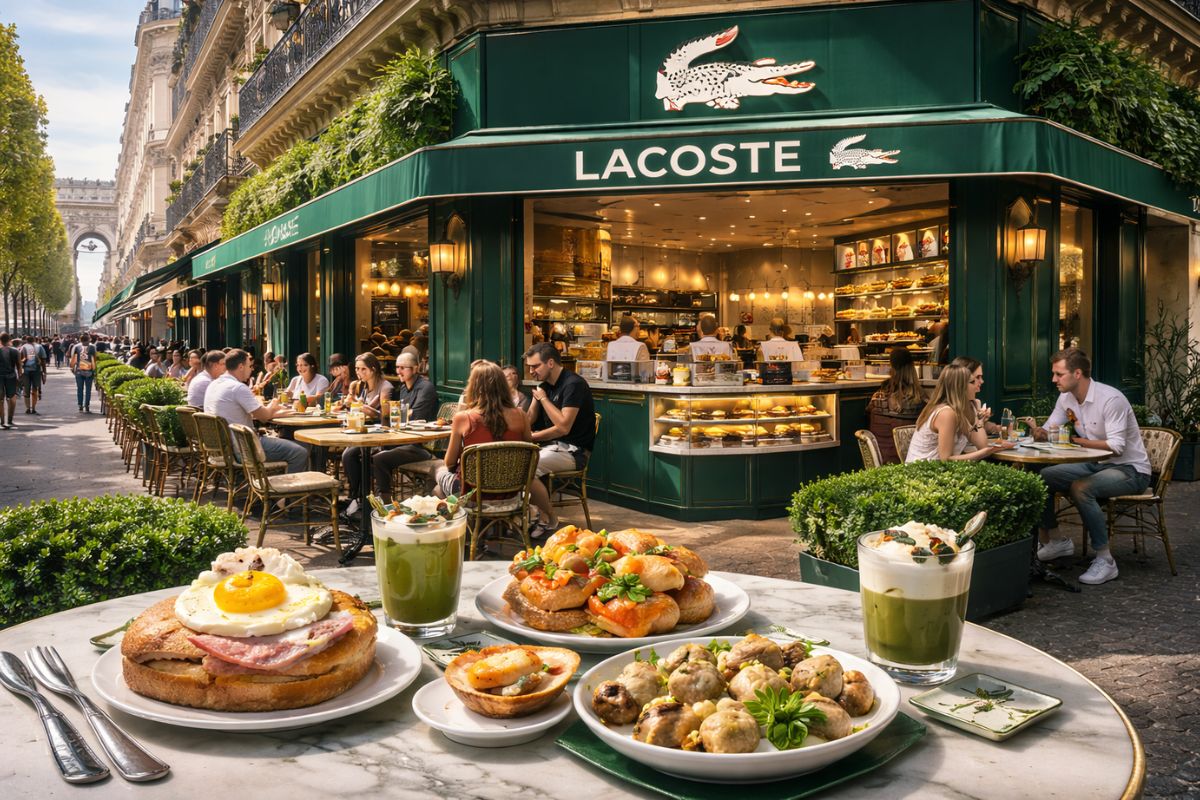
Lacoste Takes Its Apparel Brand to the Plate and Opens a Permanent Lacoste Café in Paris, Following the Pop-Up in Monaco. The Space is Located Near the Flagship on Franklin D. Roosevelt Avenue, in Partnership with Giraudi Group, and Features Off White, Terracotta, Green Colors and an Urban French Menu.
Lacoste has decided to move beyond clothing and put food at the center of its brand experience. The shift includes opening a permanent Lacoste Café in the heart of Paris, just steps from the flagship on Franklin D. Roosevelt Avenue, in a bet that combines location, design, and a revamped French menu.
The project is described as a continuation of what was tested in Monaco, now with the intent to become routine, not an event. The question is whether the public will treat the café as a natural extension of the brand or as a passing curiosity in the urban pace of Paris.
From Monaco to Paris, What Changes When the Experience Stops Being Temporary

The transition from a pop-up in Monaco to a permanent café in Paris changes the weight of investment and the expectation of consistency.
-
Friends have been building a small “town” for 30 years to grow old together, with compact houses, a common area, nature surrounding it, and a collective life project designed for friendship, coexistence, and simplicity.

-
This small town in Germany created its own currency 24 years ago, today it circulates millions per year, is accepted in over 300 stores, and the German government allowed all of this to happen under one condition.

-
Curitiba is shrinking and is expected to lose 97,000 residents by 2050, while inland cities in Paraná such as Sarandi, Araucária, and Toledo are experiencing accelerated growth that is changing the entire state’s map.

-
Tourists were poisoned on Everest in a million-dollar fraud scheme involving helicopters that diverted over $19 million and shocked international authorities.


A temporary point serves as a concept showcase, with more tolerance for quick adjustments and less pressure for repeatability day-to-day.
A fixed location, on the other hand, demands standards, predictability, and the ability to maintain flow without relying on novelty.
When Lacoste decides to stay, it accepts to be evaluated as an operation, not as a marketing installation, which directly impacts the perception of consistency.
The Address Near the Flagship and What the Brand Gains from It
The choice of a location just steps from the flagship on Franklin D. Roosevelt Avenue helps explain the goal of capturing the audience that already circulates there.
Practically speaking, those who enter to see the collection can cross the café’s door with the same convenience logic that defines consumption in central areas.
This proximity also reduces the risk of identity dispersion, as the café does not need to compete with the store for attention in distant neighborhoods.
Lacoste concentrates the narrative on a single geographical axis, reinforcing the idea that dressing and consuming in the same environment can become an urban ritual.
Partnership with Giraudi Group, Restaurant Operation, and the Limit of Brand Control
The Lacoste Café was developed in partnership with Giraudi Group, a conglomerate known for the Beefbar project, associated with premium meat cuts in exclusive design environments.
The presence of a specialized operator suggests that Lacoste does not want to improvise in execution, preferring a structure accustomed to hospitality logic.
At the same time, partnerships always bring a silent dilemma: who controls what when it comes to service, menu, and experience.
Lacoste lends its name, but the day-to-day operations of a café depend on kitchen rhythm, service, and quality standards that are not the same as those in fashion retail.
Design as a Manifestation of DNA and Sneakers as Visual Language
The interior proposal was described as a physical manifestation of the brand’s DNA, featuring a palette in off white, terracotta tones, and a deep green associated with “the face of Lacoste.”
The intention is simple to understand: to make the space recognizable even before the first order.
Beyond colors, the environment features references to the world of tennis, such as the use of rackets in the decor.
This choice connects the café to the sporting imagination that Lacoste already carries and tries to avoid the feeling that the new business is a break.
When the decor tells the story before the menu, the brand attempts to control the first impression.
Revamped French Menu and the Central Question, What Do You Eat at a Lacoste Café
The menu was created by Executive Chef Thierry Paludetto, with the proposal to revisit classics of French cuisine with a perspective aligned to the urban pace.
Instead of promising haute cuisine, the selection points to quick and recognizable consumption choices, such as club sandwiches and seasonal salads, along with signature desserts.
The beverage list features specialty coffees roasted artisanally and lattes with unique flavors like pistachio and ube.
It is here that the reader’s question turns practical: how much does this offer resonate with Lacoste’s audience, and how much does it try to attract those simply wanting a break in central Paris.
The real test isn’t just flavor; it’s repetition: does the person return or was it a one-time visit.
By opening a permanent café in Paris, near its flagship on Franklin D. Roosevelt Avenue, Lacoste expands the concept of the brand beyond clothing purchases and enters the realm of everyday consumption.
The choice of partner, the aesthetics aligned with tennis, and a revamped French menu indicate an attempt to unite identity and convenience without solely depending on novelty.
If you were passing through this part of Paris, what would make you enter a Lacoste Café for real: curiosity about the design, trust in Chef Thierry Paludetto, desire to try a pistachio or ube latte, or the idea that a clothing brand can also become a reference in food? And which brand today do you think could make that leap without sounding forced?










-

-

-

-

4 pessoas reagiram a isso.