





 Portuguese
  English
  Spanish
 5 min of reading
  0 comments


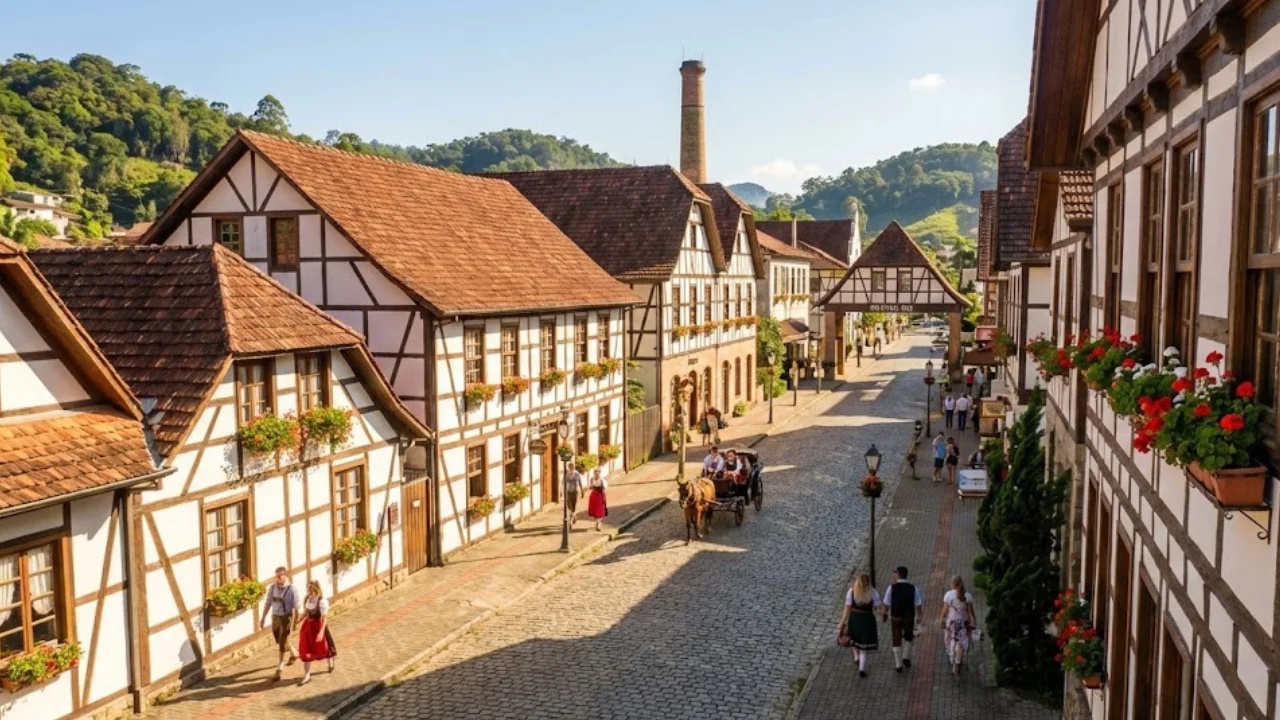
Pomerode, in Santa Catarina, Brings Together References of German Immigration That Appear in the Language, Architecture, and Traditional Festivals.
The city is cited as a tourist destination by those seeking preserved cultural signs in everyday life, amid recent official data on population and municipal laws related to co-official languages.
With just over 36 thousand residents in the most recent official estimate from IBGE, Pomerode, in the Itajaí Valley, Santa Catarina, is often described as the “most German city in Brazil” for maintaining references to immigration in language, architecture, and traditional festivals that attract tourists throughout the year.
Although it is in Brazilian territory and has a population made up of Brazilians, the municipality preserves German cultural traits in everyday life, especially among families and communities where German and Pomeranian still appear in domestic speech and local events.
-
Friends have been building a small “town” for 30 years to grow old together, with compact houses, a common area, nature surrounding it, and a collective life project designed for friendship, coexistence, and simplicity.

-
This small town in Germany created its own currency 24 years ago, today it circulates millions per year, is accepted in over 300 stores, and the German government allowed all of this to happen under one condition.

-
Curitiba is shrinking and is expected to lose 97,000 residents by 2050, while inland cities in Paraná such as Sarandi, Araucária, and Toledo are experiencing accelerated growth that is changing the entire state’s map.

-
Tourists were poisoned on Everest in a million-dollar fraud scheme involving helicopters that diverted over $19 million and shocked international authorities.


The idea that the city “almost has no Brazilians,” common in visitor reports and tourist promotional texts, tends to rely on visual and cultural signs present in areas of circulation and in tourist routes.
Bilingual signs, surnames of German origin, menus with recipes associated with European traditions, and buildings in half-timbered style make up part of this perception.
Still, public services and everyday life operate in Portuguese, with routines similar to those of other cities in Santa Catarina.
German Immigration and Historical Origin of Pomerode
The history of Pomerode’s formation is related to the arrival of immigrants from Pomerania in the 19th century, a movement noted in historical records as decisive for local identity.
Various references place the beginning of this process around 1863, in connection with the expansion of the old colony of Blumenau in the Rio do Testo region.

For visitors to the city, one of the most evident elements is the urban landscape marked by houses with exposed wood, geometric details, and colors associated with half-timbering.
This aesthetic does not appear uniformly throughout the municipality but becomes more recurrent in tourist areas and routes of cultural interest, reinforcing the association with small villages of German origin.
The cuisine also serves as a showcase for preserved traditions.
In pastry shops, cafes, and restaurants, it is common to find cucas, breads, and recipes presented as family heritage passed down through generations.
Moreover, preparations with German influence frequently appear at community events and local festivals, expanding the offerings for those seeking this type of experience.
German and Pomeranian Language: Laws and Everyday Use
The presence of German in the daily life of Pomerode is mentioned by residents and visitors as a distinguishing feature of the municipality, especially in family environments and community contexts.
In the institutional field, the city approved a municipal law on September 1, 2010, which established the German language as a complementary and secondary language alongside Portuguese, providing a legal basis for actions related to the topic at the local level.
On May 23, 2017, another municipal law co-officialized the Pomeranian language in the municipality, also alongside Portuguese.
The text provides for initiatives to promote and create opportunities for the use of the language in public actions, within the administrative reach of the municipal government.
In practice, Portuguese remains the central language of service and circulation in services, commerce, and public life.
German and Pomeranian, on the other hand, appear more frequently in family networks, cultural activities, and specific actions that reinforce linguistic heritage.
As a result, tourists report surprise at hearing conversations in German or regional varieties of the language in everyday spaces, although this experience may vary by neighborhood, age group, and social context.
Osterfest and Cultural Tourism in Santa Catarina
Besides the language, traditional festivals help explain why Pomerode has become nationally associated with German immigration and cultural preservation.
One of the most well-known events is the Osterfest, an Easter program that usually integrates the local tourist agenda and is advertised by industry publications as one of the main events in the country during this period.
In different editions, the Osterfest has been associated with large thematic structures.

According to information released by the government of Santa Catarina in 2023, Pomerode achieved a record in the Guinness World Records related to a large decorated egg, incorporated into the municipality’s Easter program.
These events, combined with the architecture and cuisine, form a combination used by the city to present its cultural heritage to visiting audiences.
The proposal is generally to gather typical elements in a single itinerary, such as buildings with European references, cuisine associated with immigration, and traditional celebrations that engage residents and tourists.
Population of Pomerode: 2022 Census and IBGE Estimate
The number of inhabitants frequently cited in texts about Pomerode does not always align with official updates.
The 2022 Census recorded 34,289 residents, a figure that supports the reference to “34 thousand residents” in materials and descriptions that continue to circulate.
Meanwhile, the IBGE estimate with a reference date of July 1, 2024 indicates 36,392 residents, signaling population growth during the period.
The difference between the figures is significant because the size of the municipality often enters into explanations about cultural preservation.
Researchers and experts in migration studies and cultural heritage often point out that community networks, associations, and family traditions tend to have greater visibility in smaller towns, which can contribute to the maintenance of festivals, cuisine, and the social use of inherited languages.
Even with the tourist image built around German heritage, Pomerode remains integrated into the Brazilian context in administrative, social, and economic terms.
The expression in the title, in this sense, appears more as a formulation used to describe visitors’ feelings about concentrated cultural signs than as a literal description of nationality or belonging of the population.
Nonetheless, verifiable data show a municipality that has formalized, by law, the recognition of languages associated with immigration and that organizes events to reinforce this identity in the cultural calendar.









-

5 pessoas reagiram a isso.