





 Portuguese
  English
  Spanish
 5 min of reading
  0 comments


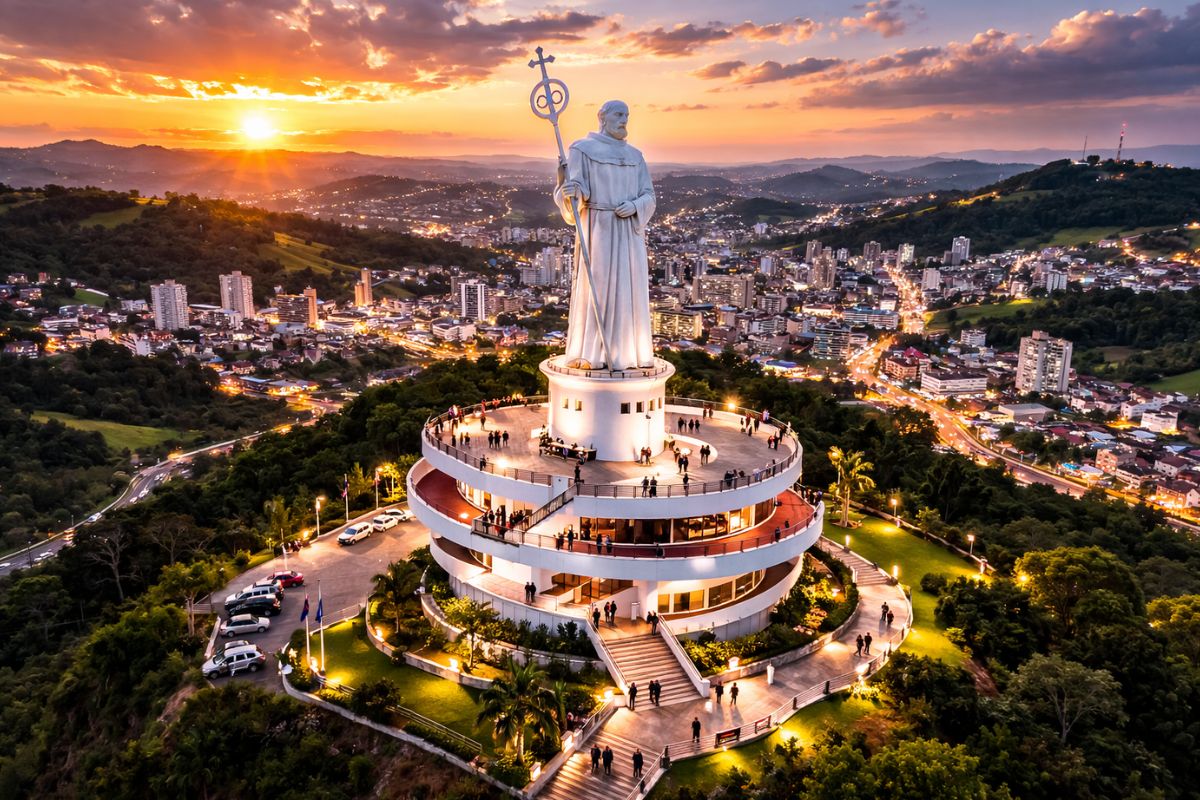
From The Top Of Panoramic Hill, The 37-Meter Giant Of The Frei Bruno Monument Appears In Neighborhoods Of Joaçaba And Also Of Herval D’Oeste, In The Midwest Of Santa Catarina. Inaugurated In 2008, The Complex Brings Together A Viewpoint, Museum And Free Visitation, With Asphalt Access For Residents And Tourists On This Hill.
The 37-meter giant on Panoramic Hill has become a kind of everyday compass in the Midwest of Santa Catarina. On clear days, the Frei Bruno Monument guides the landscape and serves as a visual reference for those traveling through Joaçaba and Herval d’Oeste.
The strength of this image lies not only in faith. More Than A Sculpture, It Has Become An Emotional Map, with a viewpoint, museum, and free visitation since 2008, at a high point that offers a view of the Rio do Peixe valley and connects the two cities.
When A High Point Becomes A Reference For An Entire City

At the top of Panoramic Hill, the 37-meter giant stands out because it answers a simple question that every resident subconsciously asks: Where Am I, Where Am I Going, Which Way Is Joaçaba And Which Way Is Herval D’Oeste?
-
Friends have been building a small “town” for 30 years to grow old together, with compact houses, a common area, nature surrounding it, and a collective life project designed for friendship, coexistence, and simplicity.

-
This small town in Germany created its own currency 24 years ago, today it circulates millions per year, is accepted in over 300 stores, and the German government allowed all of this to happen under one condition.

-
Curitiba is shrinking and is expected to lose 97,000 residents by 2050, while inland cities in Paraná such as Sarandi, Araucária, and Toledo are experiencing accelerated growth that is changing the entire state’s map.

-
Tourists were poisoned on Everest in a million-dollar fraud scheme involving helicopters that diverted over $19 million and shocked international authorities.


The Frei Bruno Monument fulfills this role without needing a sign.
The visibility enhances the effect.
From various neighborhoods in Joaçaba and Herval d’Oeste, the statue appears as a silhouette on the horizon, especially in the late afternoon when the light fades, leaving the outline more pronounced.
At this point, tourism is born almost by accident, because the landscape already extends the invitation.
The Numbers Behind The 37-Meter Giant That Looks Like A Building

The Frei Bruno Monument reaches 37 meters in height when the base is added to the body of the statue.
The figure of the religious figure alone measures about 20 meters and weighs approximately 2.5 tons, a set equivalent, by scale perception, to a building of more than 10 floors.
37 Meters Is Not Just Height, It’s Presence.
This dimension explains why the 37-meter giant has become a recurring backdrop for photos and family visits.
From the viewpoint, the reading of the territory changes: the urban layout of Joaçaba and Herval d’Oeste appears all at once, along with the green areas that surround the Rio do Peixe valley.
From Styrofoam To Fiberglass, The Choice Of Technique To Grow Without Collapsing
There’s a technical detail that often goes unnoticed on the first visit, but supports the size of the Frei Bruno Monument.
The structure was initially molded in styrofoam by the plastic artist Cláudio Silva and then coated in fiberglass, a solution that allows for a large size with structural lightness.
The use of styrofoam as a mold and fiberglass as a coating also helps to understand the finish and durability expected in a piece exposed to the elements on Panoramic Hill.
For the visitor, this appears as a silent surprise: the 37-meter giant looks solid, but the chosen technique was precisely the one that makes the scale possible.
Viewpoint, Museum And Free Visitation On Panoramic Hill
The base that supports the Frei Bruno Monument is a circular building with three floors.
A circular ramp leads to the viewpoint, in a gradual ascent that blends architecture and experience, and gives visitors time to realize how Joaçaba and Herval d’Oeste open up on the horizon.
Visitation to the Frei Bruno Monument and the viewpoint is open to the public at any time, while the Frei Bruno Museum operates from 2 PM to 7 PM.
The access to Panoramic Hill is paved, which facilitates the arrival of residents and tourists and keeps the flow constant even outside of religious dates.
Who Was Frei Bruno And Why His Name Remains On The Streets Of Joaçaba
Frei Bruno was born as Humberto Linden Jr. in Düsseldorf, Germany, on September 8, 1876.
While still young, he joined the Order of Franciscans and came to Brazil, where he developed pastoral work that would later place him in the everyday life of Joaçaba.
He arrived in Joaçaba in 1956, already elderly and in fragile health, and even so became a well-known figure for his daily walks.
He walked up and down hills on foot, visited families, blessed houses, heard confessions and paid special attention to the poor, sick, children, and inmates, with an umbrella that became his trademark.
The Devotion That Crosses Generations And Fills February In The Midwest
Frei Bruno died on February 26, 1960, and the funeral gathered thousands of people, considered the largest ever held in Joaçaba until then.
After that, reports of graces attributed to the intercession of the friar began to spread, reinforcing popular devotion and establishing the Frei Bruno Monument as a symbol.
The name spread across schools, hospitals, neighborhoods, and gyms in the region, and the Frei Bruno Penitential Pilgrimage, started in 1987, takes place in February.
The walk brings together thousands of faithful who ascend Panoramic Hill in prayer, and the 37-meter giant becomes the stage for one of the main religious manifestations in the Midwest of Santa Catarina.
Between Tourism And Identity, What The 37-Meter Giant Changed In Daily Life
Over time, the Frei Bruno Monument ceased to be merely an architectural tribute and began to integrate regional identity.
For those who live in Joaçaba and Herval d’Oeste, the image at the top of Panoramic Hill works as an everyday reference, a landmark that comes into the path to school, work, and conversations about the city.
For newcomers, the effect is twofold: panoramic view and historical curiosity.
The 37-Meter Giant Becomes A Stop In Passing And Also An Excuse To Return, whether for the viewpoint, the Frei Bruno Museum, or for how the place blends landscape and devotion without requiring a fixed itinerary.
At the top of Panoramic Hill, the 37-meter giant of the Frei Bruno Monument remains visible from Joaçaba and Herval d’Oeste, with a viewpoint, museum, and free visitation since 2008.
It Is A Landmark That Organizes The Landscape And Also Preserves Memory, at a high point that has become an urban compass in the Midwest of Santa Catarina.
If you live in the Midwest or have passed through Joaçaba and Herval d’Oeste, at what point does a monument become a true compass in routine, faith, or tourism, and what weighs more for you, the view from the viewpoint or the history in the Frei Bruno Museum?










-

-

-

-

-

-

26 pessoas reagiram a isso.