





 Portuguese
  English
  Spanish
  4 min of reading
  0 comments


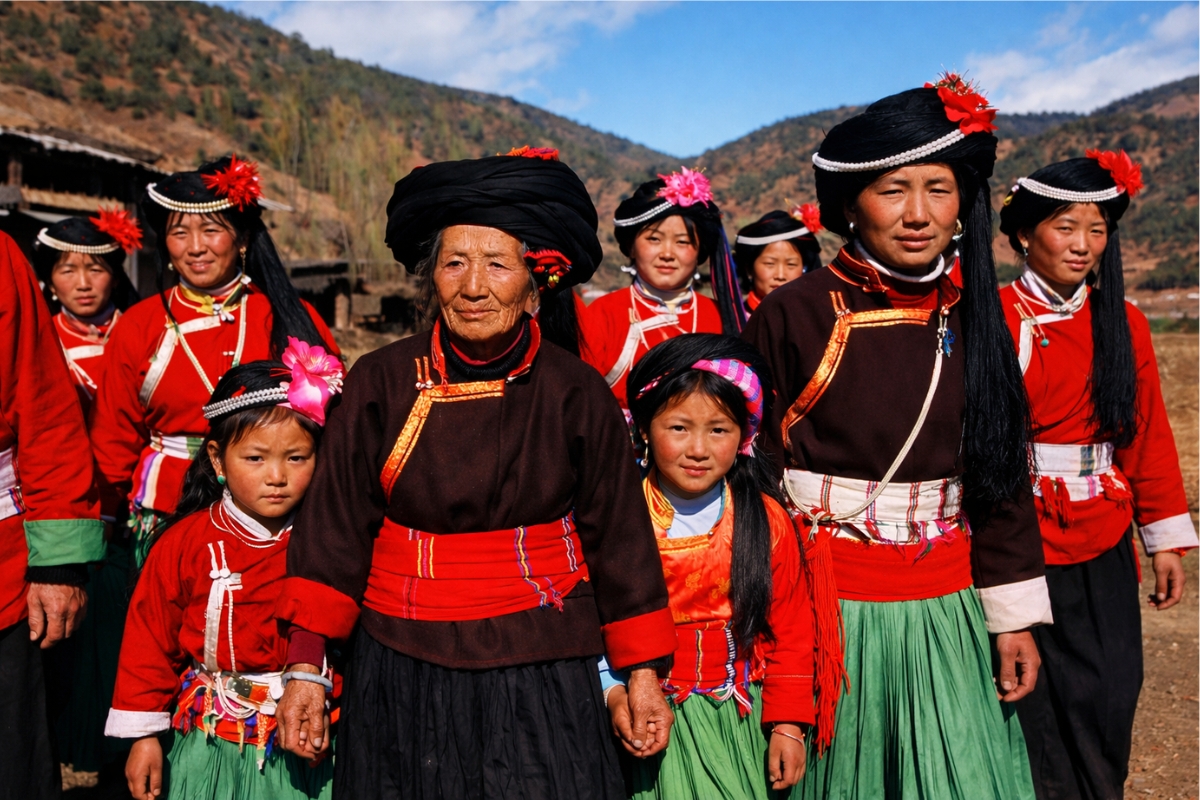
Lugu Lake Preserves for Centuries the Mosuo Culture, Where Female Lineage Defines Heritage, Domestic Leadership, and a Rare Social Organization That Resists Modernization and Tourism in the Mountains of China
In the mountains of southwestern China, Lugu Lake is home to the Mosuo people, a community that has preserved for centuries a social organization based on female lineage. Geographically isolated for generations, the Mosuo have developed their own customs related to inheritance, family structure, affectionate relationships, and spirituality. Today, this ancestral culture faces transformations caused by modernization and the growing presence of tourism in the region.
The Historical Formation of the Mosuo People
The Mosuo people have lived for centuries on the shores of Lugu Lake, located between the Chinese provinces of Sichuan and Yunnan, in a mountainous region situated at approximately 2,700 meters above sea level. The distance from major urban centers and the difficulty of access have contributed to the preservation of rare cultural practices, maintained by generations with little external interference.
Historically organized into villages composed of wooden houses, the Mosuo structured their society around the maternal family nucleus. Extended families gather mothers, children, aunts, brothers, and nephews under the same roof, forming stable units that have ensured cultural continuity over time.
-
Friends have been building a small “town” for 30 years to grow old together, with compact houses, a common area, nature surrounding it, and a collective life project designed for friendship, coexistence, and simplicity.

-
This small town in Germany created its own currency 24 years ago, today it circulates millions per year, is accepted in over 300 stores, and the German government allowed all of this to happen under one condition.

-
Curitiba is shrinking and is expected to lose 97,000 residents by 2050, while inland cities in Paraná such as Sarandi, Araucária, and Toledo are experiencing accelerated growth that is changing the entire state’s map.

-
Tourists were poisoned on Everest in a million-dollar fraud scheme involving helicopters that diverted over $19 million and shocked international authorities.


Social Organization Based on Female Lineage
The most striking characteristic of Mosuo society is its matrilineal system. In this model, the inheritance of land, houses, and property is passed down from mother to daughter, ensuring women play a central role in the management of family assets.
The eldest woman in the household acts as the leader of the domestic group, making decisions about resources, work, and daily organization. This structure has provided social stability even without the formation of traditional couples or permanent marital units.
Although women exercise authority within the family, men continue to hold important roles in community life and external relations, especially in political and administrative matters.


Affectionate Relationships and Absence of Formal Marriage
Throughout their history, the Mosuo have developed their own model of affectionate relationships, known as walking marriage. In this system, men and women maintain relationships based on mutual consent, without permanent cohabitation or formal marital obligations.
Meetings occur at night, at the woman’s house, and men return to their residences at dawn. When the relationship ends, there are no institutional breakups or property conflicts, as the family structure remains intact in the maternal lineage.
Children born from these relationships remain in their mother’s house and are collectively raised by the maternal family, with siblings and uncles playing fundamental roles in the education and support of the children.
The Historical Role of Men in the Community
Although they do not take direct paternity of their own children, Mosuo men have always had well-defined social roles. Traditionally, they were responsible for activities such as fishing, building houses, transporting goods, and trading in caravans that traveled through neighboring regions.
Furthermore, men take economic and social responsibility for their sisters’ children, strengthening family ties within the matrilineal structure. This model has contributed to social cohesion and an equitable distribution of responsibilities within the community.
Spirituality, Myths, and Cultural Identity
Mosuo spirituality is marked by animistic practices and the veneration of a Mother Goddess, associated with the origin of life and the forces of nature. Over time, these beliefs have coexisted with influences from Tibetan Buddhism, which has been present in the region for centuries.
Among the most well-known myths is the veneration of dogs, based on an ancestral narrative that explains the symbolic exchange of life expectancy between humans and animals. These stories reinforce values of respect, gratitude, and balance with nature.
Despite their distinct cultural identity, the Mosuo are not officially recognized as an independent ethnic group by the Chinese government and are often classified under other ethnicities in official records.
Modernization, Tourism, and Contemporary Challenges
The construction of roads and an airport near Lugu Lake, inaugurated in the mid-2010s, has significantly increased the flow of visitors to the region. Tourism has brought new economic opportunities, with the construction of hotels and services aimed at visitors.
At the same time, the increasing contact with the outside world has caused changes in traditional customs. Young Mosuo have begun to express interest in conventional marriage models and urban lifestyles, influenced by dominant Chinese culture.
A Cultural Heritage in Transition
Currently, the Mosuo people are experiencing a period of transition. While many families maintain ancestral practices, others adopt elements of modernity, seeking to reconcile tradition and new forms of social organization.
Lugu Lake remains a symbol of a unique historical culture, whose social structure challenges predominant models and offers a rare example of cultural diversity preserved over the centuries, even in the face of modernizing pressures. This report from the BBC site shows a bit of this Mosuo culture.
Want to receive more historical and cultural content about traditional peoples and little-known regions of the world? Follow Click Petróleo e Gás and stay informed about stories that transcend time.










-

-

2 pessoas reagiram a isso.