





 Portuguese
  English
  Spanish
 5 min of reading
  8 comments


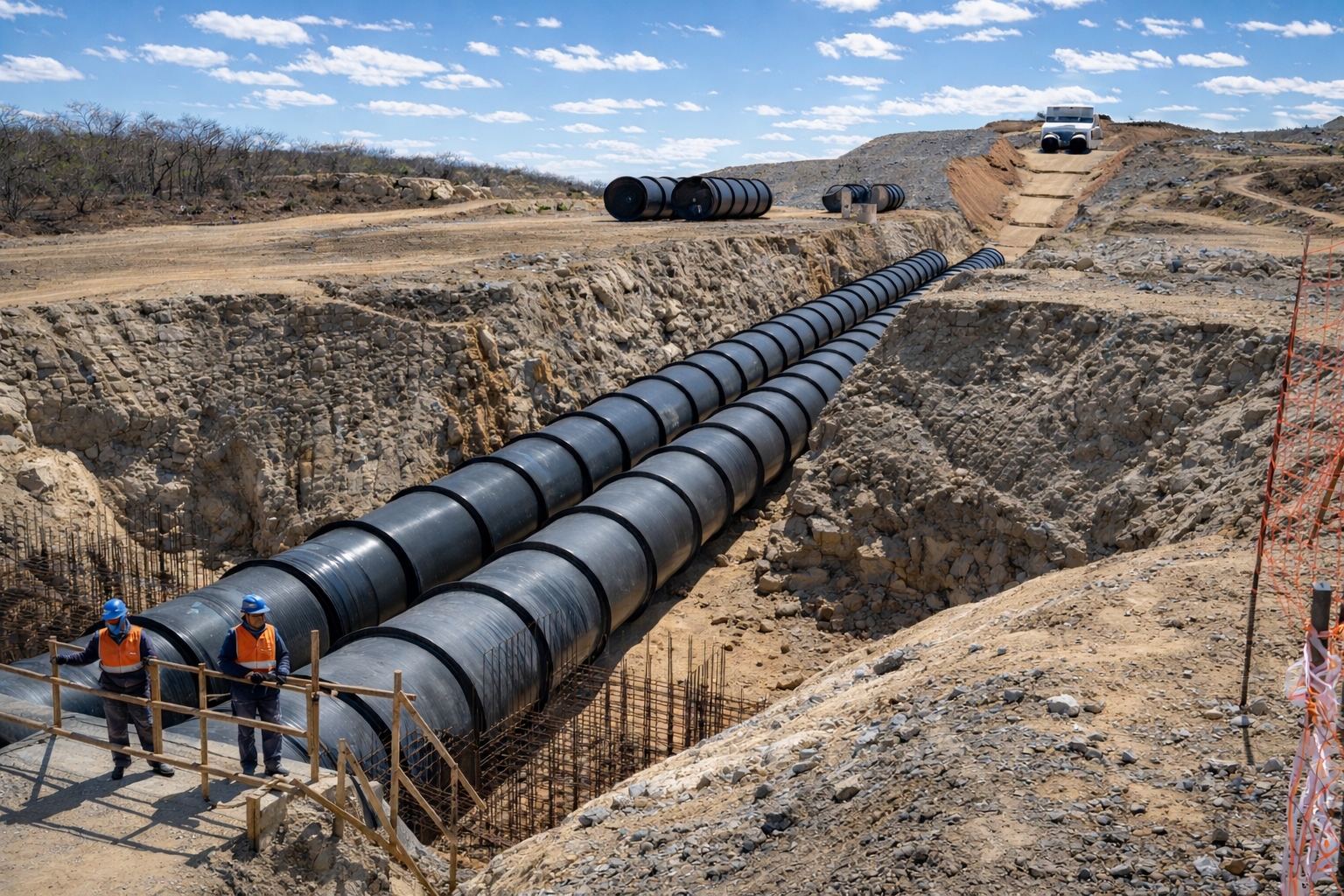


The Great Work of Brazil That Reinforces Billion-Dollar Investment in the Northeast: Understand How the Agreste Branch, Integrated with the World’s Largest Artificial River from the São Francisco River, Represents a Billion-Dollar Investment in Pernambuco and Strengthens the Country’s Water Security.
A project that changes the course of water in Brazil! When it comes to water in the Northeast, it’s not just about infrastructure. It’s about survival, dignity, and development. It is in this context that the Agreste Branch emerges as one of the most strategic stages of the São Francisco River integration project, considered the central axis of the world’s largest artificial river.
In Pernambuco, this initiative represents a true billion-dollar investment that promises to ensure regular supply for over 2.2 million people in 71 municipalities.
The proposal goes beyond just transporting water from one point to another. The goal is to create water stability for a region historically marked by irregular rainfall, boosting economic growth and quality of life.
-
The government requests the Federal Revenue Service for a new system to automate the income tax declaration, reducing errors, time, and bureaucracy for millions of Brazilians.

-
Pix in installments, international Pix, and contactless payment without internet: the Central Bank revealed the new features coming to the tool that is already used by almost every adult in Brazil.

-
Mercado Livre has just started selling medications with delivery in up to three hours to your door, and this move could completely change the way Brazilians buy medicines on a daily basis.

-
In Dubai, rising tensions from the war in the Middle East are causing super-rich individuals to leave the Gulf and direct their fortunes to a new financial refuge in Asia.


Integration with the São Francisco River: The Heart of the World’s Largest Artificial River
The Agreste Branch is connected to the East Axis of the São Francisco River Integration Project (PISF), one of the largest water interventions in the country.
The project is coordinated by the Federal Government, through the current Ministry of Integration and Regional Development (MIDR) — formerly MDR — responsible for conducting structural actions in the Northeast.
According to official information from the Ministry of Integration and Regional Development, the PISF was conceived to reduce the effects of prolonged drought and enhance water security in states such as Pernambuco, Paraíba, Ceará, and Rio Grande do Norte.
In the specific case of the Agreste Branch, water will be drawn from the Barro Branco dam, located in Sertânia (PE), and will flow to the Ipojuca reservoir in Arcoverde (PE).
This route creates a new link within the water engineering that makes up the so-called world’s largest artificial river, structured from the waters of Velho Chico.
A Billion-Dollar Investment to Transform Pernambuco
With estimated resources of approximately R$ 1.6 billion, the Agreste Branch is a project funded by the Federal Government. The amount reinforces the strategic dimension of the project for Pernambuco and the entire Northeast.
The initiative does not operate in isolation. The system will be interconnected with the Agreste Pernambucano Adutor, under the responsibility of the State Government, but with financial support from the Union.
Together, these two projects ensure the regular supply of the region using the waters of the São Francisco River.
According to the National Water and Basic Sanitation Agency (ANA), structural projects like this are essential to reduce climate vulnerabilities and ensure long-term water planning.
Robust Structure: Large-Scale Engineering in the Construction of the Branch
The scale of the construction is impressive. The Agreste Branch has a length of 70.8 kilometers and encompasses a complex set of structures:
- Two reservoirs: Negros and Ipojuca
- Five siphon aqueducts totaling 3.2 km
- One pumping station responsible for lifting water by 219 meters
- Six tunnels totaling 16 km in length
- One aductor with 7 km
- 42 km of concrete-lined canal
This configuration allows water to traverse different types of terrain, overcoming height differences and ensuring controlled flow to the final destination.
The pumping station, for example, plays a crucial role in overcoming the topographical gradient of the region. Without it, gravity distribution would be unfeasible. It is a technical solution that showcases the level of planning involved in the project.
Direct Impact on 2.2 Million People
By benefiting over 2.2 million residents in 71 municipalities, the Agreste Branch strengthens the water supply for human consumption, productive activities, and regional development.
In regions of the Agreste pernambucano, where historically the supply depended on water trucks and seasonal reservoirs, regularizing the supply represents economic and social stability.
According to data from the Brazilian Institute of Geography and Statistics (IBGE), continuous access to treated water is directly related to improving health and income indicators. In other words, water security is also a public policy for development.
Environmental Programs: Responsibility Throughout the Construction
Large projects require environmental responsibility. Therefore, the Agreste Branch implements 17 Environmental Programs simultaneously with its deployment.
These programs were defined based on the Environmental Impact Study (EIA) and the Environmental Impact Report (RIMA), technical instruments that assess risks, impacts, and compensatory measures.
Oversight is conducted by the Pernambuco State Environmental Agency (CPRH), the licensing body for the project. All programs aim to mitigate impacts generated during the construction phase, ensuring a balance between development and environmental preservation.
The programs are organized into three distinct groups, according to technical criteria established during the licensing process.
Northeast More Resilient: Water as a Driver of Development
The Agreste Branch is not just another section within the system of the São Francisco River. It integrates a broader strategy for water security in the Northeast, a region that has historically experienced severe drought cycles.
By connecting reservoirs, tunnels, pumping stations, and concrete channels in a continuous structure, the project reinforces the concept of the world’s largest artificial river, built to redistribute water where it is most needed.
This is a billion-dollar investment that combines heavy engineering, environmental planning, and direct social impact.
The expansion of water security in Pernambuco is a landmark for regional development. But public infrastructure only fulfills its role when society accompanies, oversees, and participates.
What do you think about this project? Do you believe this project will truly transform the reality of the Agreste? Leave your comment and share this content to broaden this discussion.









proyecto brasileño con tubería argentina 🤣
Obrigado Lula!
Obra revolucionária que definitiva transforma a realidade hídrica de um região marcada por fenômenos climáticos que foi determinante para outrora ocorrer o êxodo nordestino, ter hoje essa estrutura para ser alimentada do H²O milhões de pessoas, sem dúvida é um passo gigantesco para se poder investir em ações que vai aquecer a economia efeito do líquido precioso, vai chegar ao fim esse sofrimento secular pela escassez da água, esse projeto faz-se criar uma nova expectativa de abrir portas para investimentos que antes não era possível, além de trazer uma condição confortável a milhões de famílias de poderem ter uma situação confortável para fazer suas necessidades básicas é o governo Lula desmistificando o discurso de uma direita que nunca teve visão holística de desenvolvimento robusto, mas apenas se vivia de paliativos como carros pipas, à tempo aliado desse novo tempo, chega a transnordestina que rasga milhares de quilômetros para também promover um desenvolvimento sobre trilhos na vida de Estado dessa região, só agradecer a Lula seu gesto de ousadia e compromisso nessa luta histórica.