





 Portuguese
  English
  Spanish
  4 min of reading
  1 comment


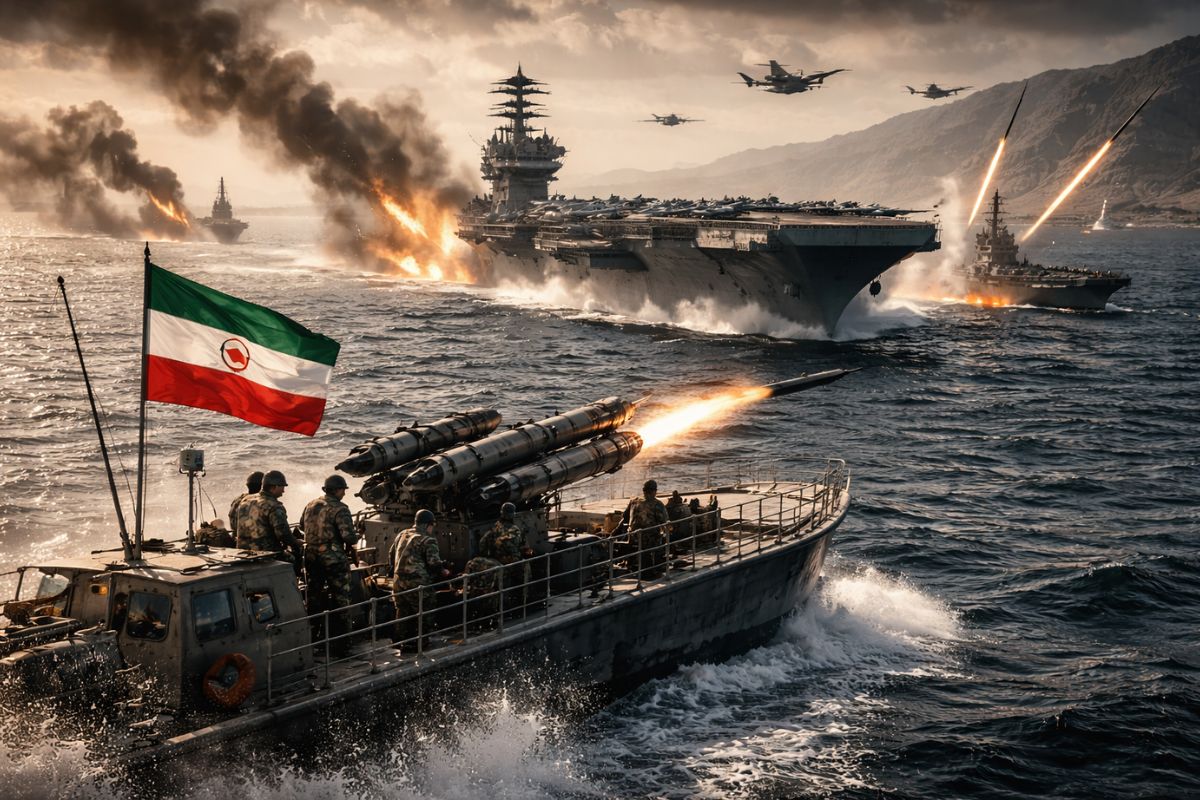


With Sections of the Strait of Hormuz Closed for Exercises, Tehran Raises the Stakes, Talks About Sinking an Aircraft Carrier, and Forces the Region to Assess Real Risks to Oil, While the Islamic Revolutionary Guard Shows Readiness and Mediators Try to Resume Talks in Switzerland Between Today and Tomorrow, Under American Pressure.
At the center of the escalation is the Strait of Hormuz, where Iran announced the closure of parts of the route for a few hours for military exercises led by the Islamic Revolutionary Guard. When a maritime chokepoint becomes an armed training ground, the message is not just technical: it is political, economic, and psychological.
The measure comes at the same time as Iranian officials ramp up their rhetoric, while an American aircraft carrier operates nearby Oman, and mediators seek to reopen diplomatic channels in Switzerland. Between displays of strength and attempts at negotiation, the region enters a gray zone where any misreading could be costly.
What It Means to Close Parts of the Strait of Hormuz for a Few Hours

The temporary closure of sections of the Strait of Hormuz, even for a few hours, holds a symbolic value disproportionate to its duration.
-
Friends have been building a small “town” for 30 years to grow old together, with compact houses, a common area, nature surrounding it, and a collective life project designed for friendship, coexistence, and simplicity.

-
This small town in Germany created its own currency 24 years ago, today it circulates millions per year, is accepted in over 300 stores, and the German government allowed all of this to happen under one condition.

-
Curitiba is shrinking and is expected to lose 97,000 residents by 2050, while inland cities in Paraná such as Sarandi, Araucária, and Toledo are experiencing accelerated growth that is changing the entire state’s map.

-
Tourists were poisoned on Everest in a million-dollar fraud scheme involving helicopters that diverted over $19 million and shocked international authorities.


Iran signals that it is capable of influencing the flow of traffic through one of the most critical energy transport routes, through which almost 30% of all the world’s oil passes, according to the very context presented alongside the announcement.
For the Islamic Revolutionary Guard, exercises in the Strait of Hormuz serve as a readiness test and a showcase of capability.
It’s not just about training: it’s about showing that control can be activated whenever Tehran wants, in a corridor through which thousands of oil vessels pass daily, with an immediate impact on risk perception.
Tehran’s Rhetoric, Threat to the Aircraft Carrier, and Calculated Escalation
The Iranian decision to close parts of the Strait of Hormuz was accompanied by statements that push the debate into the realm of the unpredictable.
Iranian leader Ali Khamenei, in a speech, stated that President Donald Trump will not succeed in toppling the Islamic Republic and suggested that even the world’s most powerful army can fail, referring to the United States.
In the same rhetorical package, there was a threat to sink an American aircraft carrier operating near Iran, without specifying when or how this could happen.
When the word sink enters the public conversation, the margin for interpretation decreases, and every move in the Strait of Hormuz begins to be interpreted as a rehearsal, warning, or test of nerves.
Why the Aircraft Carrier Near Oman Becomes the Most Visible Tension Point
The presence of the aircraft carrier Abraham Lincoln near Oman, and consequently Iran, is viewed as a signal that Washington wants to keep military options open.
The very debate surrounding the Strait of Hormuz often draws warships to the region, as any crisis there has the potential to affect trade and energy, in addition to putting pressure on insurers, freight, and supply chains.
From the perspective of neighboring countries, the problem is that an aircraft carrier, exercises by the Islamic Revolutionary Guard, and the closure of the Strait of Hormuz create an explosive combination of capability and intent, even when no one declares war.
It is in this mixture that the gray zone arises: escalation happens without formal announcement, and risk settles in the details, on the radar, and in the calendar.
Switzerland as a Negotiation Table and What Is Still in Dispute
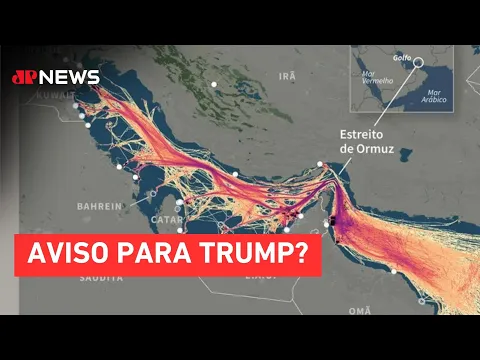

As rhetoric rises, Iranian and U.S. mediators are meeting in Switzerland today and tomorrow to discuss the possibility of a new nuclear agreement.
The declared goal of President Donald Trump, in the reading presented, is to prevent the crisis from needing to be resolved through military measures, which makes Switzerland a stage for attempts at de-escalation at a moment when the Strait of Hormuz is in the spotlight.
Nevertheless, Switzerland does not offer an automatic solution, as the agendas compete. Prime Minister Benjamin Netanyahu has requested that Iran’s missile program also be included in the discussions, but the Iranian stance described is that this point is non-negotiable for its national security.
When what is non-negotiable takes center stage, diplomacy becomes a battle over limits, and every hour of closure of the Strait of Hormuz carries weight beyond just an exercise.
The Strait of Hormuz has become a litmus test for a dispute that mixes military demonstration, intimidation language, and attempts to return to negotiations in Switzerland.
Between the Islamic Revolutionary Guard testing readiness and an aircraft carrier operating near Iran, the resulting scenario is not black and white, but rather a spectrum of risk that the global economy observes and calculates.
I Want to Hear Your Concrete Thoughts: If you were in charge of a company that relies on this route, what would be your limit for considering the closure of the Strait of Hormuz a warning rather than a step toward confrontation? And, in your view, what should weigh more on the table in Switzerland: the nuclear issue, the missiles, or the safety of maritime traffic?










Mais um mico pra coleção do TRump