





 Portuguese
  English
  Spanish
  3 min of reading
  0 comments


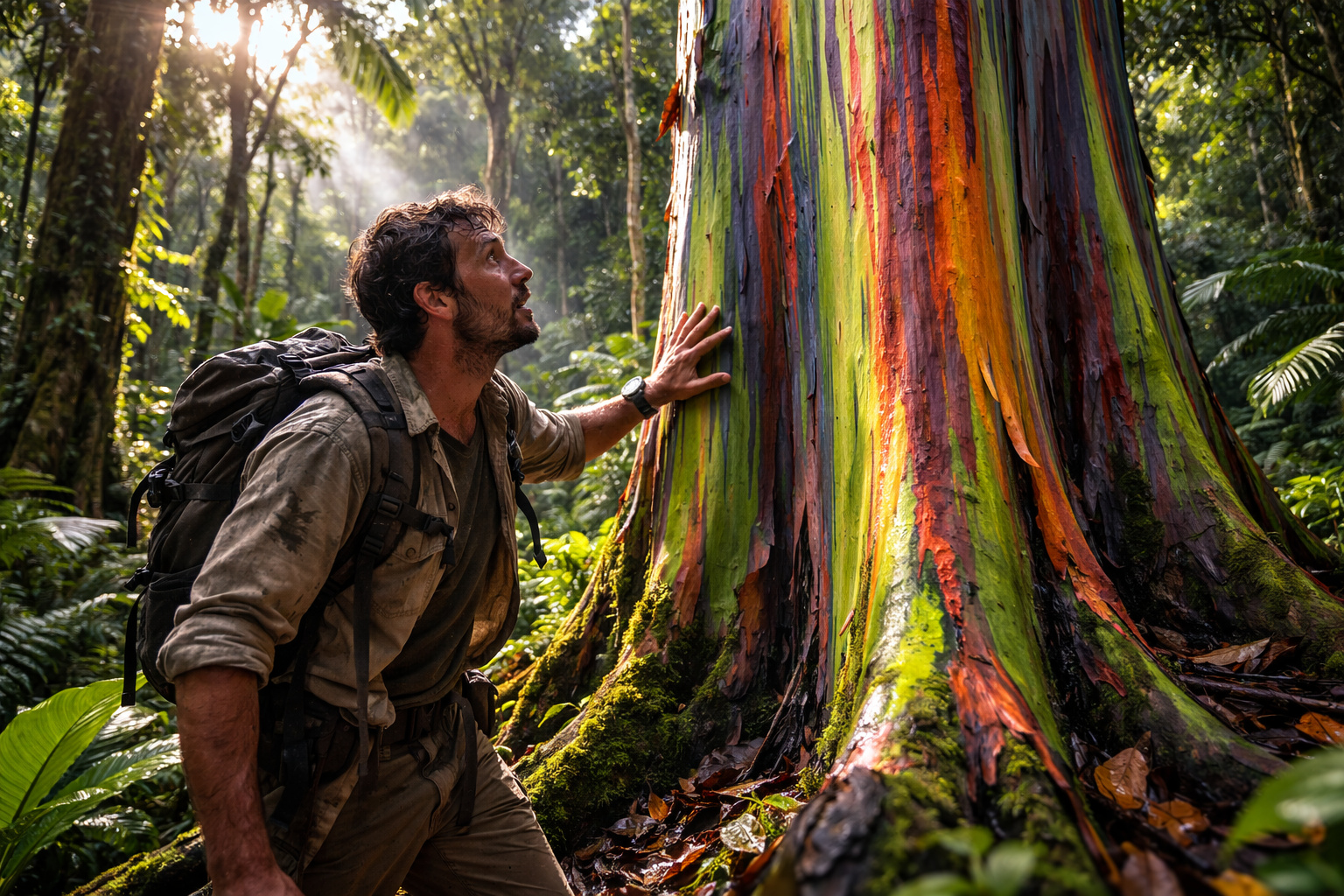
Tropical Species Impresses With Its Colorful Trunk, Has Industrial Use, and Faces Threats According to the International Union for Conservation of Nature
A forest species captures attention amidst skepticism about images on the internet. Furthermore, the rainbow eucalyptus, or Eucalyptus deglupta, exists entirely in nature. Therefore, its multicolored trunk is not a result of artificial intelligence.
Native to the Philippines, Indonesia, and Papua New Guinea, the species was recorded in botanical studies in the 20th century. Subsequently, it was planted in regions with similar climates, such as Hawaii, Southern California, and Florida. This way, it expanded its presence in tropical areas.
In favorable conditions, it can reach up to 80 meters in height. Additionally, it grows rapidly in warm, humid environments. Thus, it has become relevant both environmentally and economically.
-
Motorola launched the Signature with a gold seal from DxOMark, tying with the iPhone 17 Pro in camera performance, Snapdragon 8 Gen 5 that surpassed 3 million in benchmarks, and a zoom that impresses even at night.

-
Satellites reveal beneath the Sahara a giant river buried for thousands of kilometers: study shows that the largest hot desert on the planet was once traversed by a river system comparable to the largest on Earth.

-
Scientists have captured something never seen in space: newly born stars are creating gigantic rings of light a thousand times larger than the distance between the Earth and the Sun, and this changes everything we knew about stellar birth.

-
Geologists find traces of a continent that disappeared 155 million years ago after separating from Australia and reveal that it did not sink, but broke into fragments scattered across Southeast Asia.

Despite its beauty, it is classified as vulnerable to extinction. According to the International Union for Conservation of Nature (IUCN), overexploitation threatens the species. Therefore, conservation has become a priority.
Botanical Investigation Explains the Multicolored Trunk
The main highlight is the trunk with green, blue, purple, red, and orange stripes. This appearance, although it seems artificial, is entirely natural. Hence, it is a continuous biological process.

Unlike trees that accumulate thick bark, the rainbow eucalyptus sheds its outer layer in thin strips. As the brown bark comes off, a light green surface emerges. Consequently, the color transformation begins.
The newly exposed part contains chlorophyll, essential for photosynthesis. Later, contact with air triggers natural chemical reactions. Additionally, tannins form, which protect against fungi.
As the tannins mature, green evolves into blue or purple. Then, reddish and golden hues appear. Finally, the trunk returns to brown, and the cycle restarts.
Although the phenomenon is known, there are still few detailed studies. Nevertheless, the renewal of the bark is the most accepted explanation. Thus, science continues to investigate the process.
Economic Importance and Industrial Use
In addition to its unique appearance, the species has economic applications. Its wood is used in furniture, flooring, and construction structures. Thus, it integrates industrial production chains.
It is also a raw material for pulp and white paper. However, after processing, the colors disappear. Therefore, the commercial value lies in the material’s durability.
Vulnerability and Conservation
According to the International Union for Conservation of Nature, overexploitation threatens the species’ continuity. For this reason, it has been classified as vulnerable. Thus, preservation has become essential.
On the other hand, ornamental cultivation can help with conservation. Furthermore, responsible management reduces environmental impacts. Thus, the rainbow eucalyptus continues to impress and reinforce the importance of sustainable use of natural resources.
In light of this scenario, should the priority be to expand ornamental cultivation or reinforce protection measures against overexploitation to ensure the survival of this unique species?








-

-

5 pessoas reagiram a isso.