





 Portuguese
  English
  Spanish
  4 min of reading
  0 comments


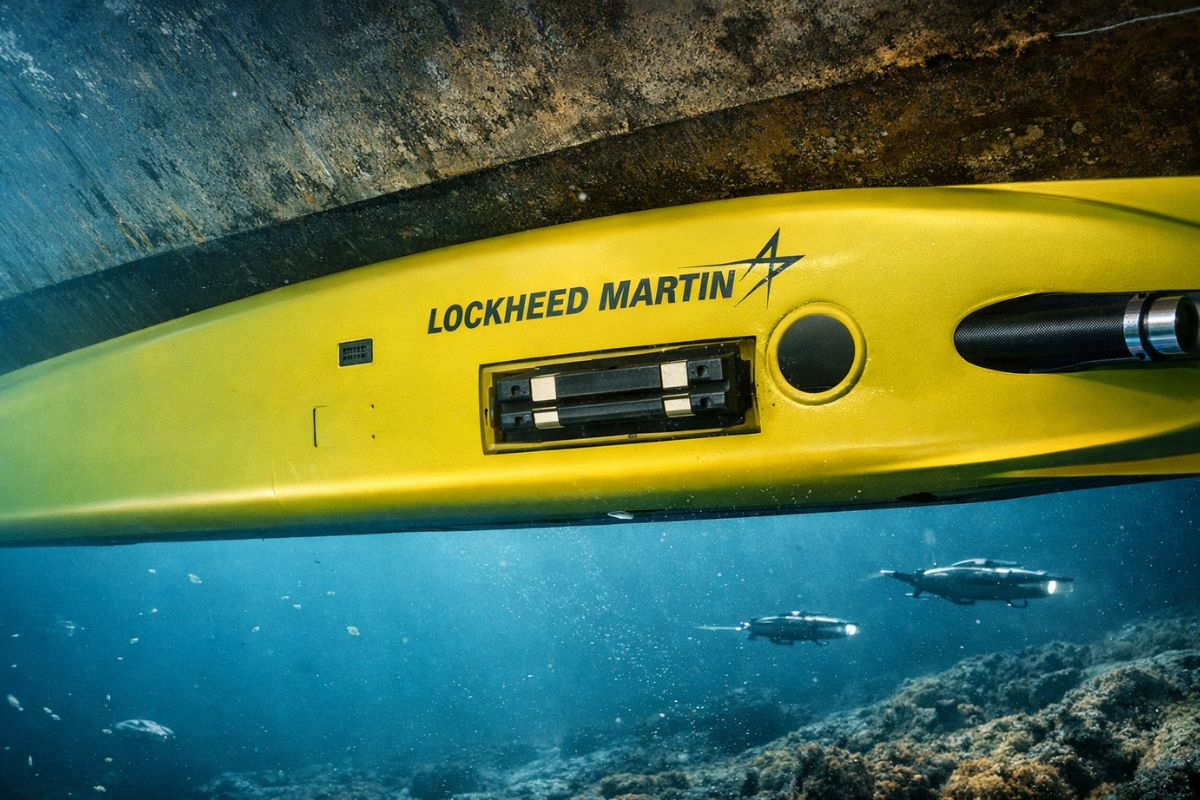
Lockheed Martin’s Lamprey Drone Latches onto Ships Like a Lamprey, Recharges Batteries in Motion, Operates Stealthily on the Ocean Floor, Launches Torpedoes and Aerial Drones, and Consolidates Various War Functions into a Single System.
The lamprey has survived for hundreds of millions of years with a simple and brutal strategy: cling to prey and siphon its energy. Now, Lockheed Martin has taken this idea to underwater warfare by creating the Lamprey Multi Mission Autonomous Undersea Vehicle, a submarine drone that literally latches onto allied ships and submarines, recharges its batteries hidden away, and detaches when it needs to attack.
This drone, just over 7 meters long, has been designed to consolidate in one artifact functions that previously required multiple different platforms. The Lamprey combines surveillance, anti-submarine warfare, strike, and aerial reconnaissance, operating with a high degree of autonomy, in swarms, and with the ability to deceive enemy defenses while hiding on the ocean floor.
How the Lamprey Drone Latches onto Ships and Recharges Hidden
The heart of the proposal is how the drone integrates with friendly vessels. The Lamprey can travel attached to an allied ship or submarine using a coupling system inspired by how a lamprey latches onto the body of its prey.
-
Motorola launched the Signature with a gold seal from DxOMark, tying with the iPhone 17 Pro in camera performance, Snapdragon 8 Gen 5 that surpassed 3 million in benchmarks, and a zoom that impresses even at night.

-
Satellites reveal beneath the Sahara a giant river buried for thousands of kilometers: study shows that the largest hot desert on the planet was once traversed by a river system comparable to the largest on Earth.

-
Scientists have captured something never seen in space: newly born stars are creating gigantic rings of light a thousand times larger than the distance between the Earth and the Sun, and this changes everything we knew about stellar birth.

-
Geologists find traces of a continent that disappeared 155 million years ago after separating from Australia and reveal that it did not sink, but broke into fragments scattered across Southeast Asia.

As it remains glued to the host vessel, the drone takes advantage of the movement and water flow to power its embedded hydro-generator, recharging its batteries unobtrusively.
This turns the ship into a mobile base, allowing the Lamprey to cover long distances without depleting its own charge and to detach only when the mission requires a discreet presence or direct action.
Submarine Drone Focused on Underwater Covert Missions

Once released from the vessel, the Lamprey takes on the role of a stealth submarine drone for covert missions.
It can remain on the ocean floor monitoring enemy movements, exploring the environment, and collecting information without being easily detected.
The secret lies in an acoustic signature profile designed to make it virtually invisible to sonar. While other means can be easily identified by submarine listening systems, the Lamprey drone is designed to blend in with the background noise of the ocean, increasing the chance of approaching targets without being noticed.
Torpedoes, Decoys, and Aerial Drones in the Same Drone
The Lamprey is not just a silent sensor. When it’s time to act, this drone transforms into a strike and deception platform. Among the described capabilities are:
- Launching decoys to confuse and saturate adversary detection systems
- Employing anti-submarine torpedoes against high-value targets
- Ability to, when surfacing, launch aerial drones for reconnaissance missions
This means that a single submarine drone can fire a torpedo from the ocean floor, release decoys to camouflage its origin, and still assist aerial operations with drones launched from the surface.
Instead of relying on several specialized vehicles, the naval force now has a versatile system that detects, deceives, and strikes on its own.
Swarm Operations and Autonomous Combat Decisions
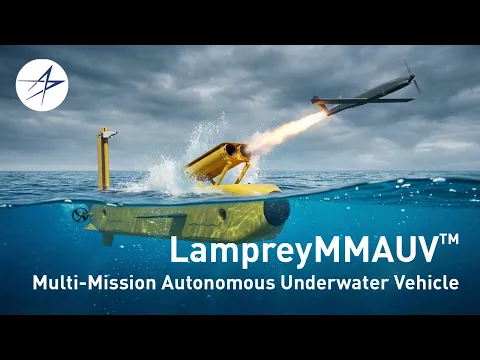

Another notable point is how the drone integrates with other unmanned systems. The Lamprey is designed to operate in swarms, coordinating with other autonomous vehicles to cover large areas, share information, and conduct combined actions.
Moreover, Lockheed highlights the high degree of autonomy: the Lamprey drone can make decisions without direct human intervention, assessing the environment, responding to threats, launching decoys, repositioning, and, in certain scenarios, executing attacks with torpedoes on its own, within pre-configured mission parameters.
Lamprey vs. Other U.S. Submarine Drones
The Lamprey arrives in a scenario where the United States had already bet on other unmanned vehicles, like Boeing’s Orca submarine.
The difference is that that system took years to develop and consumed hundreds of millions of dollars, with no guarantee of becoming a consolidated program within the U.S. Navy.
In the case of the Lamprey, Lockheed informs that the drone’s development was internally financed, without relying on a lengthy contract from the start.
According to the company’s vice president, this approach allowed for much faster iteration and to deliver a truly versatile weapon to the Navy, at a significantly lower cost than traditional manned platforms.
Race for Submarine Drones Between The United States and China
The United States is not the only one investing in this type of submarine drone. China has been developing its own fleet of unmanned vehicles to operate underwater and, at a military parade in 2025, showcased the AJX002, a system ranging from 18 to 20 meters capable of operating autonomously, laying mines, and networking with other attack vectors.
This context helps to understand why submarine drones like the Lamprey are gaining such strategic relevance.
They occupy the space between manned submarines and static mines, with the flexibility to monitor routes, protect fleets, simulate false targets, and strike with torpedoes, always with a lower direct risk to human crews.
Amidst this race for autonomous submarine technology, do you think the use of a drone that independently decides when to deceive and attack on the ocean floor increases fleet security or the risk of uncontrolled conflicts?







-

Uma pessoa reagiu a isso.