





 Portuguese
  English
  Spanish
  7 min of reading
  0 comments


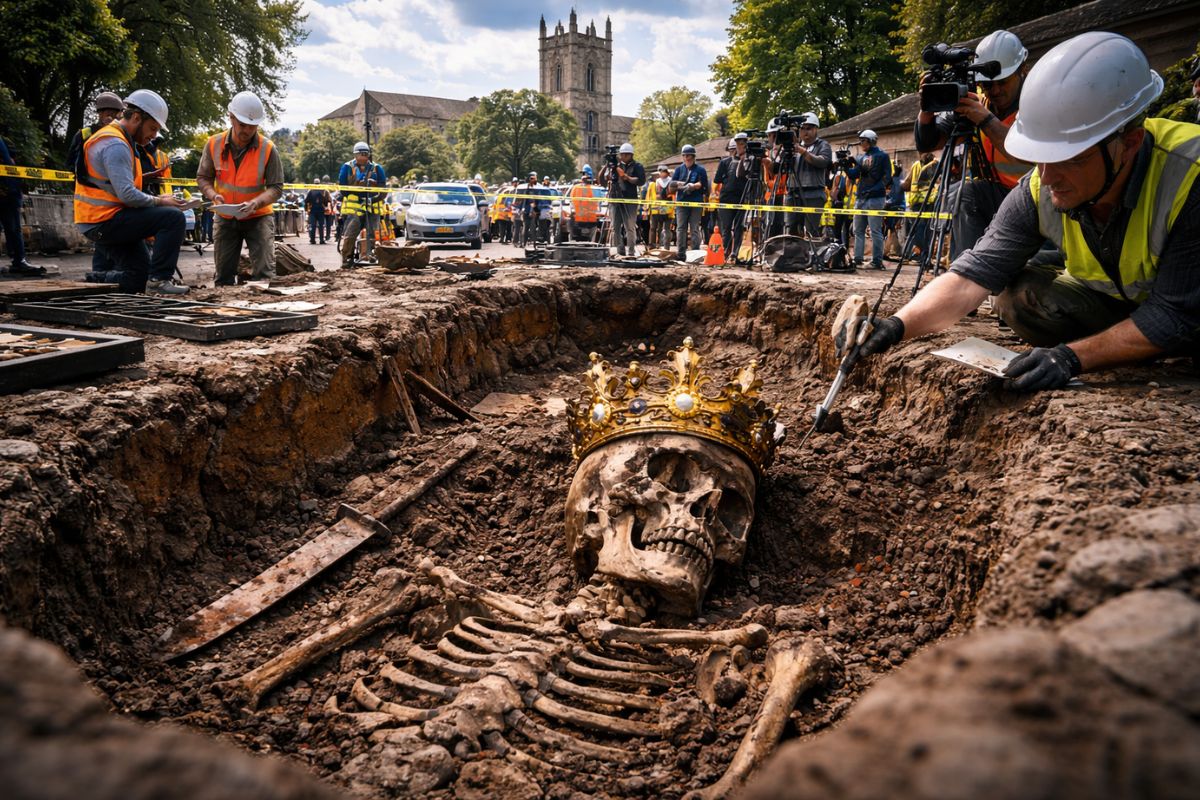
The Story of the Lost King Richard III, Marked by the War of the Roses, Reveals a Brutal Struggle for Power and a Body Forgotten for Centuries Beneath a Simple Parking Lot in England.
A lost king for over five centuries was found in a place no one would imagine: beneath the floor of an urban parking lot in Leicester, United Kingdom. The skeleton, thrown into a simple grave, without a coffin and without honors, bore marks of a violent death in battle and political scars from one of the most turbulent periods in English history.
This discovery, announced on February 4, 2013, by the University of Leicester, revealed that the skeleton beneath the parking lot was not just anyone’s. After detailed studies and DNA tests, researchers concluded that those bones belonged to Richard III, the lost king linked to the War of the Roses, a bloody conflict that reshaped the future of England.
The Lost King Beneath a Common Parking Lot
The scene seems like a movie script: a common city parking lot, cars coming and going, and no one imagining that a lost king of England was buried just below.
-
Friends have been building a small “town” for 30 years to grow old together, with compact houses, a common area, nature surrounding it, and a collective life project designed for friendship, coexistence, and simplicity.

-
This small town in Germany created its own currency 24 years ago, today it circulates millions per year, is accepted in over 300 stores, and the German government allowed all of this to happen under one condition.

-
Curitiba is shrinking and is expected to lose 97,000 residents by 2050, while inland cities in Paraná such as Sarandi, Araucária, and Toledo are experiencing accelerated growth that is changing the entire state’s map.

-
Tourists were poisoned on Everest in a million-dollar fraud scheme involving helicopters that diverted over $19 million and shocked international authorities.


Under the asphalt of the area where a Franciscan monastery once stood, researchers from the University of Leicester began excavations in 2012, guided by historical records indicating that the tomb of Richard III could be there.
Weeks later, they found a skeleton in impressive condition. The body was in a simple grave, without a coffin and without any sign of royal treatment, something completely opposite to what is expected for a monarch.
The spine showed deformities, the skull and back had multiple traumatic wounds, and everything indicated a brutal death in battle, followed by a hasty burial.
Who Was Richard III, The Lost King of the War of the Roses

To understand why this lost king ended up forgotten beneath a parking lot, we need to go back to the time when England was ruled by the powerful Plantagenet family.
This dynasty, one of the longest-lasting in the history of the United Kingdom, was divided into branches, and Richard belonged to the House of York, symbolized by the white rose in the famous War of the Roses.
Richard III was the eleventh of twelve children of Richard, his father. In theory, he never expected to become king, as the throne was meant to pass through many brothers before reaching him. However, the political reality of the time was quite different.
England was experiencing a deep crisis, with power struggles, family rivalries, and the weakening of royal authority.
In this environment, the War of the Roses erupted, putting the House of York and the House of Lancaster in direct confrontation for control of the throne.
The Unlikely Ascent of the Lost King
From an early age, Richard’s life was marked by war. He lost his father and a brother in battles of the War of the Roses, while his second oldest brother ascended to the throne as Edward IV.
From then on, Richard became a loyal ally of that brother, standing by him even when the political situation collapsed and Edward himself was kidnapped by members of his own house.
While many betrayed King Edward IV, Richard stood by his brother and helped regain power, making him the most influential figure in the country after the king himself.
When Edward IV died in 1483, the throne was supposed to pass to his eldest son, only 12 years old, who would be crowned as Edward V.
Richard was appointed a sort of tutor and protector of the young king, but the political struggle surrounding the child opened the way for an even greater crisis.
Legal Coup, The Throne and The Label of Usurper
The widow Elizabeth, mother of the young heir, was trying to pull the future king toward her family’s influence, increasing the tension between rival factions.
Then Richard made an explosive accusation: he claimed that Edward IV had married another woman before, which would make the marriage to Elizabeth invalid and their children illegitimate.
Supported by a pre-contract presented to the bishop and by canon law, the case was taken to Parliament and formalized in the document Titulus Regius.
The outcome was clear: Edward V was declared illegitimate and could not rule. Thus, Richard ceased to be merely the protector of the throne and was crowned as Richard III at the age of 30, consolidating an ascent that had seemed impossible until recently.
This maneuver, although based on legal arguments of the time, fed the image of Richard as a usurping king, a label that would strengthen with the disappearance of the twin heirs, his nephews, who mysteriously vanished after the coronation.
The Weight of Shadows, The Lost King Becomes the Villain in the Official Narrative
With the disappearance of the princes and the changes in laws and traditions to strengthen his own position, Richard III began to be seen as a suspect and dark figure. The official history, shaped by the victors, began to portray him as a tyrant, cruel and bloodthirsty.
When the Tudor dynasty took power with Henry VII, it was essential to weaken the memory of Richard III to legitimize the new reign.
The image of this lost king was transformed over time into a true historical villain, reinforced even by cultural works.
One of the most striking was the play “Richard III” by William Shakespeare, which presented him as a deformed, conspiratorial character, morally ruined.
Thus, what could have been merely the story of a defeated monarch turned into a struggle for memory, in which the figure of Richard III was buried under layers of political propaganda and theatrical dramatization.
The Fall in Battle and The Fate of The Body of The Lost King


In 1485, after just two years of reign, Richard III faced Henry Tudor in a decisive battle that would change the course of England.
Richard commanded a larger and better-positioned army, but the confrontation became a historic turning point.
Upon realizing that Henry was relatively exposed on the battlefield, Richard decided to make a direct attack to try to eliminate the rival personally, a risky strategy but common among leaders who sought not only to win but to ensure political stability by eliminating the opponent.
The initial onslaught had partial success. Richard’s troops broke through, and for a moment it seemed possible that he would end the conflict with a single blow. But the situation turned against him. Henry’s forces responded with a flanking maneuver, the charge lost control, and in the end, Richard III was killed in combat.
His body was treated with extreme humiliation. According to reports, it was disrespectfully bound, publicly exposed, and hurriedly taken to Leicester, where it ended up thrown into a simple grave.
Without honors, without a monumental tomb, without any mark of greatness – an end that did not match the position he once held.
From Forgotten to Rediscovered The Lost King

With the death of Richard III, the Plantagenet dynasty came to an end and Henry VII began the Tudor dynasty, officially ending the War of the Roses.
But as a new political era began, the body of the former king was being erased from collective memory.
The Franciscan Church of Leicester, where records indicated Richard III had been hastily buried, was demolished in 1545.
In its place, a garden emerged, which was later engulfed by urbanization and became a municipal parking lot. For centuries, no one imagined that that common parking lot hid the skeleton of a lost king.
Only in 2012, when archaeologists decided to excavate the site, did the pieces begin to fall into place. The skeleton found showed spinal deformities, skull and back wounds, and the absence of a coffin, characteristics that matched the violent end of Richard III.
Science, DNA and the Confirmation of The Lost King
The skeleton was taken to the University of Leicester, where it underwent a series of scientific analyses. The decisive stage came with the mitochondrial DNA tests, compared with living descendants of Richard III’s maternal lineage.
The results showed a 99.999 percent probability that this body was indeed that of the former king of England.
From the bones, specialists were able to reconstruct Richard III’s face, providing the public with a more realistic image of how this lost king, often portrayed as monstrous, likely appeared in life.
In 2015, after more than five centuries in an anonymous grave, the remains of the lost king were finally buried with state honors in Leicester Cathedral, concluding one of the most prolonged archaeological searches in British history and, in a way, restoring dignity to a figure that had been crushed by both war and political narrative.
A lost king, buried as an anonymous, rediscovered beneath the asphalt and retold by science and history, few stories intertwine power, propaganda, and archaeology so well.
And you, after learning about the journey of Richard III, the lost king found beneath a parking lot, do you think he was more a victim of the politics of the time or truly the villain that History tried to paint?









-

-

-

8 pessoas reagiram a isso.