





 Portuguese
  English
  Spanish
  3 min of reading
  0 comments


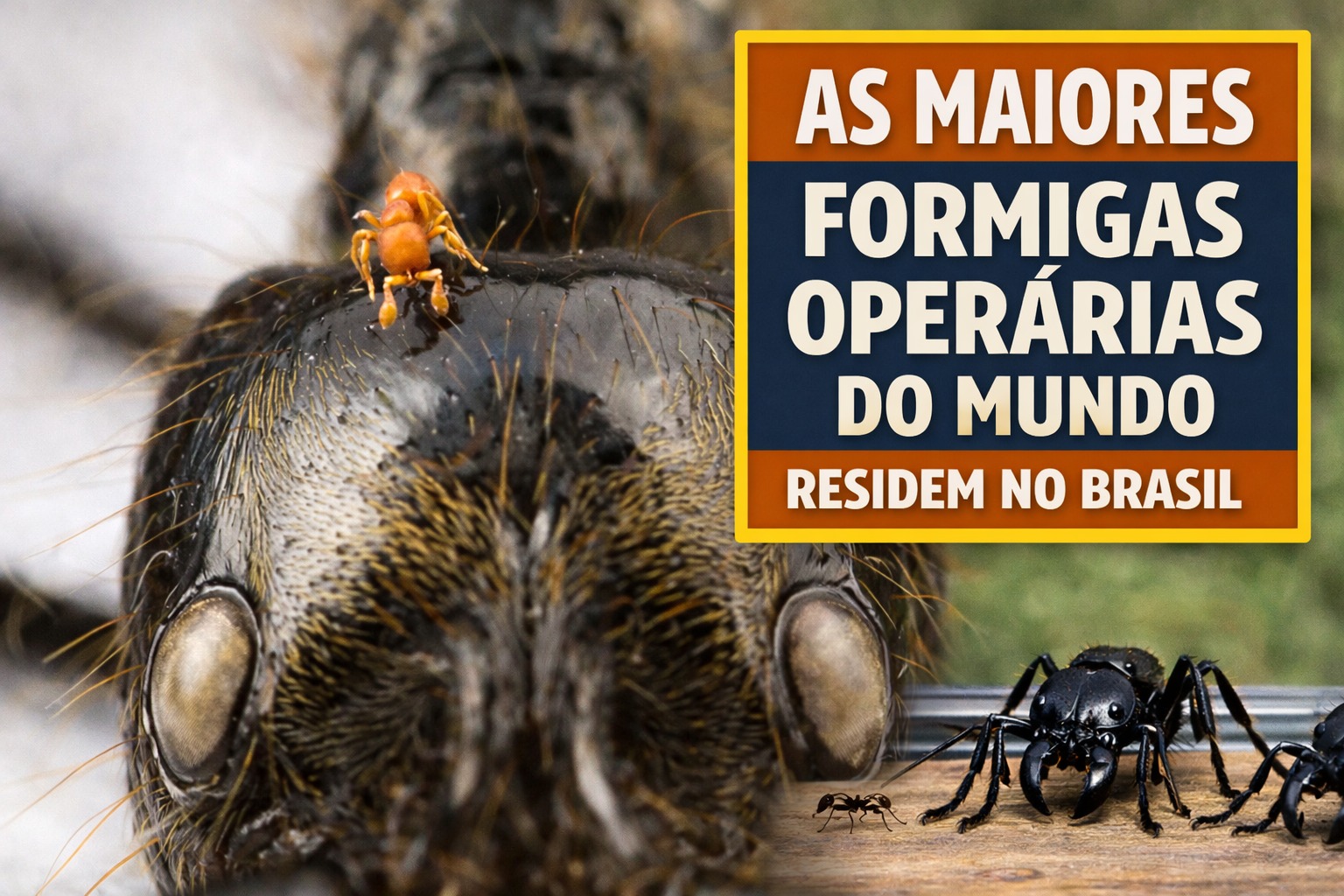
Experts Describe the Genus Dinoponera With South American Distribution, Record Size Among Ants, Four Species Restricted to Brazil, Reproduction Without Winged Queens, Internal Disputes Over Gamergates, and Greater Regional Terrestrial Environmental Vulnerability
The eight species of the genus Dinoponera, known as giant ants or false tocandira, reach nearly four centimeters, occur in South America, have four species exclusive to Brazil, and exhibit reproduction by workers, according to a specialist affiliated with The Ohio State University.
The world’s largest workers belong to the genus Dinoponera and are native to South America, with recorded occurrences in Brazil and other countries on the continent.
With nearly four centimeters, about the size of a pen cap, these ants are commonly referred to as giant ants or false tocandira, as per established taxonomic descriptions.
-
Friends have been building a small “town” for 30 years to grow old together, with compact houses, a common area, nature surrounding it, and a collective life project designed for friendship, coexistence, and simplicity.

-
This small town in Germany created its own currency 24 years ago, today it circulates millions per year, is accepted in over 300 stores, and the German government allowed all of this to happen under one condition.

-
Curitiba is shrinking and is expected to lose 97,000 residents by 2050, while inland cities in Paraná such as Sarandi, Araucária, and Toledo are experiencing accelerated growth that is changing the entire state’s map.

-
Tourists were poisoned on Everest in a million-dollar fraud scheme involving helicopters that diverted over $19 million and shocked international authorities.


The genus comprises exactly eight recognized species, listed as Dinoponera gigantea, Dinoponera grandis, Dinoponera hispida, Dinoponera longipes, Dinoponera lucida, Dinoponera mutica, Dinoponera nicinha, and Dinoponera quadriceps.
According to ant specialist Livia Pires do Prado, a postdoctoral researcher at The Ohio State University, four of these species occur exclusively in Brazil, while the others are also found in other South American countries.
Geographic Distribution and Species Exclusive to Brazil
The species Dinoponera hispida, Dinoponera lucida, Dinoponera nicinha, and Dinoponera quadriceps are considered exclusive to Brazilian territory, according to the current classification.
Dinoponera hispida is found in the Amazon, with records only in the state of Pará, indicating a restricted distribution that is possibly sensitive to environmental changes.
On the other hand, Dinoponera lucida is associated with the Atlantic Forest, occurring in the Northeast and Southeast regions, a biome historically impacted by habitat fragmentation.
Dinoponera nicinha has Amazonian records in the states of Amazonas and Rondônia, while Dinoponera quadriceps has a wide national distribution, except in the Southern region.
Confusion With Tocandira and Sting Potency
The name false tocandira stems from the frequent confusion with the species Paraponera clavata, commonly called tocandira, known for having one of the most painful stings among insects.
Despite this, the stings of Dinoponera species are not as pronounced as those of tocandira, but they are still very painful.
According to the researcher, stings can be potent and, in some cases, cause allergic reactions in sensitive individuals.
Reproduction Without Winged Queens and Internal Disputes
A notable characteristic of giant ants is the absence of a morphological caste of queens, common in most ant species.
In Dinoponera species, reproduction is carried out by the workers themselves, all of whom have reproductive potential within the colony.
The worker that will assume the reproductive role is determined through disputes between individuals, known as a gamergate, according to the myrmecologist.
These disputes involve expressions of aggression and subordination in conflict situations, varying according to the species analyzed.
Giant Ants: Terrestrial Dispersion and Environmental Risks
Another relevant behavior is the absence of wings in queens, which defines a strategy of dispersion exclusively by land.
This limitation reduces the range for founding new colonies and may restrict the geographic distribution of species over time.
As a consequence, the ants are more exposed to threats associated with human interference, such as habitat fragmentation caused by deforestation.
Taxonomic Review and Knowledge Organization
The current information about the genus Dinoponera results from a taxonomic review conducted by Amanda Dias and John Lattke, according to the researcher.
The study described a new species, organized existing knowledge, and corrected previous identifications, enhancing the understanding of these South American giant ants, now considered among the most peculiar in the group.
With information from G1.









-

-

-

-

5 pessoas reagiram a isso.