





 Portuguese
  English
  Spanish
  2 min of reading
  0 comments


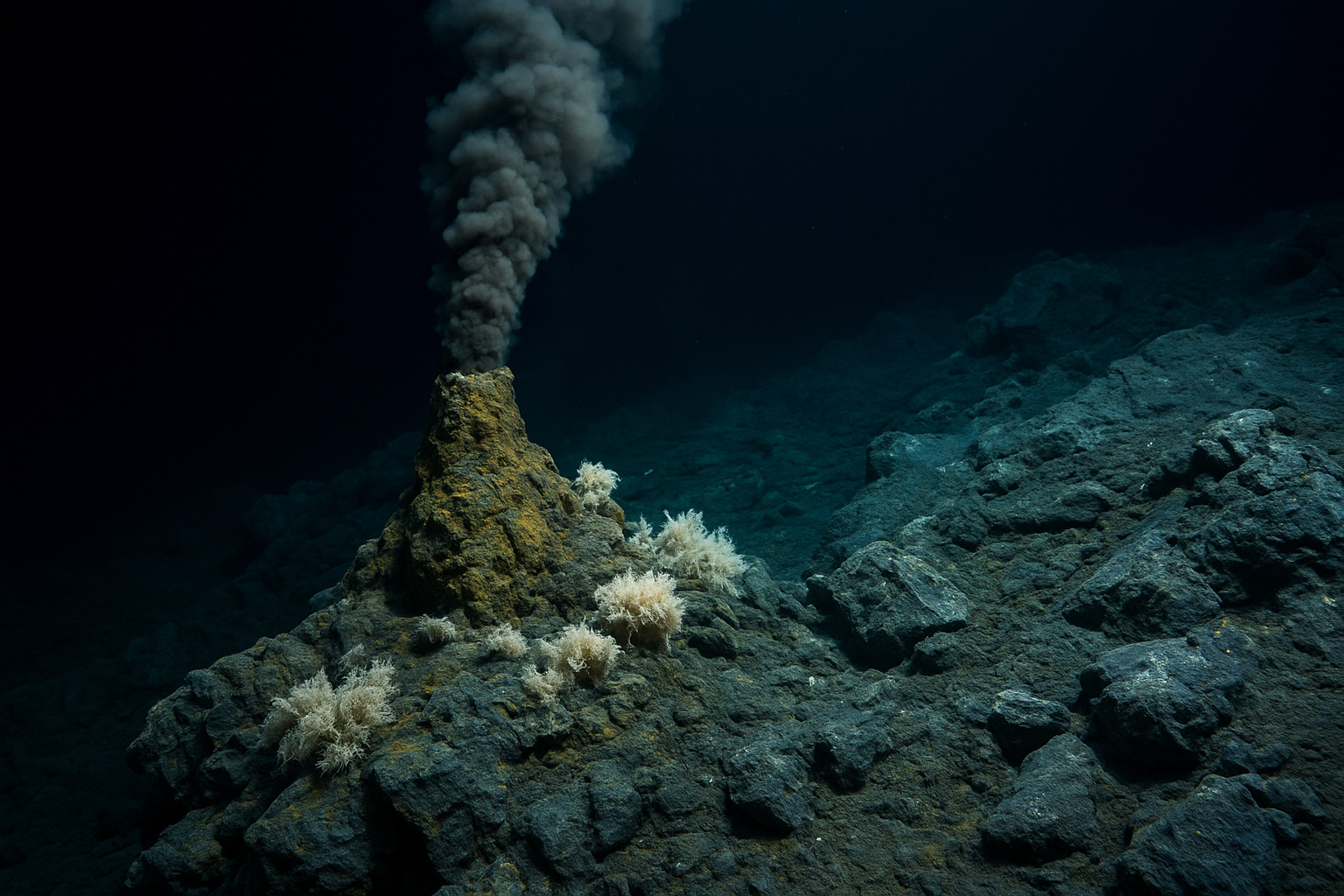
Scientists Describe Active Microbial Life Adapted to Extreme Environments in the Mariana Trench
Researchers revealed an active microbial community in the depths of the Mariana Trench’s forearc, following an expedition conducted in 2022 aboard the German ship R/V Sonne. This extreme environment has consequently become a natural laboratory showing how life adapts to the chemistry generated by serpentinization, a geological phenomenon that transforms rocks into sources of chemical energy. The study, conducted by researchers from the University of Bremen, provided new evidence on how microorganisms utilize methane and hydrogen to survive.
Extreme Environment Favors Microbial Life Adapted to Rock Chemistry
In the deep zones where the Pacific Plate sinks beneath the Philippines, serpentinization releases hydrogen and methane, thereby creating a continuous source of energy. Although this environment has a pH of 12, similar to highly alkaline products, scientists discovered an active subsurface biosphere composed of archaea and extremophile bacteria, as described in the study. With DNA fragmented by the high pH, researchers resorted to lipid biomarker analysis to identify living and extinct organisms.
According to the first author Palash Kumawat from the University of Bremen, preserved lipid molecules differentiate active cells from fossilized communities, which therefore allows for revealing metabolic activities in places with very few living cells. Co-author Florence Schubotz emphasized that life under high pH and low organic carbon concentrations is possible, even in extreme conditions.
-
Motorola launched the Signature with a gold seal from DxOMark, tying with the iPhone 17 Pro in camera performance, Snapdragon 8 Gen 5 that surpassed 3 million in benchmarks, and a zoom that impresses even at night.

-
Satellites reveal beneath the Sahara a giant river buried for thousands of kilometers: study shows that the largest hot desert on the planet was once traversed by a river system comparable to the largest on Earth.

-
Scientists have captured something never seen in space: newly born stars are creating gigantic rings of light a thousand times larger than the distance between the Earth and the Sun, and this changes everything we knew about stellar birth.

-
Geologists find traces of a continent that disappeared 155 million years ago after separating from Australia and reveal that it did not sink, but broke into fragments scattered across Southeast Asia.

Interaction Between Geology and Life Reveals Climatic Role of Microbes
Microorganisms transform carbon compounds and influence greenhouse gases, integrating themselves into a planetary recycling system that has regulated the climate for millions of years. By producing and consuming methane, they function as intermediaries between deep geological processes and surface biogeochemical cycles, enhancing understanding of how life impacts the planet.
Serpentinization Sustains Ecosystem Independent of Solar Light
These communities practice chemosynthesis, extracting energy from chemical reactions between inorganic substances derived from serpentinized rocks, without relying on light. This ecosystem functions as a “planet within another”, demonstrating that life can thrive without photosynthesis. This scenario suggests that similar hostile environments, such as Europa and Enceladus, may also be habitable.
Mariana Arc Functions as Scientific Portal to Earth’s Past
The study positions the forearc of the Mariana Trench as an ideal location to investigate extreme conditions similar to those of early Earth, as it shows how microbes can represent a significant portion of the subsurface biomass. Estimates suggest that these organisms may account for about 15% of the planet’s biomass, highlighting their biological importance.








-

Uma pessoa reagiu a isso.