





 Portuguese
  English
  Spanish
  6 min of reading
  0 comments


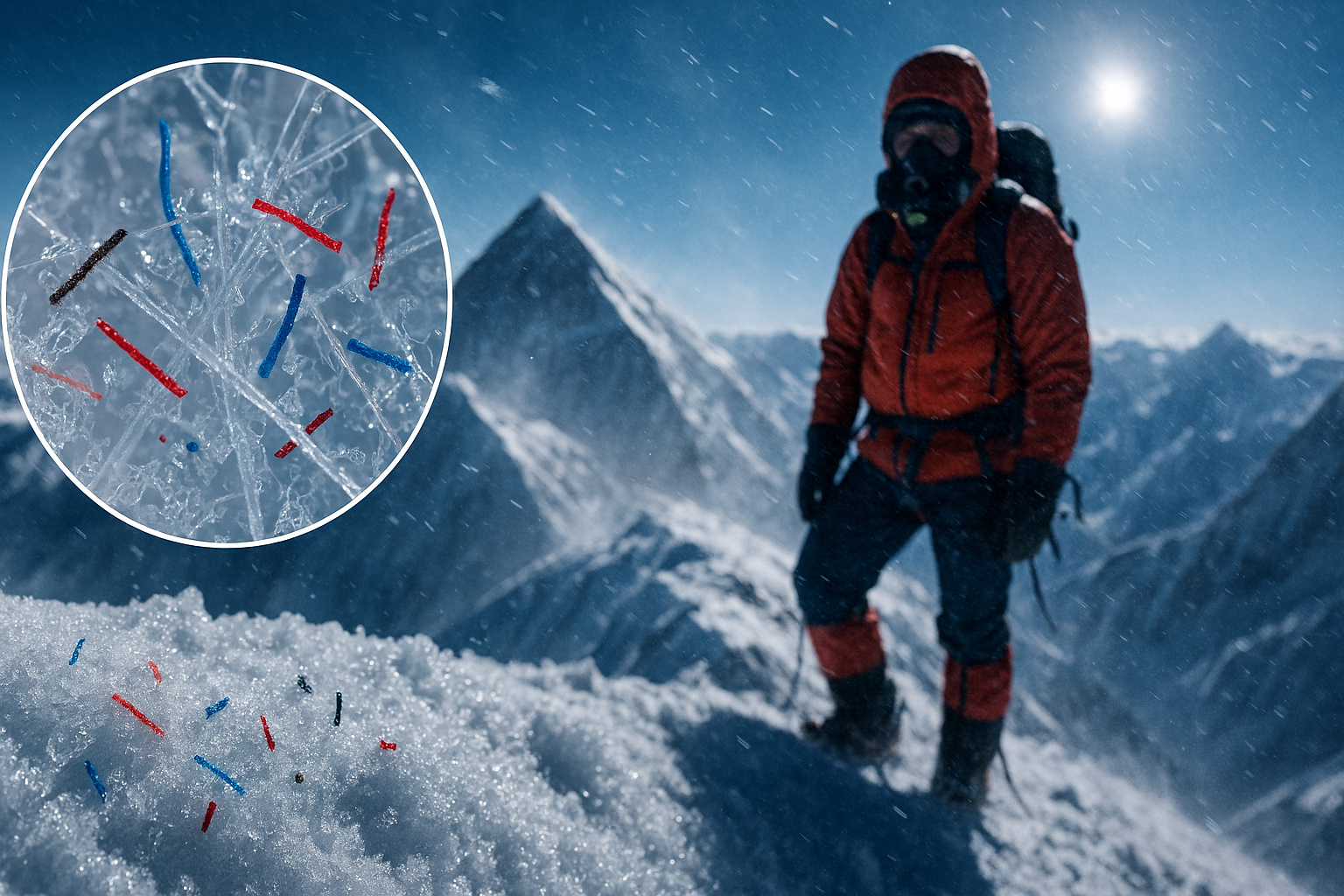
Microplastics Found at 8,440 Meters on Mount Everest, the Highest Point Ever Recorded with Plastic Contamination. Study Reveals Fibers in the Snow from the Summit to Base Camp.
Not even the top of the world is free from plastic contamination. Scientists from the University of Plymouth discovered microplastics in the snow collected at an altitude of 8,440 meters on Mount Everest, just 400 meters below the peak of the highest mountain on the planet. This is the highest point where these particles have been found to date. The discovery occurred in May 2019 during the largest scientific expedition ever conducted on Everest, organized by National Geographic and Rolex. Glaciologist Mariusz Potocki planned to extract ice core samples at the summit, but the crowd of climbers prevented this. Instead, he filled a small stainless steel container with snow at 8,440 meters.
Subsequent analyses revealed a concentration of 12 microplastic fibers per liter of snow at that altitude. But the numbers worsened as the team descended. At Base Camp at 5,364 meters, where expeditions camp for up to 40 days, they found 79 fibers per liter. Every sample collected between Base Camp and the summit was contaminated.
Climbers Are the Main Offenders
Researcher Imogen Napper, a PhD in Marine Science and National Geographic explorer, primarily identified polyester, acrylic, nylon, and polypropylene fibers in the samples. These are materials used in high-performance climbing clothing, tents, and climbing ropes.
-
Friends have been building a small “town” for 30 years to grow old together, with compact houses, a common area, nature surrounding it, and a collective life project designed for friendship, coexistence, and simplicity.

-
This small town in Germany created its own currency 24 years ago, today it circulates millions per year, is accepted in over 300 stores, and the German government allowed all of this to happen under one condition.

-
Curitiba is shrinking and is expected to lose 97,000 residents by 2050, while inland cities in Paraná such as Sarandi, Araucária, and Toledo are experiencing accelerated growth that is changing the entire state’s map.

-
Tourists were poisoned on Everest in a million-dollar fraud scheme involving helicopters that diverted over $19 million and shocked international authorities.

“Honestly, I didn’t know what to expect, but I was very surprised to find these contaminants in every snow sample taken”, Napper stated. The concentrations ranged between 3 and 119 microplastics per liter of snow, depending on the location.

The problem does not come from discarded plastic bottles or food packaging. The climbers’ own clothing is the source. One study found that one gram of synthetic clothing releases 400 microplastic fibers for every 20 minutes of use. A coat weighing almost a kilogram can total a billion fibers per year.
The fibers constantly shed due to friction during use and washing. When climbers wear jackets, pants, gloves, and synthetic socks on Everest, they release invisible particles that settle in the snow. Since there is little heavy rain and melting for most of the year at these extreme altitudes, the fibers accumulate for decades.
Contamination from Ocean to Highest Mountain
“According to our results, microplastic contamination has been found from the ocean floor to near the summit of the highest mountain in the world”, Napper confirmed. Plastic contamination is ubiquitous in the environment. Microplastics have already been detected in the Mariana Trench over 10,000 meters deep in the ocean.
The first confirmed ascent of Everest occurred in 1953, coinciding with the onset of mass plastic production. Sagarmatha National Park, which includes the mountain, saw the number of visitors rise from a few in the 1950s to over 45,000 in 2016. Global plastic production skyrocketed from 5 million tons in 1950 to 330 million in 2020.
Synthetic fibers currently account for 69% of the textile market and are expected to reach 75% by 2030, totaling 101 million tons. Polyester alone contributes to 30% of global textile production due to its low cost and versatility. A single load of laundry can release millions of microfibers.
Advanced treatment plants remove up to 99% of microfibers from the water, but since a load produces millions, the treated water still contains a large number of them. The removed fibers end up in sewage sludge applied to the soil as fertilizer. This means they contaminate both land and water simultaneously.
Threat to the Glaciers that Feed Millions
The presence of microplastics on Everest does not pose an immediate environmental threat according to scientists. However, other findings from the expedition are much more concerning. The highest glaciers in the world are melting at an accelerated pace, losing ice even above 6,000 meters where it should remain frozen year-round.
Since 1962, the Himalaya glaciers have been melting incessantly. They are currently reducing 50% faster compared to the pace from six decades ago. Between 1975 and 2000, they lost an average of 0.25 meters of ice per year. From 2000 onward, the loss accelerated to half a meter annually. Annual losses reach 8 billion tons of water.

The region known as the Third Pole for its vast amount of ice is warming almost twice as fast as the global average. About 800 million people depend on the seasonal runoff from these glaciers for irrigation, hydropower, and drinking water. The Ganges, Mekong, Yangtze, and Yellow Rivers originate there.
Millions of people downstream rely on the Himalayan glaciers for drinking water. When these “water towers” diminish over time, a vital source of fresh water is lost. The accelerated melting initially increases runoff during warm seasons, but scientists project that this will disappear within decades as glaciers lose mass, leading to scarcity.
Microplastics May Contaminate Drinking Water
The microplastics deposited in the Everest glaciers remain frozen as long as temperatures remain below zero. However, as melting accelerates due to global warming, these particles will be released into the meltwater flowing down the mountain, feeding rivers and reservoirs.
Microplastics are already present in drinking water worldwide, in polar ice, in food, in the atmosphere, and in salt. They act like sponges, absorbing other harmful chemicals. They are consumed by wildlife and end up in humans through the food chain.

Research has found microplastics in human organs such as the lungs, liver, spleen, and kidneys. Studies indicate that nylon and polyester fibers may hinder lung recovery and development. Particles found in pregnant rats crossed the placenta, reaching the liver, lungs, heart, kidneys, and brains of the fetuses.
Textile workers processing polyester and nylon fibers experience coughing, shortness of breath, and reduced lung capacity. A study at the University of California indicates that terrestrial environments receive 176,500 tons of synthetic microfibers annually, mostly polyester and nylon.
No Solution in Sight
Despite recent bans on disposable plastics in the Khumbu Valley and advancements in waste collection on the slopes, microplastics are likely to continue accumulating. They are too small to be seen and extremely difficult to eliminate.
Winds can also transport additional microplastics to the mountain. Studies in the Pyrenees mountains at 2,877 meters found one microplastic particle for every 4 cubic meters of air. The free troposphere acts as an ultra-fast means for transporting particles between continents.
“Too small to be seen with the naked eye, microplastics are extremely difficult to eliminate and are often excluded from conversations about waste that typically focus on reducing, reusing, and recycling larger materials,” warns Napper. “Solutions need to achieve deeper technological and innovative advances.”
Paul Mayewski, expedition leader and director of the Climate Change Institute at the University of Maine, summarizes: “It is time to wake up. There are serious repercussions even at high altitudes in the region. The glaciers do not lie.”
The discovery of microplastics at the top of Everest serves as a reminder that plastic pollution has literally reached every corner of the planet. From the deepest ocean floor to the highest peak on Earth, no place remains untouched by human activity.










Seja o primeiro a reagir!