





 Portuguese
  English
  Spanish
  5 min of reading
  0 comments


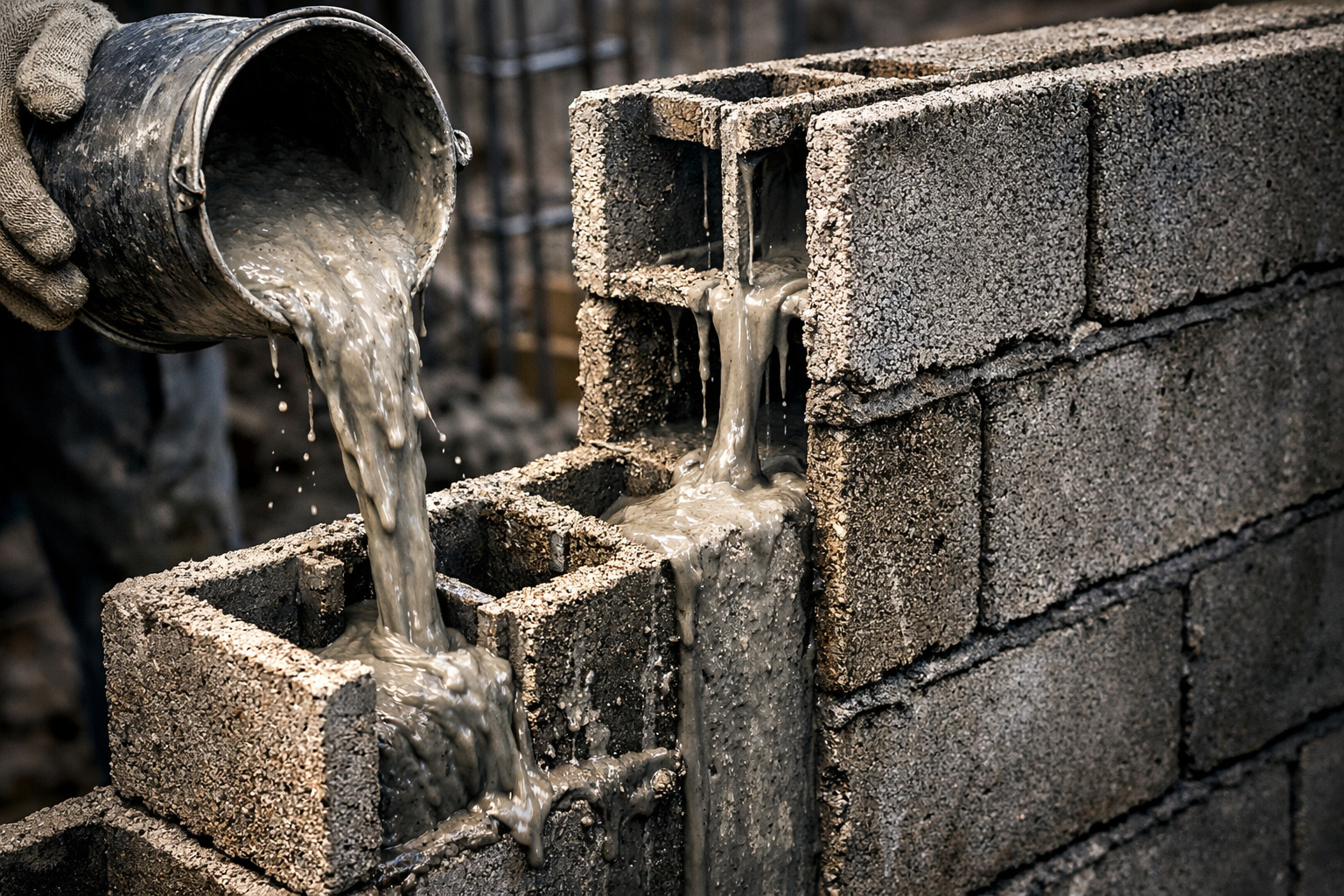
Fluid grout is a micro-concrete used to fill cavities in walls and pillars, reinforcing structures without breaking the concrete and increasing the strength of the construction.
In civil construction, there are materials that often go unnoticed by the public, but play an essential role in the safety and durability of buildings. One such material is grout, a type of extremely fluid micro-concrete developed to penetrate narrow spaces and fill structural cavities. According to technical materials from the construction industry, grout is basically composed of cement, fine sand, aggregates or stone powder, water, and plasticizing additives, which make the mixture much more fluid than conventional mortar. This characteristic allows it to be poured into cavities and confined spaces where traditional concrete cannot reach.
The main function of the material is to fill voids inside masonry blocks, pillars, or structural bases, increasing the strength of the whole and ensuring that all elements work together. Due to this infiltration and complete filling capability, grout is considered one of the most important materials in structural masonry, where the walls are part of the very structure of the building.
How Grout Penetrates Invisible Cavities
The main characteristic that distinguishes grout from traditional mortar is its high fluidity. While mortar needs to be applied with a trowel or mason’s scoop, grout can simply be poured or pumped into structural cavities.
-
Only 46 meters remain for Brazil and Paraguay to connect via the Bioceanic Route bridge, the project that will link the Atlantic to the Pacific by land and change the logistical map of four countries in South America.

-
The bridge that holds the largest stone railway arch in the world: built over 100 years ago, destroyed in the war, and rebuilt to continue operating to this day, it still carries trains over the Soča River in Slovenia.

-
Italian giant of 130 tons arrives at the Senna Tower construction site and accelerates foundations: Mite CFA 3436 drills up to 50 m, 750 hp engine, investment of R$ 20 million, unique in Latin America.

-
The adobe house in Monteiro Lobato takes shape with bamboo and clay from the land, a stone foundation, and a roof for the wind; cracks are normal, and finishing with lime turns it into a “common house.”

This liquid consistency allows the material to flow and completely fill the internal spaces of concrete blocks, structural channels, or metal bases.
Upon entering these spaces, grout envelops all present elements, including steel bars used as reinforcement. After curing, it creates a solid body that connects these elements, forming a unique structure.
This behavior is fundamental in structural constructions, as it prevents the existence of air pockets or internal voids, which could compromise the strength of the whole.
The Composition of Grout and Why It Is Different from Conventional Mortar
Although many confuse grout with mortar or concrete, the three materials have different characteristics. Grout is specifically designed to offer high fluidity and mechanical strength. Its composition typically includes:
- Portland cement
- very fine sand or stone powder
- small-sized aggregates
- water
- plasticizing or superplasticizing additives
These additives help control the amount of water in the mixture, maintaining the necessary fluidity without compromising the final strength of the material.


Another important characteristic is that grout has controlled expansion, which means it does not undergo significant shrinkage during curing, avoiding the formation of voids or cracks after hardening.
Why Grout Is Used in Structural Masonry
In constructions made with structural blocks, the blocks have internal cavities that allow for the passage of steel bars and the insertion of grout. When these cavities are filled, an integration occurs between three elements:
- concrete blocks
- steel bars
- grout
This assembly begins to function as a unique structural system, capable of withstanding vertical and horizontal loads. Without the filling with grout, the steel bars would not be able to properly transmit loads to the wall, which could lead to cracks or structural failures.
Therefore, grout is considered an essential element for structural walls to have strength equivalent to reinforced concrete elements.
Most Common Applications of Grout in Construction
Although it is little known outside the construction sector, grout has countless technical applications. Among the main ones are:
Filling Structural Blocks
In structural masonry systems, grout is poured into the cavities of the blocks to create reinforced internal columns.
Fixing Metal Structures
Base industrial equipment, poles, or metal structures are often fixed with grout to ensure full adhesion.
Reinforcement of Pillars and Columns
The material can be used to fill voids or recover deteriorated parts of pillars.
Repair of Concrete Floors
In areas where concrete has suffered wear or cracks, grout can restore structural integrity.
Anchoring Steel Bars
The material is also used to anchor metal reinforcements in existing structures.
This versatility explains why grout appears in residential, industrial, and even large infrastructure projects.
Why Grout Can Make a Structure More Resistant
When a structural cavity is filled with grout, an important change occurs in how loads are distributed within the building.

Without filling, the load can concentrate on specific points of the structure. With grout, these forces begin to be distributed more uniformly along the structural element.
This significantly reduces the risk of:
- structural cracks
- internal displacements
- localized deformations
Moreover, the material creates a firm bond between steel and concrete, increasing the structure’s capacity to withstand high loads.
Grout Can Also Be Used to Recover Old Structures
Another important application of grout is in the recovery of deteriorated structures. In old or damaged constructions, there may be empty spaces or internal cracks that are not visible externally.
In these cases, grout injection techniques allow for these voids to be filled without demolishing the structure. The material is introduced through small holes made in the concrete or masonry. Once injected, it spreads throughout the internal cavities and hardens, restoring the piece’s integrity.
This method is widely used in:
- bridges
- tunnels
- dams
- building foundations
Difference Between Cementitious Grout and Epoxy Grout
There are two main types of grout used in civil construction.
Cementitious Grout
This is the most common type, based on Portland cement. It is used in conventional structural applications, such as masonry and fixing pillars.
Epoxy Grout
It is based on synthetic resins and offers even greater mechanical resistance. Therefore, it is used in situations where there are vibrations or very high loads, such as bases for industrial machines.
Although more expensive, epoxy grout has excellent adhesion and chemical resistance.
A Discreet Material That Supports Many Modern Constructions
Although little known outside construction sites, grout plays a fundamental role in modern engineering. Its ability to fill internal cavities, envelop metal reinforcements, and create monolithic structures makes it essential in various construction systems.
In many cases, the final strength of a wall or pillar directly depends on the correct application of this material.
Thus, what might seem like just a liquid mixture of cement and fine aggregates turns into an invisible yet essential element that ensures stability and safety in countless constructions.










-

Uma pessoa reagiu a isso.