





 Portuguese
  English
  Spanish
  5 min of reading
  0 comments


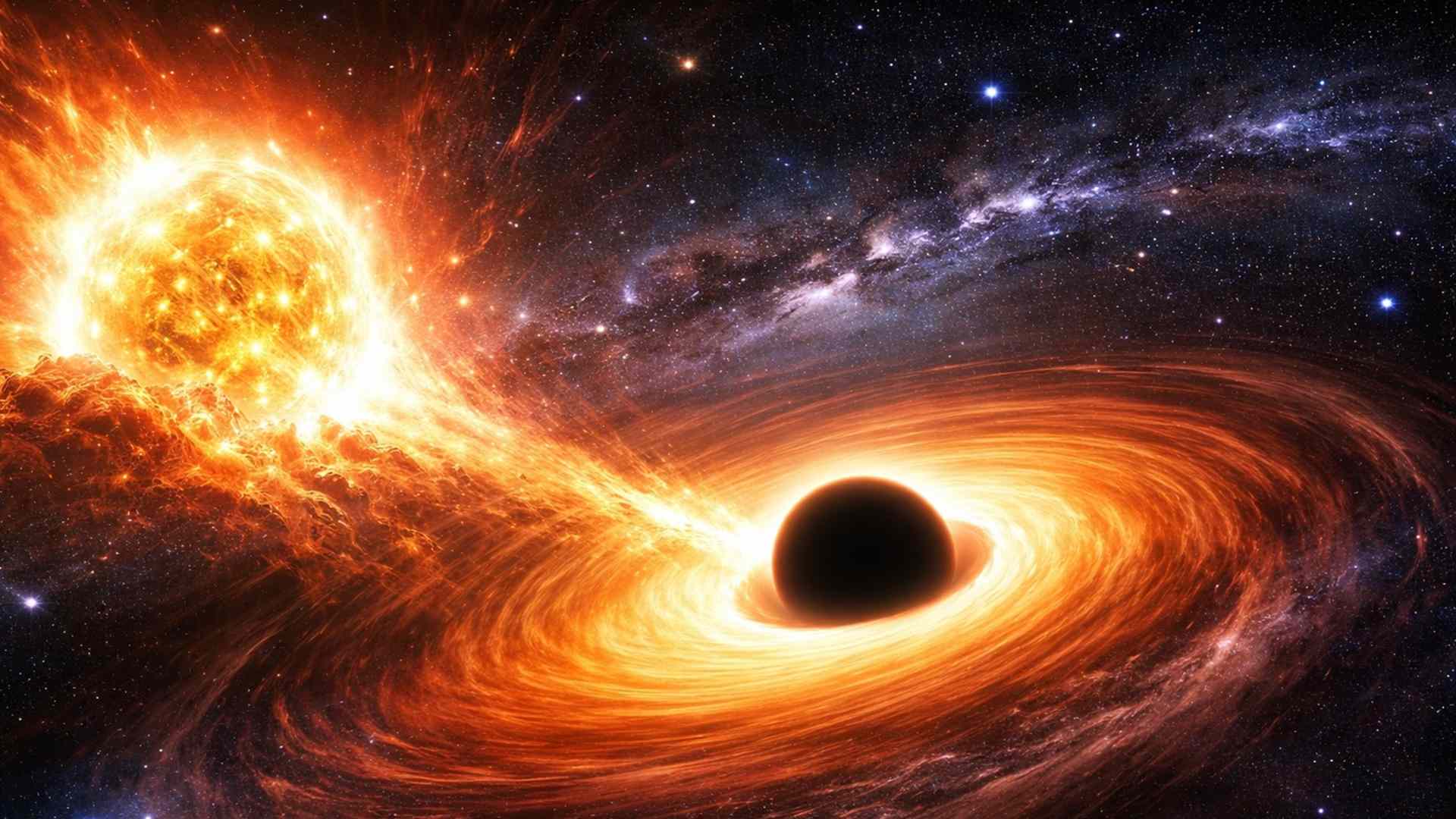
Star 13 Times More Massive Than The Sun Showed Continuous Infrared Increase Since 2014, Lost Brightness 10,000 Times Until 2023 And Collapsed Directly Into Black Hole In Andromeda, According To Study Published In Science, Without Visible Supernova Record
A star 13 times more massive than the Sun quietly disappeared in the Andromeda galaxy, shone in infrared starting in 2014, lost brightness 10,000 times until 2023, and collapsed directly into a black hole, according to a study published in Science.
Astronomers reported that, contrary to the expected pattern for massive stars, the object did not explode as a supernova. Instead, it exhibited a continuous and unusual decline, interpreted as evidence of the direct collapse of the core, without the explosive phase traditionally observed in such events.
Kishalay De, lead researcher and professor of astronomy at Columbia University, stated that the dramatic and continuous decline suggests that a supernova did not occur. According to him, the data points to the core collapsing directly into a black hole.
-
Motorola launched the Signature with a gold seal from DxOMark, tying with the iPhone 17 Pro in camera performance, Snapdragon 8 Gen 5 that surpassed 3 million in benchmarks, and a zoom that impresses even at night.

-
Satellites reveal beneath the Sahara a giant river buried for thousands of kilometers: study shows that the largest hot desert on the planet was once traversed by a river system comparable to the largest on Earth.

-
Scientists have captured something never seen in space: newly born stars are creating gigantic rings of light a thousand times larger than the distance between the Earth and the Sun, and this changes everything we knew about stellar birth.

-
Geologists find traces of a continent that disappeared 155 million years ago after separating from Australia and reveal that it did not sink, but broke into fragments scattered across Southeast Asia.

If confirmed, the event could change the way scientists account for stellar deaths and understand black hole formation. The analysis was based solely on archived observational records and in comparison to existing theoretical predictions since the 1970s.
A Star 13 Times More Massive Than The Sun Quietly Disappeared And Shone In Infrared Before The Collapse
The sequence began in 2014, when NASA’s NEOWISE mission space telescope recorded an unusual increase in the infrared brightness of a massive star in Andromeda. The emission steadily grew over about three years.
Infrared light, invisible to the human eye, can reveal hot dust and gas. After the increase period, the object exhibited a drastic drop in visible brightness, reducing its luminosity by approximately 10,000 times until 2023.
Over time, it practically disappeared, leaving behind a detectable layer of dust in infrared. At the time, the phenomenon was not recognized. The data remained archived in public records for years.
Subsequently, the study authors decided to systematically research archived infrared data in search of signs of direct collapse. They conducted the largest survey ever done on variable infrared sources in the Milky Way and nearby galaxies.
The investigation was guided by a prediction formulated in the 1970s. According to this hypothesis, a star that collapses directly into a black hole should briefly shine in infrared as it loses outer layers and becomes enveloped by dust, before disappearing.
Identification Of Star M31-2014-DS1 In Andromeda
The team identified the candidate as star M31-2014-DS1, located about 2.5 million light-years from Earth, in the Andromeda constellation. When it formed, it had about 13 times the mass of the Sun.
Classified as a supergiant with low hydrogen content, the star lost much of its material over its lifetime through intense stellar winds. At the time of its death, it had approximately five times the mass of the Sun.
According to the researchers, the prolonged and steady decline does not correspond to the pattern observed in normal supernovae. Instead of ejecting outer layers in a bright explosion, the inner core appears to have collapsed completely.
The outer layers dispersed more gently, forming the dust visible in infrared. The remaining infrared brightness is attributed to the dust and gas heated by the material surrounding the newly formed black hole.
Kishalay De stated that the evidence of the disappearance was in public archives and had not been recognized for years. He described the identification as the most surprising discovery of his life.
Comparison With Previous Case In Galaxy NGC 6946
A possible similar case was recorded around 2010 in the galaxy NGC 6946. However, that object was about 10 times farther away and was 100 times fainter, with less detailed data.
As a result, the true nature of that event remained uncertain. In contrast, M31-2014-DS1 provides evidence considered clearer and of higher quality, with detailed infrared records over several years.
Morgan MacLeod, co-author of the study and professor of astronomy at Harvard, stated that black holes must originate from stars. According to him, with the events of NGC 6946 and M31-2014-DS1, it is possible to observe this process occurring.
MacLeod said that the observations allow for learning more about how direct collapse works. The case reinforces the possibility that some massive stars do not explode as supernovae before forming black holes.
Impacts For Estimates Of Supernovae And Black Hole Formation
Black holes were predicted over 50 years ago. Currently, dozens are known in the Milky Way, and hundreds have been detected through gravitational waves associated with distant cosmic collisions.
There is still no consensus on which stars turn into black holes and under what conditions. For a long time, it was believed that stars with masses similar to M31-2014-DS1 always exploded as supernovae.
The new case suggests that such stars may, under certain conditions, skip the explosive phase. The interaction between gravity, gas pressure, and shock waves in the final moments may determine the ultimate outcome.
If direct collapse is more frequent than previously thought, estimates of supernovae in the universe may need to be revised. This would affect models of heavy element distribution, such as iron, in galaxies.
It would also influence predictions about the number of existing black holes and the frequency of mergers capable of producing gravitational waves. However, scientists emphasize that more observations are needed.
The team intends to continue analyzing archival data and utilize future infrared surveys to identify other disappearing stars. The study was published in the journal Science, consolidating the presented evidence.
Thus, a star 13 times more massive than the Sun disappeared without a visible explosion, leaving a detailed infrared record and raising new questions about how massive stars end their lives in the universe.








-

-

-

5 pessoas reagiram a isso.