





 Portuguese
  English
  Spanish
  4 min of reading
  0 comments


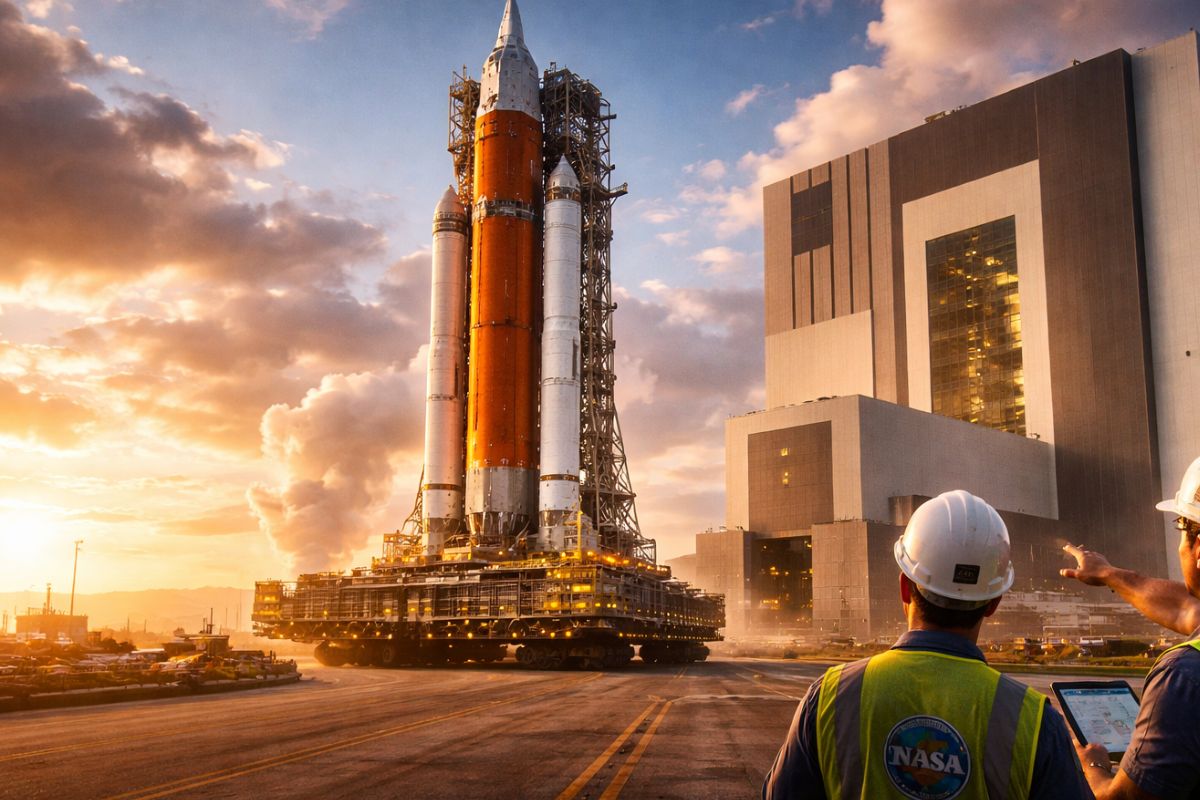
NASA Rocket That Will Make First Crewed Moon Mission In Over Half A Century Returns To Assembly Building At Kennedy Space Center After Helium System Failure Delays Launch That Was Already Late.
The NASA decided to return its giant lunar rocket to the hangar before even embarking the crew, after identifying a new technical problem in the helium system. The space agency had just completed a fueling test, considered crucial to contain hydrogen leaks, when the defect forced a revision of the launch plan and to keep the vehicle on the ground at least until April.
As a result, the trip of the four astronauts who will loop around the Moon on the Artemis II mission is once again in suspense. NASA had been working with a date of March 6, already a month past the previous timeline, but the failure in the helium flow to the rocket’s upper stage halted progress and pushed the launch campaign to a new window, which can only be confirmed after repairs and additional tests.
Why NASA Lunar Rocket Returned To Hangar
According to the agency itself, the NASA rocket will make a slow journey of about 6.4 kilometers within Kennedy Space Center in Florida to return to the vehicle assembly building.
-
Motorola launched the Signature with a gold seal from DxOMark, tying with the iPhone 17 Pro in camera performance, Snapdragon 8 Gen 5 that surpassed 3 million in benchmarks, and a zoom that impresses even at night.

-
Satellites reveal beneath the Sahara a giant river buried for thousands of kilometers: study shows that the largest hot desert on the planet was once traversed by a river system comparable to the largest on Earth.

-
Scientists have captured something never seen in space: newly born stars are creating gigantic rings of light a thousand times larger than the distance between the Earth and the Sun, and this changes everything we knew about stellar birth.

-
Geologists find traces of a continent that disappeared 155 million years ago after separating from Australia and reveal that it did not sink, but broke into fragments scattered across Southeast Asia.

This relocation, expected to take place on a favorable weather day, is necessary so that engineers can safely investigate the source of the failure.
The structure cannot be fully repaired on the platform, hence the decision to take a step back before advancing with the mission.
NASA emphasizes that returning to the hangar is the only way to dismantle, inspect, and correct the system with the level of detail required for a crewed flight to the Moon, something that hasn’t happened since the Apollo era.
Helium System Defect Delays Mission Even More
The new problem appeared soon after a successful hydrogen fueling test, planned specifically to control dangerous leaks in the rocket’s cryogenic lines.
When it seemed that this obstacle had been overcome and the March 6 date was secured, the failure in the helium system emerged.
The helium flow to the upper stage was interrupted, which is critical because helium is needed to purge engines and pressurize fuel tanks. Without this system functioning reliably, there is no way to authorize a countdown for a flight with four astronauts on board.
Therefore, NASA states that it is essential to return to the assembly building, discover the cause of the defect, and only then discuss a new launch date.
Launch Window And Pressure On NASA’s Schedule
Even with the setback, NASA tries to preserve the possibility of launching the mission starting in April. The agency reminds that it works with narrow windows of a few days each month to send the crew around the Moon and bring them back safely. This means that any additional repairs that deviate from the plan may push the launch to the next available opportunity.
At the same time, the technical team is racing against time. NASA emphasizes that the new launch attempt directly depends on the pace of repairs in the helium system and the results of subsequent checks, which will need to verify that both hydrogen leaks and helium pressurization are under control.
Only then will it be possible to realign the rocket, the platform, the crew, and the necessary orbital conditions for the mission.
Who Are The Astronauts Of Artemis II And Why Is The Mission Historic
The Artemis II mission will take four astronauts around the Moon, on a journey that marks the return of humans to the neighboring space after more than half a century. Three of them are American, and one is Canadian, all on standby in Houston while awaiting the definition of the new schedule.
They will be the first people to go to the Moon since NASA‘s Apollo program, which sent 24 astronauts to space between 1968 and 1972.
The current delay does not change the historical significance of Artemis II, but adds pressure from a technical, political, and symbolic perspective, as the world closely watches the agency’s ability to fulfill its promise to usher in a new phase of lunar exploration.
What Is At Stake For NASA’s Lunar Program
The successive date adjustments and issues with hydrogen and helium do not mean that the mission is at risk but reinforce the complexity of operating a rocket of this size.
For NASA, each test, controlled leak, and return to the hangar is a validation step before putting the lives of four people on a trajectory to the Moon and back.
At the same time, there is global anticipation surrounding the Artemis program. The success of this mission will be the decisive step for the sequential flights that include flybys, landings, and a more enduring presence on the lunar surface, creating a foundation for future structures, experiments, and possibly even more ambitious missions in deep space.
As NASA prepares the rocket again behind the scenes, do you think it’s more worthwhile to delay as long as necessary to ensure total safety, or should the agency have taken fewer risks with the schedule from the start?







-

3 pessoas reagiram a isso.