





 Portuguese
  English
  Spanish
  3 min of reading
  0 comments


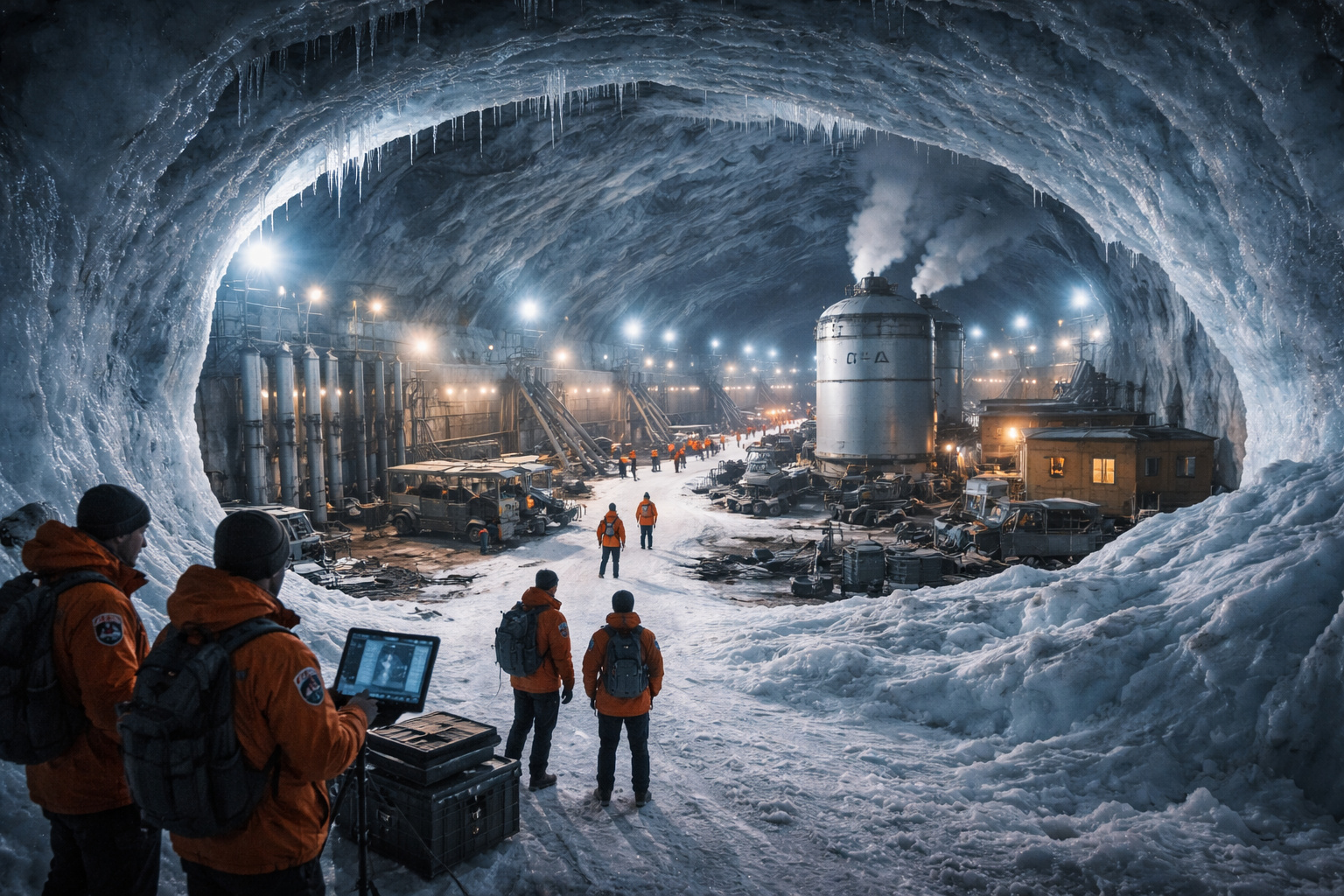
Structure Known as Camp Century Was Built Between 1959 and 1960, Deactivated in 1967 and May Lose Ice Coverage Starting in 2090, According to Study Cited by Popular Mechanics
A historic discovery of significant scientific and strategic relevance returned to the center of international debate in April 2024.
NASA identified, beneath approximately 30 meters of ice in Greenland, the former military base Camp Century, which the United States built during the Cold War.
The United States Army Corps of Engineers constructed the underground structure between June 1959 and October 1960, as reported by the portal Interesting Engineering.
-
Friends have been building a small “town” for 30 years to grow old together, with compact houses, a common area, nature surrounding it, and a collective life project designed for friendship, coexistence, and simplicity.

-
This small town in Germany created its own currency 24 years ago, today it circulates millions per year, is accepted in over 300 stores, and the German government allowed all of this to happen under one condition.

-
Curitiba is shrinking and is expected to lose 97,000 residents by 2050, while inland cities in Paraná such as Sarandi, Araucária, and Toledo are experiencing accelerated growth that is changing the entire state’s map.

-
Tourists were poisoned on Everest in a million-dollar fraud scheme involving helicopters that diverted over $19 million and shocked international authorities.


In 1967, the U.S. government terminated activities at the site and abandoned the complex beneath the ice.

Radar Technology Reveals Forgotten Underground City
The team was mapping the ice bed when they encountered the unexpected structure.
According to glaciologist Chad Greene from NASA, the radar images showed formations that did not correspond solely to the natural terrain.
To investigate further, the agency used the UAVSAR synthetic aperture radar, a technology that employs radio waves to identify hidden structures.
Alex Gardner, a scientist at NASA’s Jet Propulsion Laboratory (JPL), explained to Popular Mechanics that the discovery happened by chance.
Initially, the researchers were unable to identify what appeared in the images.
Military Context and NATO Agreement
The United States initiated the project after the Greenland Defense Agreement of 1951, signed with Denmark in the context of NATO.
According to the United States National Museum of Nuclear Science and History, the treaty authorized the use of facilities on the island to protect allied countries.
The base, known as the “city under the ice,” had 21 underground tunnels totaling nearly three kilometers in length.
The main corridor, called Main Street, reached about 300 meters.
In the early 1960s, the military installed the PM-2A nuclear reactor to generate power and heat the complex.
Project Iceworm and Secret Nuclear Strategy
Although researchers conducted geological studies at the site, the U.S. government planned something more ambitious.
In 1997, the Danish Institute of International Affairs released a report that revealed the true objective of the project.
The United States intended to implement Project Iceworm and store up to 600 ballistic missiles beneath the ice of Greenland.
The plan also included 60 launch centers and infrastructure to accommodate up to 11,000 military personnel, according to Interesting Engineering.
Faced with technical and strategic challenges, the government abandoned the implementation.
Closure and Nuclear Waste Beneath the Ice
After abandoning the plan, the U.S. government permanently closed the base in 1967.
Nonetheless, the PM-2A reactor left waste at the site.
According to the National Museum of Nuclear Science and History, over 177,000 liters of nuclear waste remained beneath the ice.
Future Risk Amid Climate Change
Currently, scientists are monitoring the potential impacts of global warming in the region.
According to a study cited by Popular Mechanics, the ice covering the base may begin to decrease starting in 2090.
William Colgan, a researcher at York University in Toronto, stated to The Guardian that in the 1960s, no one considered global warming a relevant factor.
Today, however, the climate scenario has changed significantly.
In light of this, the central question arises: Will the thaw expose structures and waste that have remained hidden for more than half a century?










Seja o primeiro a reagir!