





 Portuguese
  English
  Spanish
  4 min of reading
  0 comments


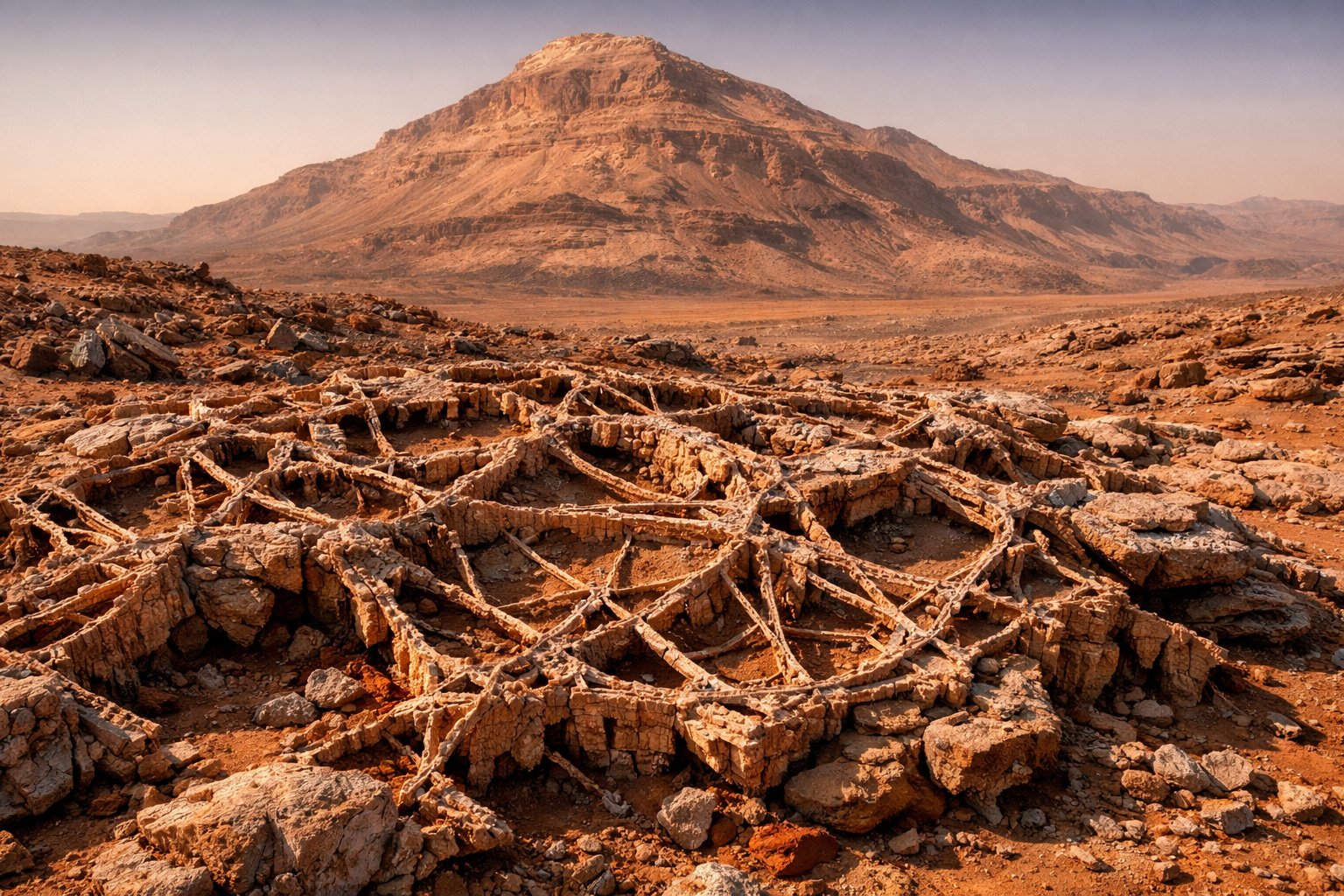
Martian Formations Intrigue Scientists and Indicate Underground Water Circulation on the Red Planet Throughout Its Geological History
An unusual landscape observed on Mars has been attracting the attention of the scientific community and the general public. Seen from space, the region resembles a vast network of “spider webs” spread across the Martian surface, a rare geometric pattern that raises new questions about the planet’s past. The images were analyzed by NASA, which has been monitoring the area with the Curiosity rover, operational on the planet for over a decade.
These mysterious structures reinforce an increasingly accepted hypothesis among scientists: Mars may have harbored underground liquid water for long periods, even after the surface began to dry. The discovery helps to reconstruct the planet’s transition from a potentially habitable environment to the cold, arid desert we know today.
The information was initially disclosed by the portal R7.com, based on data and official images from the American space agency, which has been monitoring the phenomenon for about six months through orbital observations and field analyses conducted by Curiosity.
-
Motorola launched the Signature with a gold seal from DxOMark, tying with the iPhone 17 Pro in camera performance, Snapdragon 8 Gen 5 that surpassed 3 million in benchmarks, and a zoom that impresses even at night.

-
Satellites reveal beneath the Sahara a giant river buried for thousands of kilometers: study shows that the largest hot desert on the planet was once traversed by a river system comparable to the largest on Earth.

-
Scientists have captured something never seen in space: newly born stars are creating gigantic rings of light a thousand times larger than the distance between the Earth and the Sun, and this changes everything we knew about stellar birth.

-
Geologists find traces of a continent that disappeared 155 million years ago after separating from Australia and reveal that it did not sink, but broke into fragments scattered across Southeast Asia.

What Are Mars’ “Spider Webs” and Why Are They Called Boxwork

The observed formations have been technically named boxwork, a type of geological structure composed of intertwined mineral ridges, forming patterns resembling networks or honeycombs. On Mars, these structures measure between 1 and 2 meters wide and are cut by sandy depressions, creating an impressive visual when seen from above.
They are concentrated around Mount Sharp, a mountain over five kilometers high located at the center of Gale Crater, the area where Curiosity conducts its scientific explorations. According to researchers, these formations did not arise by chance. On the contrary, everything suggests that they were shaped by processes associated with underground water.
According to the hypotheses raised, water would have circulated through deep fractures in the rock, transporting dissolved minerals. Over time, these minerals settled on the walls of the fractures, acting as a “natural cement” that hardened certain areas of the Martian rock. Subsequently, the continuous action of the wind—one of the main agents of erosion on Mars—wore away the more fragile material around, preserving only the mineralized ridges that today form the boxwork pattern.
Curiosity Faces Unprecedented Challenges to Investigate the Formations Up Close

Although similar structures exist on Earth, especially in caves or arid regions, they rarely exceed a few centimeters. On Mars, however, the scale is much larger, making the phenomenon even more intriguing. Before Curiosity arrived in this specific area of Mount Sharp, scientists were unsure of how these formations appeared up close or how they had formed.
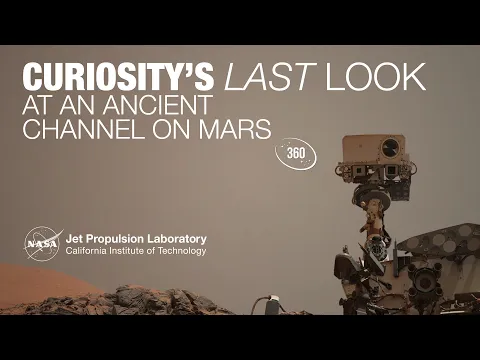
Thus, the mission team decided to conduct a detailed analysis on-site, even in the face of risks. Curiosity, which is approximately the size of an SUV and weighs about 899 kilograms, had to be carefully guided over the top of the mineralized ridges, an uneven and potentially dangerous terrain for its wheels.
“It’s almost like a road we can drive on. But then we need to descend into the valleys, where we have to be careful that the wheels don’t slip or get stuck in the sand,” explained Ashley Stroupe, operational systems engineer at NASA’s Jet Propulsion Laboratory and mission lead. According to her, each advance requires meticulous planning and virtual tests before sending commands to the rover.
Water Gradually Disappeared but Left Deep Marks on Mars

As Curiosity climbs Mount Sharp, scientists observe gradual changes in the landscape, indicating a long process of drying on the planet. Rock layers reveal that Mars underwent warm periods interspersed with increasingly arid phases, when rivers and lakes appeared temporarily before disappearing again.
In addition to the boxwork structures, the rover also identified irregular textures known as nodules, another strong indication of the presence of underground water in the past. These nodules had been detected in previous missions and reinforce the idea that water played a crucial role in shaping the Martian terrain.
For researchers, understanding how these structures managed to form and withstand erosion for millions of years is essential to understanding the climatic and geological evolution of Mars. Each new piece of evidence helps put together the puzzle of when, how, and for how long the planet maintained conditions favorable for the presence of liquid water.
Next Destination of Curiosity and the Next Steps in Exploration
According to NASA, Curiosity is set to leave the boxwork region starting in March, heading to a new area of Mount Sharp rich in sulfates—minerals that form when water evaporates. The team plans to explore this layer over several kilometers, seeking to answer one of the great questions of planetary science: how Mars went from a potentially habitable world to a frozen and inhospitable desert.
Every meter traveled by the rover enhances understanding of the red planet’s history and brings scientists closer to answering whether Mars once had sufficient conditions to support some form of microbial life.







-

-

-

-

-

-

34 pessoas reagiram a isso.