





 Portuguese
  English
  Spanish
  4 min of reading
  20 comments


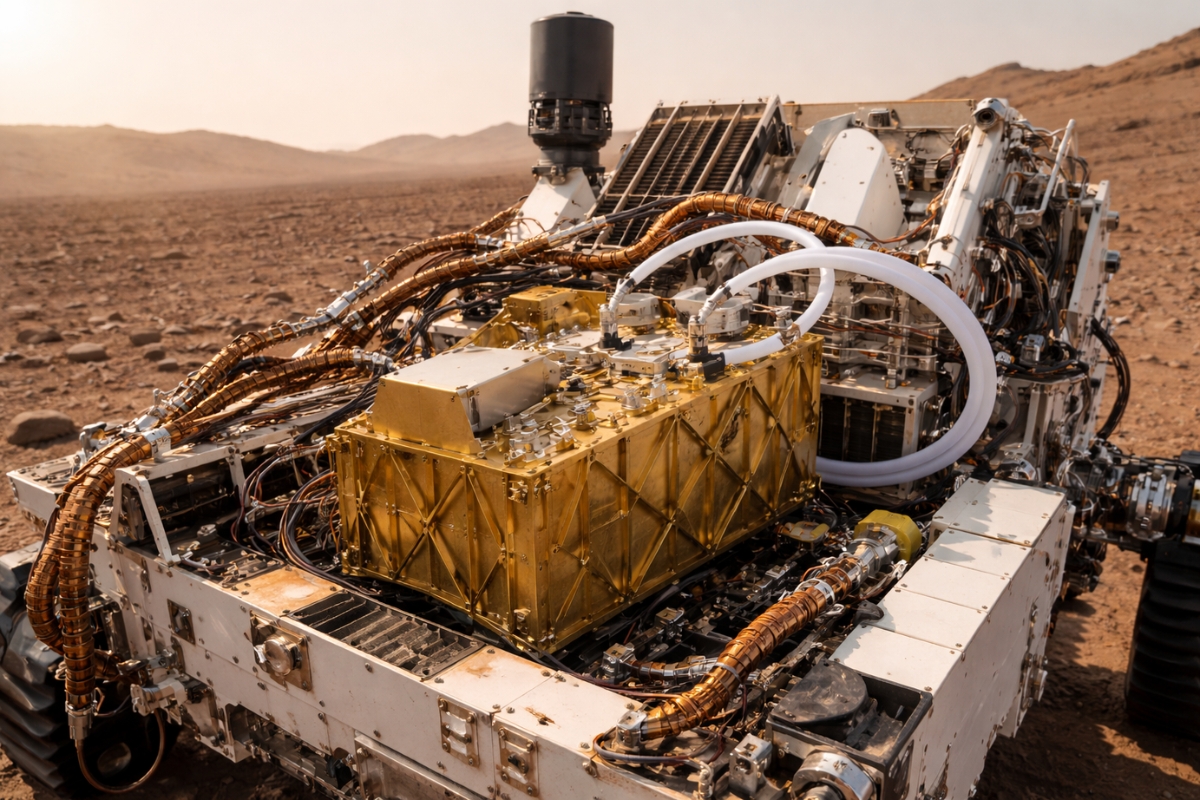


The MOXIE Experiment Demonstrated on Mars That It Is Possible to Generate Oxygen from the CO₂-Rich Atmosphere, Paving the Way for More Self-Sufficient Crewed Missions on the Red Planet.
For decades, one of the biggest challenges in getting humans to Mars has not just been the journey but how to survive on the red planet. Transporting large quantities of oxygen from Earth is expensive, heavy, and logistically complex. However, a NASA experiment has demonstrated that Mars can provide part of this essential resource by utilizing its own atmosphere.
The instrument is called MOXIE (Mars Oxygen In-Situ Resource Utilization Experiment) and was sent to Mars aboard the Perseverance rover in 2020. Its goal was clear: to test whether it would be possible to produce oxygen directly on Mars from carbon dioxide (CO₂), which makes up about 95% of the Martian atmosphere.
How MOXIE Works
MOXIE operates through a process called solid oxide electrolysis. The system captures CO₂ from the Martian atmosphere, compresses the gas, and heats it to high temperatures. It then separates the CO₂ molecules into carbon monoxide (CO) and oxygen (O₂).
-
Motorola launched the Signature with a gold seal from DxOMark, tying with the iPhone 17 Pro in camera performance, Snapdragon 8 Gen 5 that surpassed 3 million in benchmarks, and a zoom that impresses even at night.

-
Satellites reveal beneath the Sahara a giant river buried for thousands of kilometers: study shows that the largest hot desert on the planet was once traversed by a river system comparable to the largest on Earth.

-
Scientists have captured something never seen in space: newly born stars are creating gigantic rings of light a thousand times larger than the distance between the Earth and the Sun, and this changes everything we knew about stellar birth.

-
Geologists find traces of a continent that disappeared 155 million years ago after separating from Australia and reveal that it did not sink, but broke into fragments scattered across Southeast Asia.

The oxygen produced was not stored for later use, as the main objective of the experiment was to validate the technology and measure its performance under various environmental conditions on Mars, including temperature variations and atmospheric density.
According to NASA, MOXIE completed multiple oxygen production cycles during its operation on Mars, achieving the technological objectives set for the mission.

Results of the Experiment
During its mission, MOXIE was able to produce oxygen repeatedly, demonstrating that the process works in the actual Martian environment — and not just in conditions simulated on Earth.
This advance is particularly relevant because oxygen would be necessary not only for astronauts to breathe but also as an essential component of rocket fuel. In future missions, producing oxygen on Mars could allow for the manufacture of propellant directly on the planet, significantly reducing the amount of material that would need to be transported from Earth.
Nasa confirmed that MOXIE met all its technological objectives before concluding its operation in 2023.

Why This Changes the Future of Space Exploration
The strategy used by MOXIE is part of a concept called ISRU (In-Situ Resource Utilization), which involves using resources available on other planets to sustain human missions. In practice, this means reducing the dependency on bringing everything from Earth, utilizing local materials and conditions to produce essential items.
If an expanded version of MOXIE can produce oxygen in larger quantities, this resource could serve both to provide breathable air for astronauts and to produce the oxidizer necessary for rocket fuel, which would help reduce costs and weight on crewed missions. Additionally, the ability to generate oxygen on the planet itself would increase the autonomy of human operations on the Martian surface.
Therefore, this type of technology is considered a fundamental component in planning future human missions to Mars.
A Small Experiment with Huge Implications
MOXIE was approximately the size of a car battery, but its technological impact is significant. The success of the experiment demonstrates that producing essential resources off Earth is not just a theoretical idea, but a proven technical capability.
While it may be years before a crewed mission to Mars, the experiment left a clear conclusion: the red planet can provide some of the oxygen needed for humans to live and eventually return to Earth.
Space exploration advances step by step — and MOXIE represents one of those discrete yet fundamental steps that could redefine how humanity explores other worlds.
This article was based on official information released by NASA and the Jet Propulsion Laboratory (JPL), especially in the announcement of the conclusion of the MOXIE experiment mission on Mars. All data presented is based on institutional materials and technical publications from the U.S. space agency.








Muito Interessante! Isso mostra a capacidade do ser humano em viver e sobreviver em outro Planeta!
Sei lá! Tudo teve a sua chance: ( ex: os dinossauros tiveram a sua chance na Terra, más, por uma razão ou força maior, achou por melhor extingi-los. Agora ñ temos o direito de com uma tecnologia humana, traze-los de volta. Assim! Nos referimos à respeito de ( Marte).Ele já teve a sua chance, e ñ sabemos por quais motivos ou circunstâncias, eliminou os seus supostos( habitantes)… Se o planeta Marte , ñ suporta mais vida! Ouve um por quê…!Agora nós humanos com a nossa tecnologia, ñ nos cabe intervir na linha do ( tempo história. )Ñ se dá vida a um vírus morto, para q o mesmo ñ nos desimine da face da Terra…
Que isso cara, faltou um chapéu de alumínio aí blz?
Povoar marte é uma tolice das mais ****. E isso prova que muita inteligência se torna burrice… pois o ser humano deveria salvar esse planeta: e não ir destruir mais um. Pra salvar o planeta Terra, basta adotar a pena de morte em todo o planeta, acabar com a corrupção e também ter o controle de natalidade… e isso basta.
Concordo plenamente com você 👏👏
Já começou errado em querer a pena de morte, quem começa assim tá fadado a falência moral, espiritual e intelectual.
Salvar nosso planeta e respeita-lo é algo fundamental mesmo, mas ter condições de levar a humanidade para outro planeta é essencial para a sobrevivência da espécie em conceito de milênios…. Afinal a destruição do planeta pode vir de outras formas, e não só por nossa culpa…. A vida em nosso planeta já foi extinta em várias oportunidades, por vários motivos, e a mais conhecida foi a dos dinossauros….. Termos colonizado outros planetas é a única solução para salvarmos o ser humano e toda a sua cultura.