





 Portuguese
  English
  Spanish
  5 min of reading
  1 comment


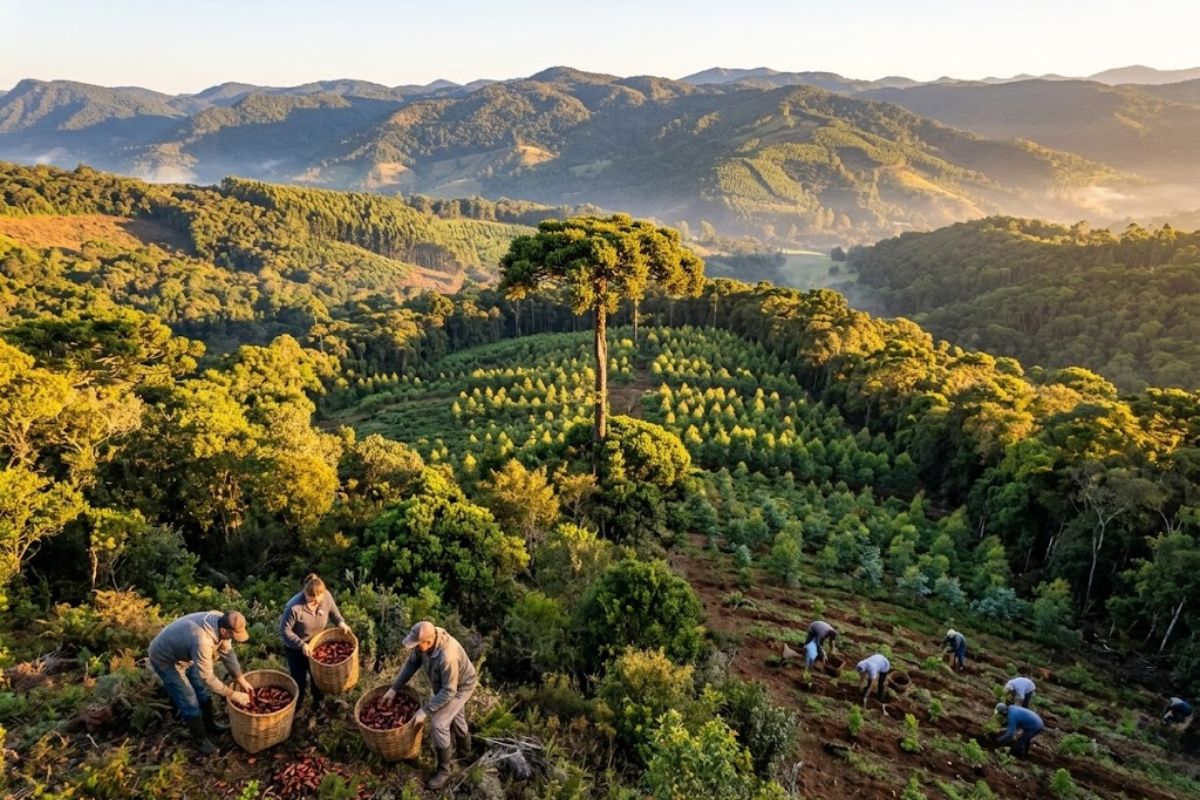


In The Mais Floresta Com Araucária Project, Funded By BNDES And Executed By Fundação CERTI, 292 Hectares Of Degraded Atlantic Forest Were Restored In Urupema, Urubici, Bom Retiro And Passos Maia, With Native Planting, Agroforestry Systems, Seed Collection And Income For Families Equivalent To More Than 290 Football Fields.
The word forest takes on another scale in Santa Catarina when 292 hectares of degraded Atlantic Forest are restored through an effort that combines science, planting, and rural work, with the Mais Floresta Com Araucária project, executed by Fundação CERTI and funded by BNDES. The result spans mountains and settlements, connecting Urupema, Urubici, Bom Retiro, and Passos Maia.
What’s at stake goes beyond “recomposing green” on the map: the recovery targets ecosystems that have been losing genetic diversity, which affects the production of fruits and timber and, at the same time, weakens environmental services that sustain local life, such as climate regulation, pollination, soil conservation, and water availability.
Where The Forest Reappears And Why It Matters

In the Serra Catarinense, restoration reached areas of Permanent Preservation and degraded sections within the RPPN Canto do Araponga, involving the municipalities of Urupema, Urubici, and Bom Retiro.
-
Friends have been building a small “town” for 30 years to grow old together, with compact houses, a common area, nature surrounding it, and a collective life project designed for friendship, coexistence, and simplicity.

-
This small town in Germany created its own currency 24 years ago, today it circulates millions per year, is accepted in over 300 stores, and the German government allowed all of this to happen under one condition.

-
Curitiba is shrinking and is expected to lose 97,000 residents by 2050, while inland cities in Paraná such as Sarandi, Araucária, and Toledo are experiencing accelerated growth that is changing the entire state’s map.

-
Tourists were poisoned on Everest in a million-dollar fraud scheme involving helicopters that diverted over $19 million and shocked international authorities.


Together with what has been done in Passos Maia, these fronts complete the 292 hectares recovered, a dimension that helps to visualize, but does not alone translate what it means to make the forest function again as a system.
When the forest fragments, it doesn’t lose just trees; it loses continuity, genetic exchange between populations, and part of the ecological “work” that keeps the environment stable.
That’s why the declared goal of halting the loss of genetic diversity appears as a focus of the project: without variability, the forest becomes more vulnerable and tends to respond worse to pressures from weather, climate, and land use.
Araucária As Axis Of The Forest And Income

Araucaria (Araucaria angustifolia) was not chosen by chance: it is a symbol of the Ombrófila Mista Forest and has a cultural and ecological role that spans generations in the South.
By placing araucaria at the center of restoration, the project rebuilds a landscape identity and also recovers the potential of the pine nut as a traditional food and source of income.
But a resilient forest is not made with a single species. That’s why other natives like mate herb, mountain guava, imbuia, and casca d’anta come into play, expanding the ecological and economic “menu” of the restored areas.
Diversifying species is diversifying functions: it changes the food offerings for fauna, alters pollinator dynamics, and reinforces soil structure, while creating real opportunities for income generation over time.
Agroforestry Systems In Practice: From Soil To Plate

In Passos Maia, restoration reached 192 hectares of Legal Reserve in the Zumbi dos Palmares and 29 de Junho settlements, with the implementation of agroforestry systems that combine native trees and agricultural crops. The logic of agroforestry systems (AFSs) is simple yet demanding: produce without repeating monoculture, building layers of vegetation and income that sustain themselves longer.
In this model, cover crops with well-defined functions come into play, such as protecting the soil, improving fertility, and fixing nitrogen, preparing the ground for the growth of native trees.
The gain is not just environmental: with integrated production, families can provide food for public programs like PNAE, while waiting for the growing time of araucaria seedlings and other species to increase supply at local fairs and markets. It’s a forest that also needs to “balance the accounts” to remain standing.
Seeds, Seedlings, And Fences: The Invisible Work That Sustains The Forest
One of the most decisive points of the project was involving family farmers in stages that often fall off the radar: seed collection, seedling planting, and fence construction.
This participation is not an operational detail; it builds local capacity and scales up restoration, as it transforms forest recovery into a productive chain with trained people to execute and maintain what has been implemented.
In practice, fencing areas under restoration protects young seedlings and reduces the risk of loss due to trampling, unauthorized access, or surrounding pressure, increasing planting efficiency.
Seed collection, when organized and done carefully, helps maintain genetic diversity and the suitability of species to the territory.
Restoration is not just planting: it’s ensuring that the forest can move from a fragile stage to a stable stage.
Genetic Diversity And Environmental Services: What Changes When The Forest Connects
The project manager of the Green Economy Center of CERTI, Gisele Alarcon, points to the loss of genetic diversity as a threat that compromises fruit production, timber, and essential environmental services.
This highlights the impact: genetic diversity is not a distant concept; it appears when the forest responds better to climate variations, sustains pollinators, and keeps water and soil cycles functioning with fewer disruptions.
Studies from the Santa Catarina Institute of Environmental Research (IPA SC) mentioned in the project context indicate that initiatives integrating agroforestry systems and recovery of permanent preservation areas (APPs) enhance ecosystem resilience, strengthen ecological connectivity, and improve water and soil quality.
In everyday terms, it means less erosion, more infiltration, more stability, and an environment that starts to “work” in favor of those who live and produce around the forest, rather than demanding constant repairs.
In your region, where does the forest most need to breathe again: by the riversides, on degraded slopes, or in production areas that could become agroforestry systems without losing income?
Have you ever seen a mature araucaria laden with pine nuts up close, or do you know stories of families that depend on this cycle to supplement their income?
And if there were a seed campaign in your community, would you participate, or do you think this responsibility should rest solely with institutions and governments?










Bom dia. Sempre falei para as pessoas do meu círculo que deveriam plantar araucárias e outras espécies, em lugar apropriado. Com essa atitude recupamos nossas florestas.
O envolvimento da sociedade também é fundamental.