





 Portuguese
  English
  Spanish
  3 min of reading
  14 comments


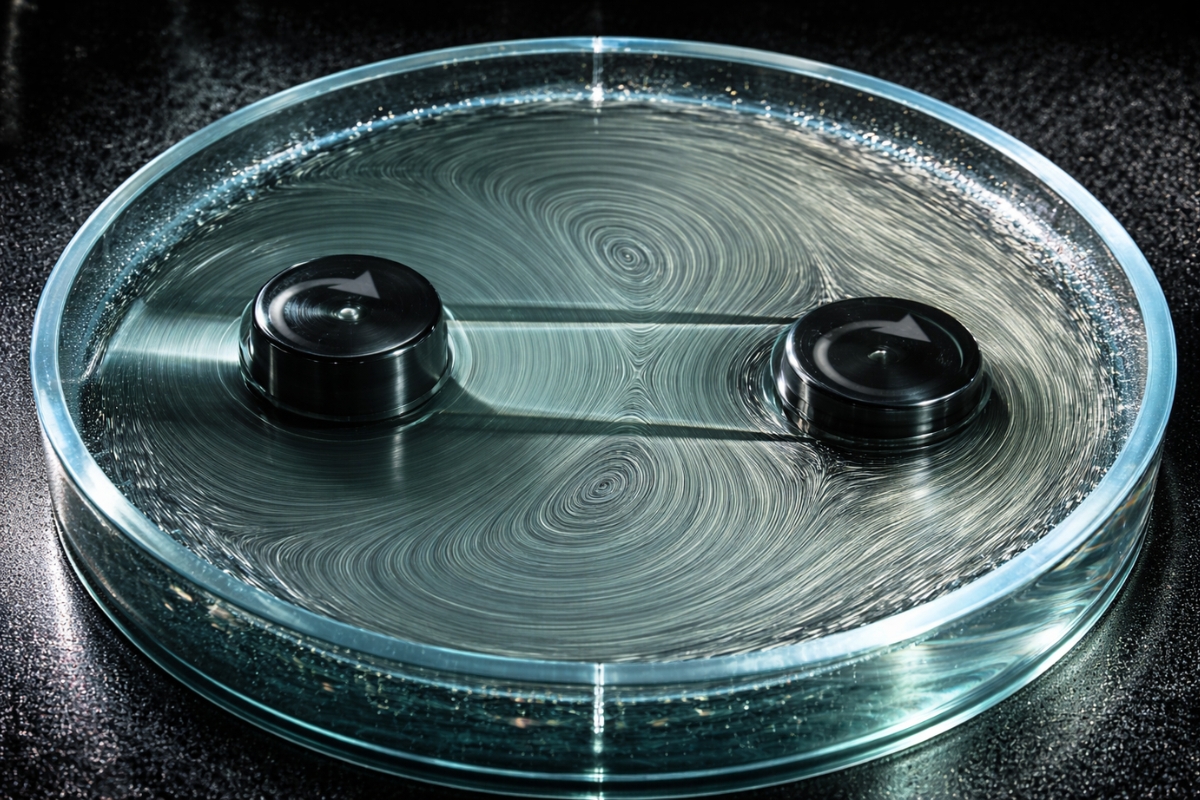


Researchers at NYU Created in New York a System with 2 Cylinders and Glycerin Water to Transfer Rotation Without Contact and Reduce Wear and Jamming.
What seemed to depend on metal and rigid teeth gained an unexpected shortcut. In New York, two smooth cylinders began to function as gears, but without touching.
The motion comes from a motor-driven cylinder and reaches the other solely through the flow of the liquid. The result points to systems more tolerant of dirt, misalignment, and friction failures.
A Turn After 5,000 Years of Teeth and Friction
Traditional gears were born from precision and rigidity, from the era of old cars to modern gearboxes. This path has always come with a cost in friction, noise, and jamming when something goes out of place.
-
Motorola launched the Signature with a gold seal from DxOMark, tying with the iPhone 17 Pro in camera performance, Snapdragon 8 Gen 5 that surpassed 3 million in benchmarks, and a zoom that impresses even at night.

-
Satellites reveal beneath the Sahara a giant river buried for thousands of kilometers: study shows that the largest hot desert on the planet was once traversed by a river system comparable to the largest on Earth.

-
Scientists have captured something never seen in space: newly born stars are creating gigantic rings of light a thousand times larger than the distance between the Earth and the Sun, and this changes everything we knew about stellar birth.

-
Geologists find traces of a continent that disappeared 155 million years ago after separating from Australia and reveal that it did not sink, but broke into fragments scattered across Southeast Asia.

The proposal replaces the bite of metal with a continuous push from the fluid. Instead of accumulated wear, the liquid tends to absorb small variations and dissipate tensions.
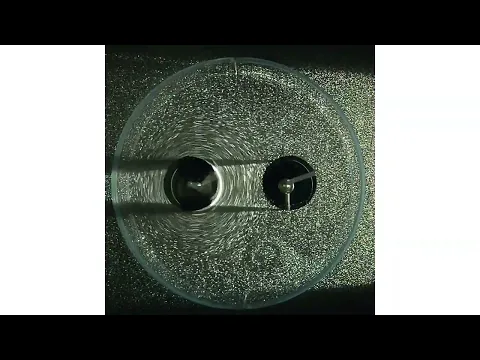

Glycerin Water Transforms Cylinders into Coupling
The test placed two rotary cylinders in a mixture of water and glycerin. One rotated actively with a motor, while the other remained free, reacting only to what the liquid transmitted.
To visualize the flow, microbubbles were used as markers. This made the pattern of the liquid visible and allowed comparison of the distance between cylinders and speed of rotation.
Microbubbles Reveal the Spin and Direction Change
With fine adjustments, the fluid began to organize whirlpools between the cylinders. This defines whether the passive cylinder spins in the opposite direction or follows the direction of the active cylinder.
According to Physical Review Letters, a peer-reviewed scientific journal of physics, the system describes hydraulic gears capable of transmitting rotation without contact, exploring only the behavior of the liquid in motion.
Near Vortices Imitate Classic Gears Without Touching
When the cylinders are very close, the flow creates opposing vortices between them. This arrangement makes the passive cylinder spin in the opposite direction to the active one, like two common gears working together.
The difference lies in the contact: here there are no teeth, nor shocks between surfaces. The coupling comes from the pattern of the liquid, not from mechanical fitting.
Greater Distance and High Rotation Change to Belt Mode
By increasing the separation and raising the speed, the behavior changes. The flow begins to wrap around the passive cylinder from the outside, and the movement arrives in the same direction as the active cylinder.
The strong point is functional flexibility. The basic design remains intact, and the effect changes with physical conditions, without changing parts and without reengineering the set.
Robots, Energy, and Strategy in Pressure Environments
In motors and robots, failures often arise from dust, misalignment, and continuous friction. A contactless coupling can reduce downtime and maintenance, with fewer jamming and more tolerance to error.
This gains value in scenarios of presence and influence, where reliability weighs more than brute force. In microturbines and energy recovery in slow currents, robustness becomes an advantage and pressures technological competition.
The technology is still in experimental phase but is already changing the way we think about motion transmission. Replacing metal with flow opens up space for more adaptable machines that are less vulnerable to wear.
If this logic scales, it not only changes robotics and energy projects but also redefines reliability priorities in critical systems and changes strategic reading.








Japonês estuda isso desde a década de 60
O experimento é valido mas acho difícil ser utilizavel em aplicações, e uma correção: Transmissão de torque sem engrenagens e sem contato mecânico já existe há muito tempo. São os conversores de torque usados em maquinas tratores e barcos.
Bom dia, estamos falando de engrenagens sem torque, e ou torque mínimo, substituir engrenagens elicoidais, extremamente tratadas, com desempenho magnífico, de força e confiabilidade, esse experimento com certeza foi ótimo, porém não redefine as engrenagens jamais, é só uma adaptação específica de alguma engenharia e ou operação que não precisa de torque.
Ou seja força motora.