





 Portuguese
  English
  Spanish
  5 min of reading
  0 comments


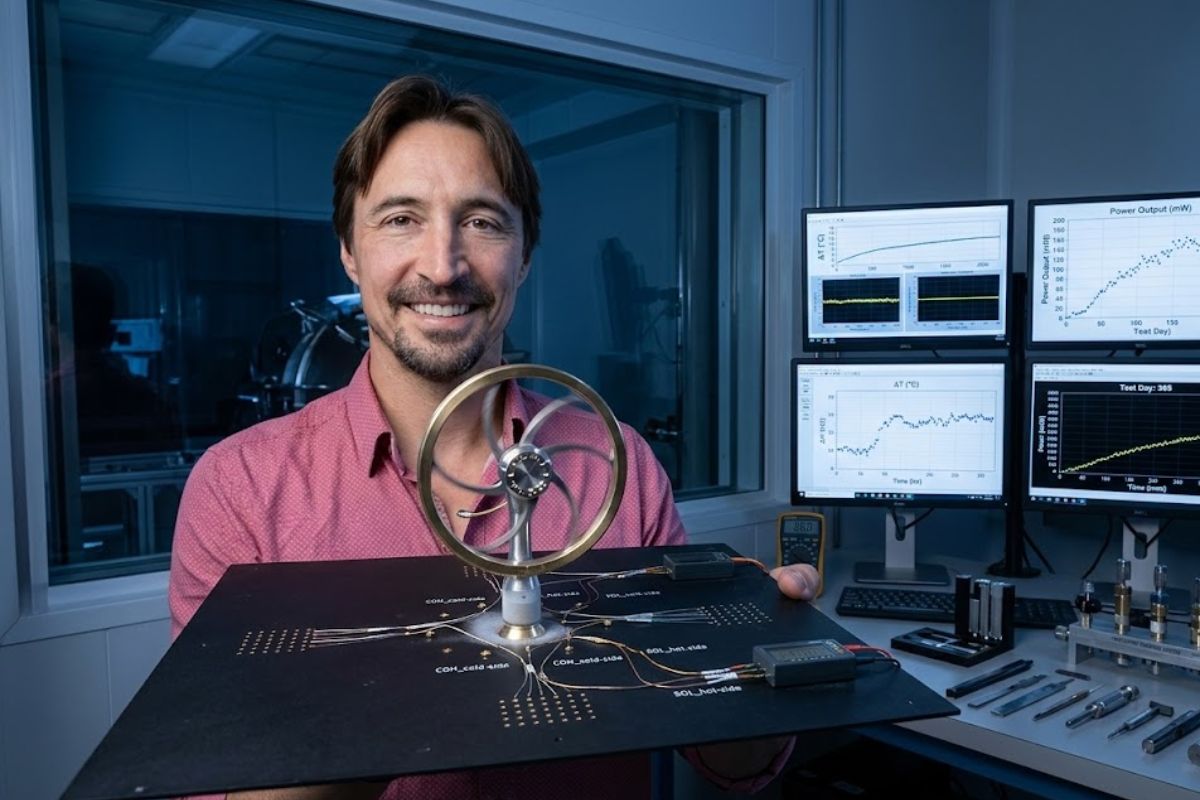
Engineers from UC Davis created a Stirling engine that tries to generate nighttime energy by connecting one side to the heat of the ground and the other to the cold of deep space via radiation. After a year, the prototype produced at least 400 mW per square meter and powered a fan in tests
What seems like “just night” may hide a silent source to generate energy when the Sun has already set. Instead of fuel, the experimental engine relies on something that is always there, but rarely takes center stage: the temperature difference between the Earth’s surface and the sky, which acts as a window to the cold of deep space.
Developed by Jeremy Munday, an engineering professor at UC Davis, with participation from graduate student Tristan Deppe, the device was tested outdoors for a year and showed that the night sky can function as a cold reservoir, capable of triggering a compact mechanical system and, in demonstrations, directly moving a small fan.
What Is Behind the Idea of “Pulling Cold” from Space

The proposal stems from a simple principle: an engine needs a temperature difference to operate. In this case, the team used a Stirling engine, a machine that converts heat into mechanical motion and can operate even when the thermal variation is not huge.
-
Motorola launched the Signature with a gold seal from DxOMark, tying with the iPhone 17 Pro in camera performance, Snapdragon 8 Gen 5 that surpassed 3 million in benchmarks, and a zoom that impresses even at night.

-
Satellites reveal beneath the Sahara a giant river buried for thousands of kilometers: study shows that the largest hot desert on the planet was once traversed by a river system comparable to the largest on Earth.

-
Scientists have captured something never seen in space: newly born stars are creating gigantic rings of light a thousand times larger than the distance between the Earth and the Sun, and this changes everything we knew about stellar birth.

-
Geologists find traces of a continent that disappeared 155 million years ago after separating from Australia and reveal that it did not sink, but broke into fragments scattered across Southeast Asia.

The efficiency of the Stirling appears precisely when the temperature “step” is small, something that other engines utilize less effectively.
In practical terms, the engine relies on two sides with different temperatures. One side receives heat, the other is cooled, and this thermal asymmetry moves a piston connected to a flywheel, producing mechanical work.
Without this difference, nothing happens because the system tends toward equilibrium: if all sides are at the same temperature, there is no thermal “push” to turn into movement.
Why the Stirling Engine Comes into Play When the Difference Is Small
Internal combustion engines typically rely on large temperature differences to operate with high efficiency, which involves burning fuel and high temperatures. The Stirling engine, by design, can work with smaller contrasts.
Jeremy Munday compares this contrast scale to something everyday: it can be as small as that between a hot cup of coffee and the air around it, because the Stirling does not require a “thermal chasm” to start producing motion.
This changes the type of opportunity that opens up at night. Instead of creating heat through combustion, the strategy is to find a naturally available “cold side”.
The key insight of the project was to look upward: deep space is extremely cold, and on a clear night with low humidity, some of the heat from objects on Earth is radiated upward towards the sky, cooling exposed surfaces.
How the Prototype Uses the Sky as a Cold Reservoir Without Touching It
The engine was mounted on a panel that acts as a heat radiating antenna. The assembly is exposed to the outdoors at night.
On one side, the ground provides heat; on the other, the panel releases heat upward, thermally “coupling” the system to the night sky through radiation. There is no need to physically reach space: contact is made through radiative exchange.
This detail is crucial to understanding why the device is nocturnal. During the night, especially in clear sky, upward thermal radiation tends to cool the surface facing the sky.
This way, the project creates a thermal gradient with what already exists in the environment: relatively warmer ground below and effectively colder sky above, allowing the piston to work without fuel.
What the Tests Showed and How Much the Engine Was Able to Deliver
After a year of nighttime experiments, the team observed that the compact device was able to generate at least 400 milliwatts of mechanical power per square meter.
This number does not describe a power plant, but it is a direct signal of operation: measurable mechanical energy is being extracted from the thermal gradient between night and sky.
In demonstrations, the engine directly powered a small fan, showing immediate application for low-power air movement.
Additionally, the system was also connected to a small electric motor to produce electric current, indicating a path for conversion of mechanical movement into electricity when it makes sense for the end use.
Where the Technology Tends to Work Best and What Limits Performance
The results themselves point to an environmental requirement: the approach works best in regions with low humidity and consistently clear skies.
This happens because humidity and cloudiness interfere with the radiative exchange with the sky, reducing the effective cooling of the “cold” side of the system. When the sky ceases to be a good “thermal window,” the gradient diminishes, and the engine loses power.
This type of dependency also helps to understand why the team tested outdoors and why the nighttime scenario is so important.
The device relies on the real environment, not an isolated test bench. The technology, therefore, is not “magic”: it depends on how much the panel can radiate heat to the sky and how much the ground can sustain the hot side, maintaining the temperature difference that makes the piston work.
What This Could Be Used For, Without Promising What Does Not Yet Exist
The practical motivation appears in direct examples: the system could, in the future, help ventilate greenhouses and other buildings at night without relying on fuel.
Night Ventilation Is a Coherent Use with Low Power, because small airflows already make a difference in thermal control, humidity, and internal circulation of environments.
At the same time, it is important to keep the focus on what has been demonstrated: this is a prototype that showed mechanical power per area and was able to trigger small loads, such as a fan, in addition to generating current when coupled to a simple generator.
UC Davis has filed a provisional patent related to the invention, signaling interest in protecting and maturing the concept, but the final utility still depends on scaling engineering, integration, and adaptation to climatic conditions.
The idea of generating energy at night without fuel gains a new piece in this puzzle: using the sky as a “cold side” through radiation and the ground as a “hot side” to keep a Stirling engine operating silently.
The tests do not turn the device into a universal solution, but show that there is mechanical work that can be harnessed when the sky is clear and humidity does not interfere, allowing a small fan to spin solely with the physics of the environment.
If this technology were available in your area, what would you imagine using it for first: ventilating a greenhouse, improving the thermal comfort of a room, or powering some simple equipment during the night?
And does where you live have clear sky nights frequently enough for this to work well?








-

-

-

-

10 pessoas reagiram a isso.