





 Portuguese
  English
  Spanish
  6 min of reading
  1 comment


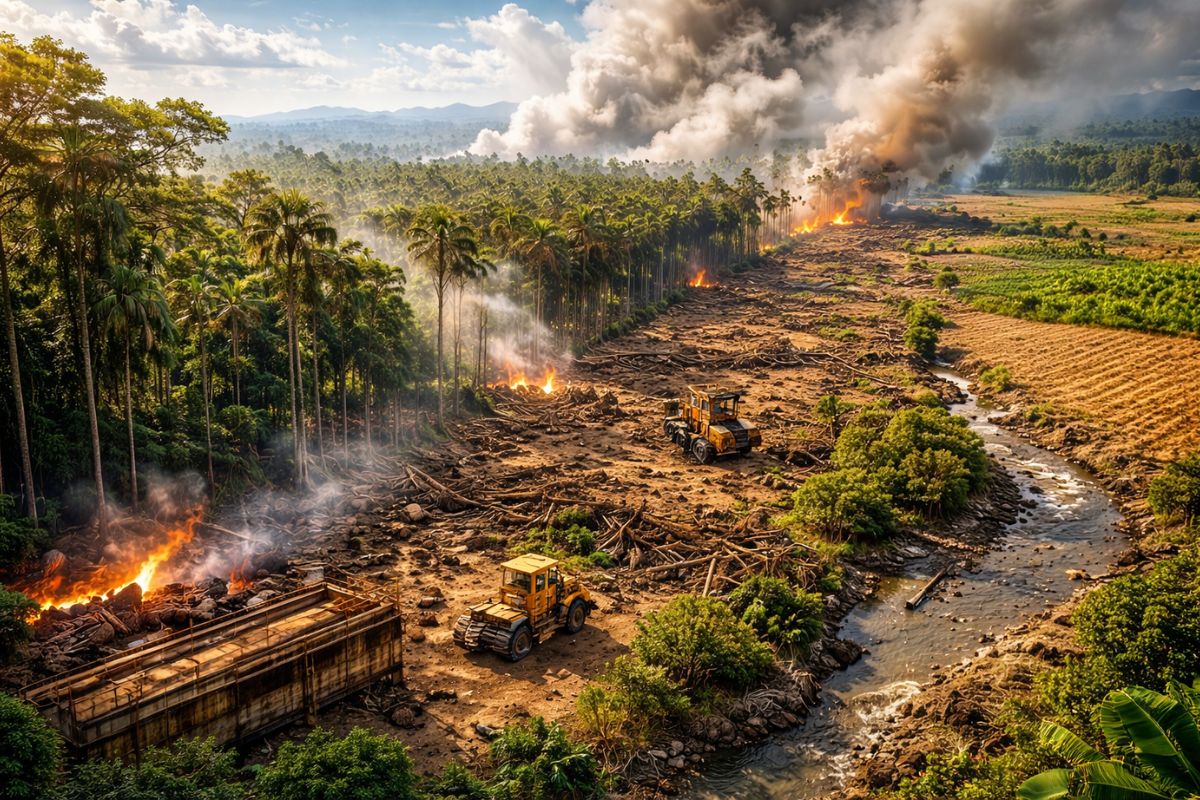


New Study Shows Clearing Large Areas of the Amazon Accelerates Regional Warming, Reduces Rain, and Brings the Forest Closer to a Breaking Point That Affects Climate, Agriculture, and Economy Across the Country.
By comparing regions with different levels of forest cover, researchers identified that clearing the Amazon above 40% transforms the forest into a hotter, drier system with fewer rainy days, weakening the climatic balance that supports crops, cities, and water reservoirs far beyond the North region.
The Amazon is not just a large green blot on the map. It acts as an active climate regulator, capable of influencing temperature, humidity, and rain on a continental scale. The new study indicates that, as decisions are made to clear the Amazon on a large scale, this mechanism stops operating as it should. In heavily deforested areas, surface temperatures during the dry season can rise up to 4°C compared to neighboring stretches where the forest remains intact.
At the same time, these regions register a reduction of about 25% in precipitation and approximately eleven fewer rainy days per season. These changes are not just isolated variations. The work points to a new local climate pattern, where the environment behaves like a transition zone to savanna, with less available moisture, more accumulated heat, and greater vulnerability to prolonged droughts and wildfires.
-
Motorola launched the Signature with a gold seal from DxOMark, tying with the iPhone 17 Pro in camera performance, Snapdragon 8 Gen 5 that surpassed 3 million in benchmarks, and a zoom that impresses even at night.

-
Satellites reveal beneath the Sahara a giant river buried for thousands of kilometers: study shows that the largest hot desert on the planet was once traversed by a river system comparable to the largest on Earth.

-
Scientists have captured something never seen in space: newly born stars are creating gigantic rings of light a thousand times larger than the distance between the Earth and the Sun, and this changes everything we knew about stellar birth.

-
Geologists find traces of a continent that disappeared 155 million years ago after separating from Australia and reveal that it did not sink, but broke into fragments scattered across Southeast Asia.

How Clearing the Amazon Alters Temperature and Rain
The first result of the study is straightforward. The more the Amazon is cleared, the hotter and drier the region becomes. In areas where forest cover falls below 60%, average surface temperatures during the dry season rise by 3°C.
In the most critical scenarios, where deforestation leaves only about 40% of remaining forest, this increase can reach 4°C, creating an environment that deviates from the natural variability recorded in preserved areas.
Rainfall also changes behavior. Regions where deforestation is more intense receive about a quarter less precipitation and have fewer rainy days throughout the season.
It’s not just a matter of less rain, but of rain behaving differently. The data points to more concentrated rain events, with intense downpours followed by longer periods of drought.
This combination is especially delicate for soils, rivers, reservoirs, and crops, as they begin to face alternation between excess and lack of water in short intervals.
When the Forest Stops Producing Its Own Rain
The key to understanding why clearing the Amazon alters the climate so much lies in evapotranspiration. Large trees, with deep root systems and dense canopies, pull water from the soil and release it into the atmosphere as vapor. This constant flow feeds cloud formation and sustains rain in the Amazon throughout the year.
The study shows that in the most deforested areas, evapotranspiration drops by about 12%. With fewer trees, there is less water being pumped into the air.
The soil loses moisture, the air becomes drier, and heat accumulates easily. The forest ceases to function as a rain factory and becomes a scene of heat and water scarcity.
When persistent clearing is undertaken, this process creates a feedback cycle. Less forest means less water vapor. Less vapor means fewer clouds and less rain. Less rain increases the water stress on the trees that remain standing.
Stressed trees become more susceptible to fires and diseases, paving the way for further deforestation and exacerbating the problem. At a certain point, the system no longer oscillates around the former balance but operates under a new climatic condition, drier and hotter.
Clearing the Amazon and the Direct Impact on Agriculture
The effects of clearing the Amazon are not limited to biodiversity or regional temperature. They directly reach the agriculture in the Amazon and other regions of Brazil that rely on the so-called “flying rivers,” moisture flows that come from the forest and feed rain systems in distant areas.
When large areas are converted into pastures or open fields, the local microclimate changes completely. Days become hotter, relative humidity decreases, and the soil loses water more rapidly.
Agriculture in the Amazon and neighboring regions begins to operate in an environment with a higher risk of heat waves, dry spells, and irregular harvests. In an ongoing global warming scenario, each additional hectare cleared pushes the system a little further toward extreme events.
This relationship between forest and production is not just theoretical. Researchers and international agricultural organizations emphasize that areas with more robust forest cover withstand climatic shocks better.
By clearing the Amazon without considering this connection, the country weakens the water and climatic foundation that sustains long-term field productivity. Protecting the forest, in this sense, is also protecting future harvests, jobs, and supply chains that depend on stable climate.
Forest as Climate and Economic Infrastructure

The study reinforces a notion that has gained traction among experts. The Amazon should be treated as climate and economic infrastructure, not just as an environmental asset.
Just like roads, transmission lines, and dams, the forest provides essential services that don’t appear in everyday accounts but sustain productive activities across multiple sectors.
When large areas of the Amazon are chosen to be cleared, the costs are not limited to the loss of vegetation cover.
They manifest in crop losses associated with more severe droughts, increased pressure on water supply systems, extra energy consumption to cope with higher temperatures, and interruptions in production chains affected by floods or abnormal droughts.
Clearing, in this context, is deteriorating a climate infrastructure that takes centuries to form and can be impacted in just a few decades.
Seeing the forest as infrastructure helps to reposition the discussion. Instead of treating Amazon protection as an obstacle to development, the study indicates that keeping the forest standing is a condition for viable economic development and water security in the medium and long term.
How Much Has Been Cleared and What the Study Shows About Limits
The work relies on figures that help to understand the scale of the problem. Between 1985 and 2024, the Amazon lost about 13% of its native vegetation, equivalent to approximately 520,000 square kilometers.
In 2024, more than 6,300 square kilometers were cleared only in the Legal Amazon. These values are recorded while the planet faces the hottest year on record, the first to exceed 1.5°C above pre-industrial average.
To isolate the specific effects of deforestation on the regional climate, scientists divided the Amazon area into large quadrants of approximately 55 by 55 kilometers.
Each more deforested quadrant was compared to nearby regions that maintained over 80% forest cover. Eleven climate variables were evaluated, including temperature, precipitation, evapotranspiration, and the number of rainy days.
The result was consistent. In the zones where deforestation was most prevalent, the climate already behaves differently, with persistent warming, reduced rain, and lower moisture retention capacity.
The alteration does not seem like a temporary fluctuation but a transition to a new condition. This pattern reinforces alerts about critical limits.
As forest loss approaches certain thresholds, the risk grows that the Amazonian system will lose the resilience needed to recover, even if deforestation is subsequently reduced.
Clearing Now or Restoring While There Is Still Time?
In light of this data, the central question is not just how many percent of forest has already been lost, but what kind of response the country intends to build.
The study suggests that restoring degraded areas can recover some of the lost ecosystem services, such as temperature regulation, water cycle, and carbon storage.
This restoration, however, requires time, planning, financial resources, and consistent public policies.
Clearing is quick, while restoring is slow, but the results indicate that there is still room to avoid more extreme scenarios if the advance of deforestation is contained before critical limits are crossed.
Treating the Amazon as a cornerstone of a climate, agricultural, and economic security strategy can be decisive for the future of the country.
Knowing all of this, in your opinion, should Brazil prioritize reducing deforestation in the Amazon immediately or focus first on other sectors, such as energy and transport, to tackle the climate crisis?







Com certeza priorizar em reduzir o desmatamento é muito mais importante!
A terra é a nossa casa,as árvores,a natureza é como se fosse um combustível para nós vivermos bem 🥰❤️💝💚🌲🌳🌴🌵🌍🙈🦁🐼