





 Portuguese
  English
  Spanish
  5 min of reading
  0 comments


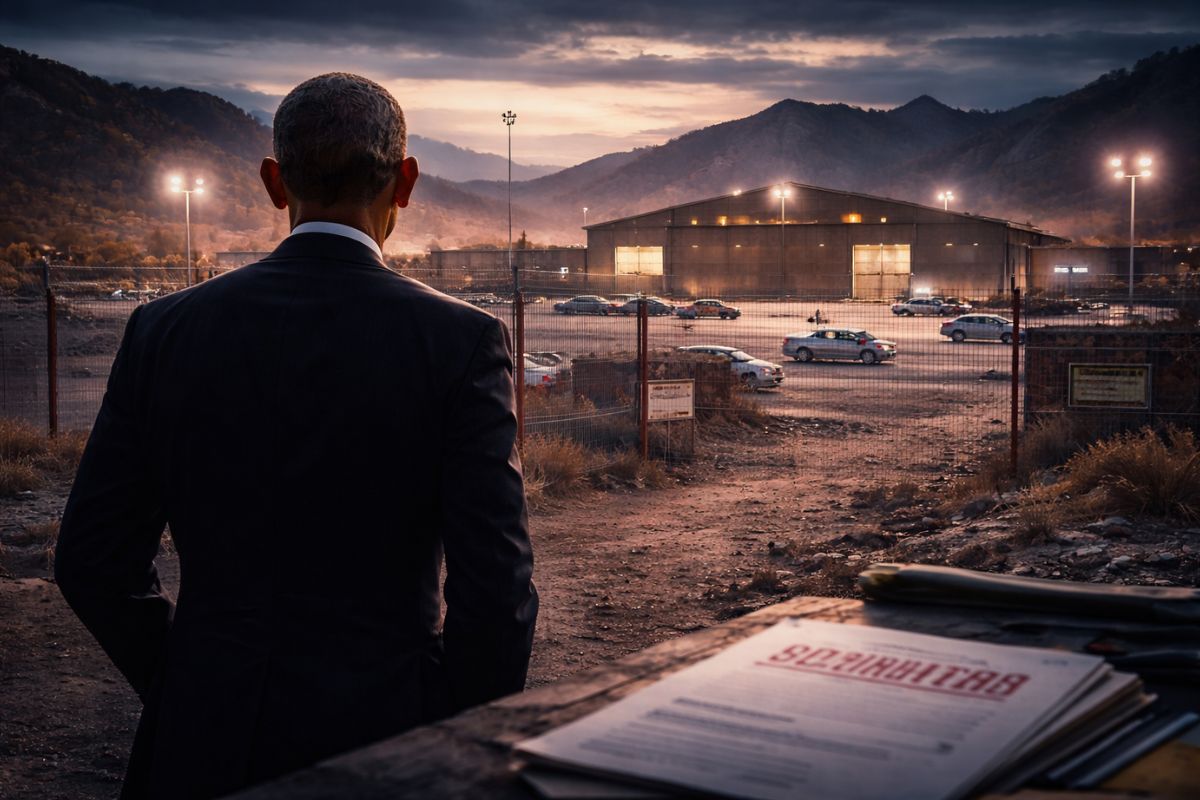
In Conversation With Brian Tyler Cohen on No Lie, Barack Obama Said That Aliens Are Real, But Claimed He Has Not Seen Them and Denied They Are at Area 51; The Statement Reignites Cover-Up Suspicions and Pushes Congress to Revisit Reports of Secret Programs, and Almost Half of Americans Suspect.
Barack Obama returned to the center of a type of conversation that rarely emerges from the cultural underground: aliens, Area 51, and the idea of a cover-up so deep that even the president would not see the bottom. On No Lie, hosted by Brian Tyler Cohen, the former President of the United States responded directly when provoked: “They are real, but I haven’t seen them.”
The short and calculated statement was followed by an objective denial about Area 51 and an even more uncomfortable provocation: if there were a “secret sector” guarding evidence about aliens, it would have been hidden even from the president. The topic resurfaces as Congress has resumed hearing reports about hidden programs, and a 2025 survey indicates that almost half of Americans suspect a cover-up.
What Barack Obama Said and What Remains Unanswered

Barack Obama’s statement about aliens occurred in an environment where the tone is usually more relaxed than in a press conference.
-
Motorola launched the Signature with a gold seal from DxOMark, tying with the iPhone 17 Pro in camera performance, Snapdragon 8 Gen 5 that surpassed 3 million in benchmarks, and a zoom that impresses even at night.

-
Satellites reveal beneath the Sahara a giant river buried for thousands of kilometers: study shows that the largest hot desert on the planet was once traversed by a river system comparable to the largest on Earth.

-
Scientists have captured something never seen in space: newly born stars are creating gigantic rings of light a thousand times larger than the distance between the Earth and the Sun, and this changes everything we knew about stellar birth.

-
Geologists find traces of a continent that disappeared 155 million years ago after separating from Australia and reveal that it did not sink, but broke into fragments scattered across Southeast Asia.
Still, he chose words that do not allow for a completely innocuous reading: he stated that aliens “are real,” but placed a personal lock by saying he has not seen them.
This lock separates two layers of the debate. One is the belief in the existence of aliens. The other is the possession of direct evidence.
By denying that aliens are kept at Area 51, Barack Obama debunks the most popular version of the myth, but does not dispel the distrust.
He pushes the suspicion to a less verifiable place, as if the cover-up were diffuse, with no sign on the door and no access route.
Another detail weighs: Brian Tyler Cohen did not press with additional questions. This froze the narrative precisely at the point where it could be tested.
When Barack Obama mentions the hypothesis of a “secret sector” inaccessible even to the president, he does not provide names, dates, or documents, and this keeps the subject suspended between curiosity and irritation.
It is the kind of statement that gains traction because it does not close the account.
Area 51, Cover-Up, and Why Doubt Adapts

Area 51 serves as a symbol because it provides a “mental address” to a topic that, by nature, eludes addresses.
When someone like Barack Obama joins the conversation about aliens and Area 51, the debate shifts in scale: it moves from niche noise to a dinner table discussion, radio show, and social media topic.
However, the symbol has a side effect. The same image that organizes the doubt can also oversimplify the mechanics of cover-up. If Obama says that aliens are not at Area 51, the suspicion does not disappear; it migrates.
The cover-up becomes a fluid hypothesis, resistant precisely because it adjusts to every official denial, feeding the feeling that “there is always a level above.”
The mentioned survey from 2025, which indicates almost half of Americans believe the federal government hides evidence of alien life, measures the size of the terrain.
It is not consensus, but it is also not an irrelevant margin. In politics, when distrust becomes a habit, the truth has to work twice as hard to be accepted.
And it is in this climate that “Area 51” becomes the password, “cover-up” becomes the ready explanation, and “aliens” become the emotional trigger.
Congress, Hearings, and the Return of Reports of Hidden Programs
Congress reappears as a stage because, in 2024, there was a hearing on the subject, and the idea of secret programs linked to aliens began circulating again.
The most sensitive detail of the report is the mention of a supposed informant who claimed that President Donald Trump had been informed about secret programs and confidential information involving aliens.
Even with this type of statement, there is a hard limit that separates news from certainty: a hearing is not a sentence, and a report is not proof by itself.
Still, when Congress opens space to listen, it lends this universe an institutional sheen that the debate would not have in other environments.
For part of the public, the simple fact of having a hearing already becomes “social evidence”, even without robust documentation presented to the public.
Combined with Barack Obama’s statement, the hearing in Congress creates a narrative short-circuit. On one side, a former president suggesting that a “secret sector” could be above the president. On the other, Congress listening to reports of hidden programs.
The result is not a conclusion; it is tension: if a cover-up exists, who controls it; if it does not exist, why do so many people believe it; and why do aliens always return to the debate when politics is in turmoil.
Why 2026 Becomes the Year of the Echo Effect, Not the Final Answer
The year 2026 enters as a milestone less for an unprecedented revelation and more for the recent accumulation: the 2025 survey, the hearing in Congress in 2024, and Barack Obama’s statement now.
This creates a short timeline, easy to share, and this type of sequence is usually more potent than long technical explanations.
The practical consequence can be ambiguous. If the conversation about aliens grows from impactful phrases and distrust, the public debate can become a maze: every “no” begins to sound like proof of a cover-up, and every lack of detail becomes a sign that something is hidden.
The central question shifts from “Are there aliens?” to “Who decides what can be known?”
In the end, Area 51 remains a cultural magnet, Congress continues as an institutional stage, and the cover-up persists as a resilient hypothesis.
Barack Obama, by saying that aliens are real without providing direct evidence, adds more fuel to a debate that already had its own momentum. And when almost half of a country suspects a cover-up, the topic ceases to be mere curiosity and becomes a test of public trust.
Barack Obama’s statement on No Lie brought aliens and Area 51 back into the news, but did not deliver proof, only a framing: life exists, he has not seen it, and a possible “secret sector” would have remained outside presidential reach.
Meanwhile, the 2025 survey about cover-up and the hearings in Congress in 2024 keep the theme circulating strongly.
If you heard a former president claim that aliens are real, what would weigh more for you: the denial about Area 51, the idea of a cover-up above the president, or the fact that Congress has already heard reports of hidden programs? And in your perception, what is the point at which distrust stops being a question and becomes a rule?








-

-

-

-

13 pessoas reagiram a isso.