





 Portuguese
  English
  Spanish
  6 min of reading
  2 comments


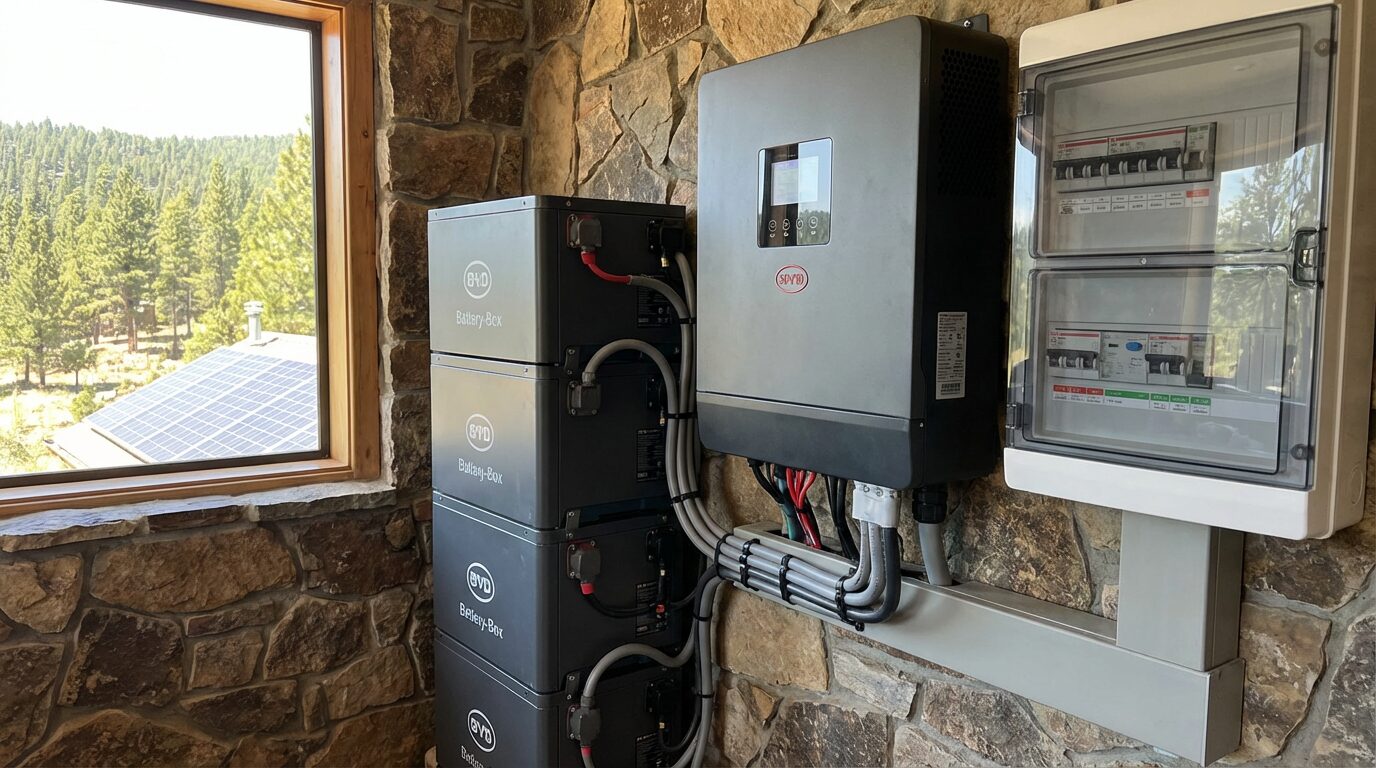


Electric Cars From BYD Store More Energy Than Many Off-Grid Homes Consume in a Day. The Temptation Is to Use This Battery as a Definitive Solution. The Technical and Financial Reality Shows Where the Idea Works and Where It Becomes an Expensive Risk.
Using the battery of an electric car from BYD to power an off-grid home seems like an obvious solution. A hatchback like the BYD Dolphin has about 44.9 kWh of capacity in the entry-level version, a number that impresses when compared to the daily consumption of many autonomous households. In theory, this could mean two to four days of energy for an average house with moderate use.
However, the calculation that seems to close on capacity opens a hole in power delivery, electrical integration, and lifespan. The central point is not just how much the battery stores, but how it delivers that energy continuously and safely. It is at this turning point that the conversation moves from marketing to the physics of the system.
The LFP chemistry from BYD is a true asset. It offers more cycles, thermal stability, and lower fire risk compared to other chemistries, as BYD itself emphasizes when describing the Blade Battery in its technical materials (referenced in 2024). However, designing for vehicle traction is not the same as designing for daily stationary use.
-
Friends have been building a small “town” for 30 years to grow old together, with compact houses, a common area, nature surrounding it, and a collective life project designed for friendship, coexistence, and simplicity.

-
This small town in Germany created its own currency 24 years ago, today it circulates millions per year, is accepted in over 300 stores, and the German government allowed all of this to happen under one condition.

-
Curitiba is shrinking and is expected to lose 97,000 residents by 2050, while inland cities in Paraná such as Sarandi, Araucária, and Toledo are experiencing accelerated growth that is changing the entire state’s map.

-
Tourists were poisoned on Everest in a million-dollar fraud scheme involving helicopters that diverted over $19 million and shocked international authorities.

To separate fact from illusion, it’s worth looking at the complete ecosystem. A car integrates battery, inverters, and control in a closed system; in off-grid situations, success depends on precisely coupling inverter, BMS, protections, and communications. This is where makeshift adaptations often fail.
Capacity, Daily Consumption, and The Mistake of Confusing Autonomy with Power Delivery


A capacity of 40 to 60 kWh in an electric vehicle is impressive, but autonomy is not just about kWh. A typical off-grid home works with load peaks at specific times, such as refrigerator starts, pumps, and microwaves. If the interface between battery and house cannot sustain those peaks, the experience degrades even with plenty of stored energy.
In vehicles, the architecture favors peak power for short durations and frequent recharging. In autonomous homes, the goal is efficiency and consistency with minimal losses and heat. As the International Energy Agency reminds us, the philosophy of stationary use requires more stringent cycle management and conversion efficiency than electric transport (IEA, Global EV Outlook 2024).
The practical result is that what seems like slack in kWh can become a bottleneck at the inverter and at control. The question would shift from whether it works to how long it works well without penalizing the battery.
BYD’s LFP Chemistry Helps, But Traction Design Does Not Replace Stationary Design
BYD popularized the Blade Battery LFP, celebrated for its thermal safety and durability. The brand typically offers 8 years of warranty for the traction pack, which instills confidence in the consumer (BYD Brazil, technical specifications 2023-2024). This does not make residential application automatic, because the profile of daily discharge and average depth of discharge changes radically.
At home, usage tends to be daily and deep, with long cycles and multiple AC-DC conversions. Even with LFP, each inefficient conversion generates heat and heat accelerates degradation. The chemistry helps, but the system design is what dictates the real lifespan in the stationary scenario.
Inverter, BMS, and Electrical Integration, Where Adaptation Often Fails
A car is a closed system where battery, BMS, and inverters speak the same language. Trying to replicate this in a home requires matching voltages, protocols, current limits, protections, and firmware. Without proper communication with the BMS, operation can drift outside the safe window for charging and discharging.
Another often overlooked point is the coordination of protections. Fuses, circuit breakers, contactors, and thermal sensors need to be adjusted to the stationary profile. Makeshifts create electrical and safety risks that nullify any cost gains in the short term.
There’s also compatibility with the residential inverter. Continuous power, peak current, and harmonics need to be addressed to avoid drops, disconnections, and losses. Integrators report that the engineering phase consumes time and money, and those who skip this phase often learn the hard way, with rework and premature degradation.
In mature markets, V2H and V2G solutions are advancing with their own hardware and standards, reducing risks. The IEA cites movements towards standardization and commercial pilots in 2023-2024, but emphasizes that widespread adoption requires guaranteed interoperability and robust certifications.
That’s why the difference between a functioning prototype and a repeatable and safe system lies less in the battery itself and more in the end-to-end certified integration.
Efficiency, Depth of Discharge, and Degradation, What Changes in Continuous Residential Use
At home, the key is to maintain high conversion efficiency and depth of discharge within healthy ranges. Daily cycles of 70 to 90% DoD, if poorly managed, compress lifespan. Even with LFP, operating hot and without proper cell balancing accelerates capacity losses.
Safety standards for storage, like IEC 62619 for batteries and UL 9540 for systems, align design, testing, and risk mitigation. When the set meets these references, the predictability of lifespan improves and technical insurance tends to accept the risk with fewer reservations.
When The Solution Becomes Mature, Stationary Systems BYD Battery-Box and V2H With Standards
BYD offers stationary lines like the Battery-Box, designed for integration with market inverters, communication with BMS, and international certifications. These kits are made for residential use, with compatible load curves and thermal protection, which enhances reliability.
Meanwhile, the V2H feature is only solid when there is approval of the vehicle, bidirectional system, and home system under the same standards. Without this, even if it works, it becomes a luxury workaround with low replicability and high risk of maintenance surprises.
In practice, BYD’s technology proves that the quality standard has risen. What dies is the traditional off-grid, not the project that ignores cycles, BMS, efficiency, and certification.
Costs and Market Impact, The Account Changes When the Project is Professional
When migrating from vehicle adaptations to certified stationary solutions, the price goes up. Compatible inverters, gateways, protection, and commissioning enter the budget and undermine the narrative of absolute cheapness. The gain comes in predictable lifespan and lower operational risk.
According to technical materials from BYD itself and inverter manufacturers consulted in 2024, certified integration shortens installation time, facilitates support, and reduces losses. For integrators, this means fewer corrective calls and more standardization, which is critical to scaling projects in Brazil.
In the end, the decision is strategic. Paying more for a stationary system with clear warranties and replicable performance tends to cost less over the life cycle than insisting on makeshift adaptations of vehicle batteries.
What Is at Stake in Brazilian Off-Grid
Answering whether it’s possible to operate an off-grid house with BYD technology is simple on paper and complex on-site. Technically, it is possible. With safety, control, and predictable lifespan, only when the system is born stationary and certified. Outside of that, it works, but the margin for error increases and scalability decreases.
And you, where do you stand in this healthy sector debate, V2H as the future or expensive makeshift that ignores the daily reality of maintenance and integration? In your next project, would you risk adapting an electric car battery or prefer to invest in a certified stationary solution? Leave your comment and share your real field experience, including both successes and setbacks. Well-founded technical debate helps raise the standard of off-grid systems in Brazil.










Para projetos elétricos na Vale a pena improviso, aí é onde o barco sai caro sem falar nas consequências que pode acontecer
Barato sai caro