





 Portuguese
  English
  Spanish
  3 min of reading
  0 comments


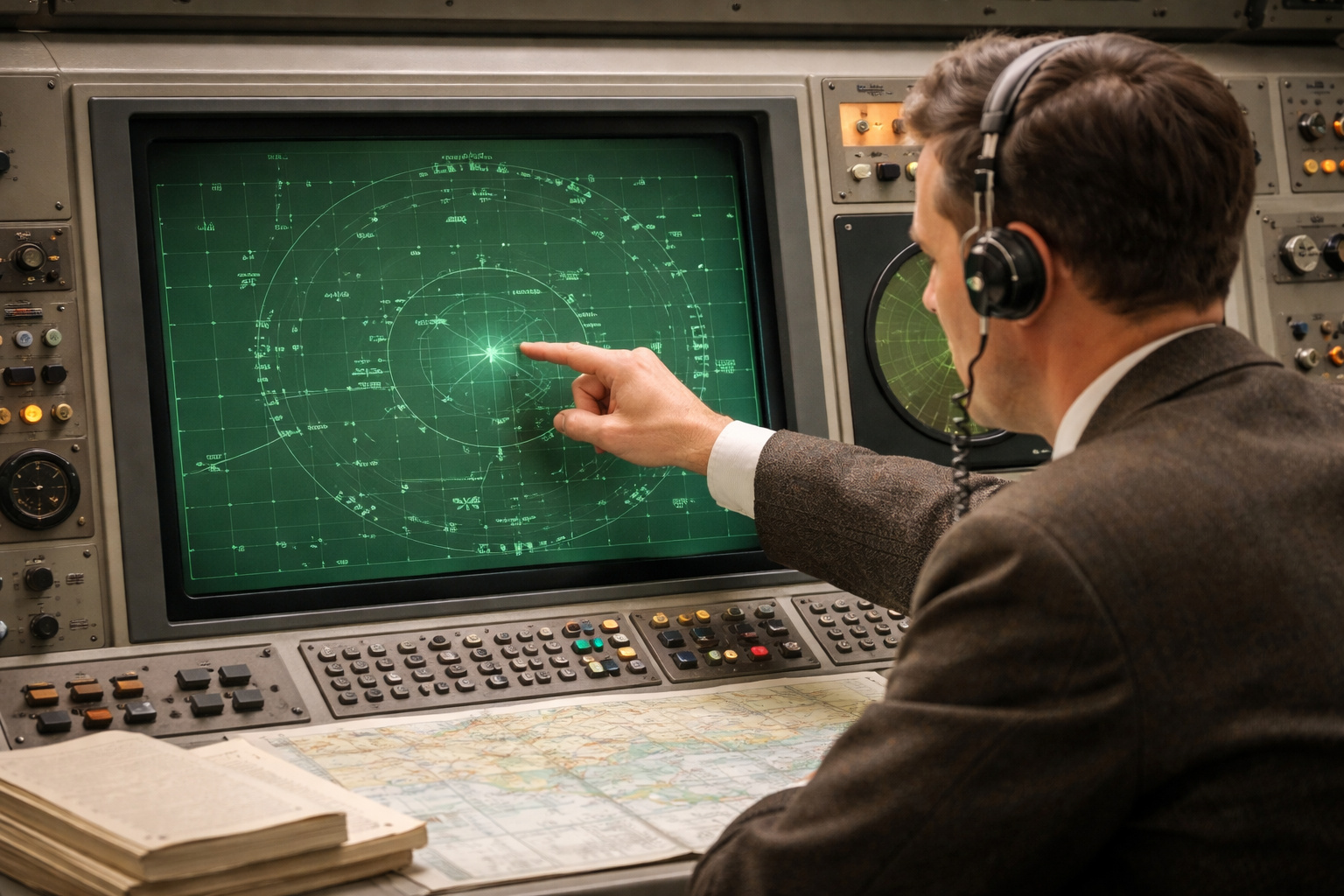
Technology Emerged for Air Traffic Control Decades Before Arriving on Smartphones and Changing the Way We Interact with Screens
A significant historical technological innovation began long before the smartphone era and, therefore, still generates surprise.
The first capacitive touch screen was developed in 1965 by British engineer Eric Johnson at the Royal Radar Establishment in the UK.
The system was designed for use in air traffic control and, thus, met a critical operational need.
This historical fact is cited in technical records from the time and later in analyses published by specialized technology outlets.
Thus, the origin of the touch screen is linked to industrial and governmental applications, not to the consumer market.
Technical Development Marks the First Advances of the Touch Screen
In the following years, the technology continued to evolve and consequently gained new applications.
In 1971, Samuel Hurst developed the touch sensor called “Elograph,” expanding the possibilities of human-machine interaction.
This advancement represented an important step and, at the same time, consolidated research on touch-sensitive interfaces.
Later, in 1983, HP launched the HP-150, one of the first commercial computers with touch technology based on infrared sensors.
With this, the feature began to be incorporated into the corporate environment and ceased to be exclusively experimental.
Tests in the Automotive Industry Reinforce the Expansion of Technology
In addition to the computing sector, the automotive industry also tested tactile interfaces.
In 1985, the Buick Riviera was equipped with a touch-sensitive panel, demonstrating the versatility of the system.
Still, despite these experiences, the technology remained restricted to specific niches.
Therefore, its widespread adoption had not yet occurred, even after two decades of technical development.
-
Motorola launched the Signature with a gold seal from DxOMark, tying with the iPhone 17 Pro in camera performance, Snapdragon 8 Gen 5 that surpassed 3 million in benchmarks, and a zoom that impresses even at night.

-
Satellites reveal beneath the Sahara a giant river buried for thousands of kilometers: study shows that the largest hot desert on the planet was once traversed by a river system comparable to the largest on Earth.

-
Scientists have captured something never seen in space: newly born stars are creating gigantic rings of light a thousand times larger than the distance between the Earth and the Sun, and this changes everything we knew about stellar birth.

-
Geologists find traces of a continent that disappeared 155 million years ago after separating from Australia and reveal that it did not sink, but broke into fragments scattered across Southeast Asia.

Apple Made Multitouch Popular in 2007
Decades later, in January 2007, during the Macworld Conference & Expo, Apple introduced the iPhone.
The device used multitouch technology and, in this way, allowed gestures like “pinch-to-zoom.”
Although the company did not invent the touch screen, it transformed its application by making it accessible and intuitive.
Accounts published in biographies and interviews indicate that Steve Jobs initially showed skepticism about the concept.
However, the company’s engineers created functional prototypes and thus convinced leadership to integrate the feature into the final product.
Transformation of Technical Tool into Everyday Item
What began in 1965 as a solution for air control evolved throughout the 70s and 80s.
Later, it went through commercial computers and automotive tests before reaching the average consumer.
Only in 2007, with the launch of the iPhone, was the technology widely disseminated.
Thus, a technical innovation developed for critical environments became a central element of contemporary digital life.
Today, when we use smartphones and other touch-sensitive devices, few remember that this technology was born in British governmental laboratories over four decades before the iPhone and that its first use was related to airspace security.
Did you imagine that the touch screen emerged to control air traffic before transforming the smartphone industry?








Seja o primeiro a reagir!