





 Portuguese
  English
  Spanish
  5 min of reading
  0 comments


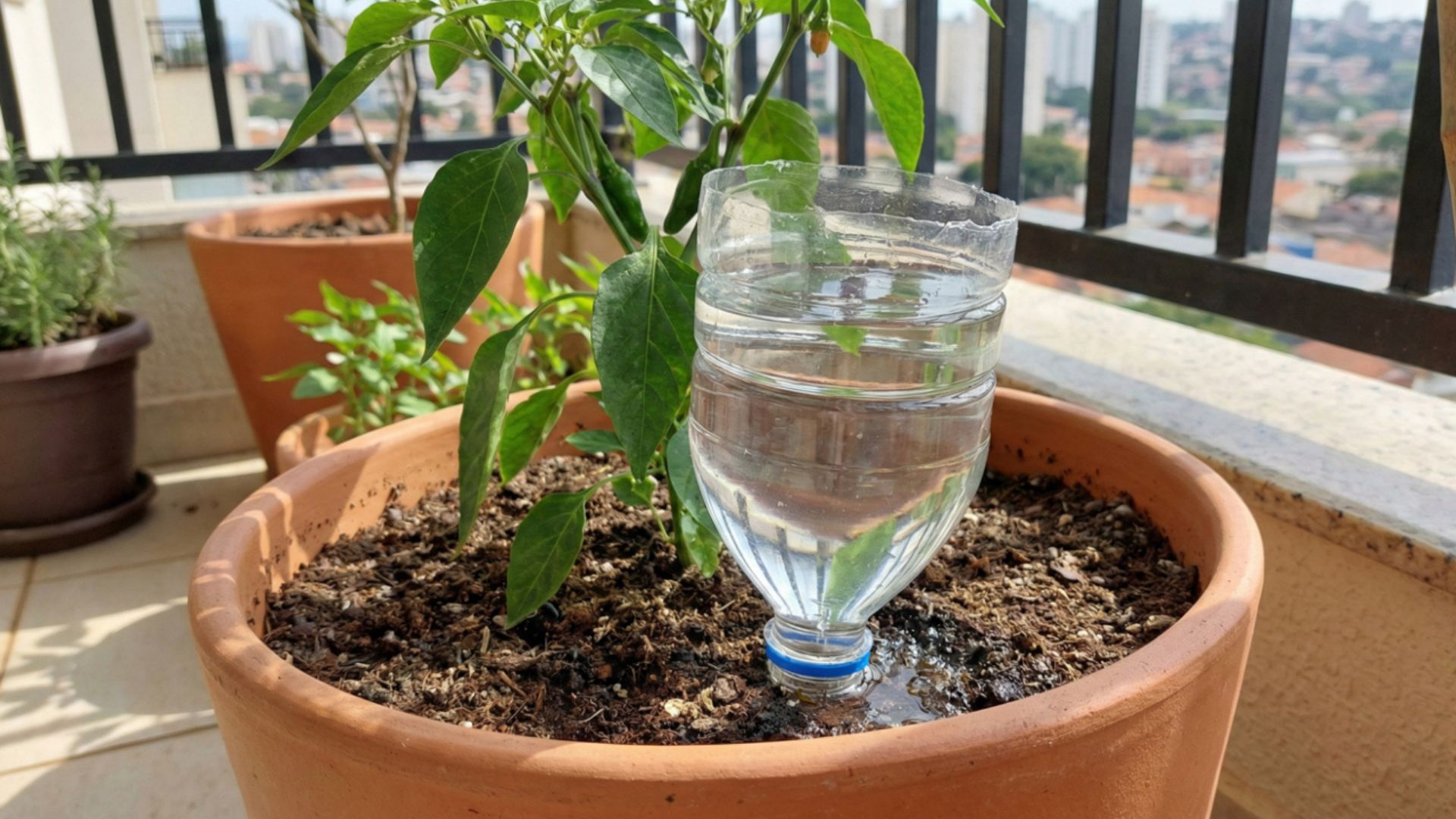
Simple Technique Transforms PET Bottle Into Homemade Drip System and Helps to Keep Soil Moisture More Stable in Pots and Beds, Reducing Fluctuations Between Drought and Excess Water with Easy and Low-Cost Adjustment.
Using a cut and inverted PET bottle in pots and beds has become a household resource for delivering water slowly near the roots, reducing sharp variations between dry soil and excessive watering, something common when irrigation depends on irregular schedules.
In practice, the technique works as an improvised drip system: the container becomes a reservoir, water flows through small holes, and infiltration occurs gradually, which can help keep moisture more stable on hot days or in very sunny places.
Despite its popularity on social media, exact results vary according to bottle size, the number and diameter of holes, substrate type, and pot drainage, so there is no guaranteed release time for water in all cases.
-
Friends have been building a small “town” for 30 years to grow old together, with compact houses, a common area, nature surrounding it, and a collective life project designed for friendship, coexistence, and simplicity.

-
This small town in Germany created its own currency 24 years ago, today it circulates millions per year, is accepted in over 300 stores, and the German government allowed all of this to happen under one condition.

-
Curitiba is shrinking and is expected to lose 97,000 residents by 2050, while inland cities in Paraná such as Sarandi, Araucária, and Toledo are experiencing accelerated growth that is changing the entire state’s map.

-
Tourists were poisoned on Everest in a million-dollar fraud scheme involving helicopters that diverted over $19 million and shocked international authorities.


How the Inverted PET Bottle Affects Soil Moisture
As it releases water gradually, the method tends to concentrate moisture in the area where the plant absorbs water most efficiently, preventing the entire applied volume from running off at once through the sides or bottom, especially in pots with light substrate.

As water arrives in a continuous and more predictable flow, it decreases the chance of alternation between “thirst” and “saturation,” a condition that often favors intermittent wilting, irregular growth, and the appearance of fungi when the soil remains saturated.
Still, homemade drip irrigation does not replace basic management criteria, such as observing the specific needs of each species, checking the water runoff at the bottom of the container, and adjusting the replacement frequency according to the season and sun exposure.
Localized Irrigation and Waste Reduction in the Pot
Localized irrigation is described in agronomy as a strategy that directs water to the root zone and helps to reduce losses from evaporation and surface runoff compared to broad applications, such as hoses or sprinkling.
In the case of the PET bottle, the principle is similar, but without the fine flow control of commercial systems, which makes it essential to observe whether the soil is absorbing at the right pace, without creating persistent puddles or leaving dry areas for long periods.
When water enters less abruptly, it also reduces the occurrence of “washing” of the substrate in a single watering, where water crosses the pot quickly and can carry away fine particles and soluble nutrients, especially in small containers.
Step-by-step to Set Up the Drip System with a PET Bottle
The most common model starts with a clean bottle cut in half, using the top part as an inverted funnel, while the cap receives small perforations so that water flows out slowly, instead of pouring out the contents in a few minutes.
Next, it is recommended to secure the neck to the substrate carefully not to crush roots, leaving the set firm enough not to topple, and then fill the reservoir to monitor, in the first few hours, if the flow matches the type of plant.
If the water disappears quickly and the surroundings become heavy and shiny, the adjustment usually involves reducing the number of holes or decreasing the diameter, while the absence of flow for a long time may indicate holes that are too small or compacted substrate around.

It is worth considering that more structured versions use attached drippers and leakage tests to prevent water from escaping through threads or gaps, which can distort the expected functioning.
When the Trick Works Best in Pots and Beds
In medium pots and small beds, the inverted bottle is often used as support during periods of heat or short absence, as the reservoir helps to maintain a gradual supply without relying on someone to water daily, as long as drainage is correct.
In containers with poor drainage, very clayey soil, or plants that prefer to dry out between waterings, the method can keep moisture above ideal, favoring bad odors and fungi, which often requires reducing dripping and improving substrate aeration.
Meanwhile, plants with high water demand, such as certain vegetables, tend to respond better to continuous supply, as long as the flow is not intense enough to saturate the soil and compromise root oxygenation.
There are also technical assessments on drip irrigation with plastic bottles in agricultural contexts, indicating that performance depends on variables such as hole size and the bottle height relative to the soil.
Practical Adjustments to Avoid Common Watering Mistakes
If the leaves wilt between one replenishment and another, the correction usually involves bringing the drip point closer to the root zone or increasing the reservoir capacity, always observing if the water infiltrates and does not create a waterlogged area beside it.
When the soil remains dark and heavy for days, the most frequent indication is excessive flow, a situation where reducing holes and reviewing the drainage of the pot helps to recover the healthy alternation of moisture and oxygenation around the roots.
If the bottle stays full for too long, in addition to lightly enlarging the perforations, it is often necessary to loosen the surface substrate because compaction can prevent air from entering and block the flow, producing irregular dripping.
Finally, it is recommended to maintain hygiene and replenish with clean water, as residues can clog holes and alter flow, and the initial observation is the step that most reduces failures, as the system is not standardized and changes according to each pot and cultivated species.









-

-

3 pessoas reagiram a isso.