





 Portuguese
  English
  Spanish
  4 min of reading
  0 comments


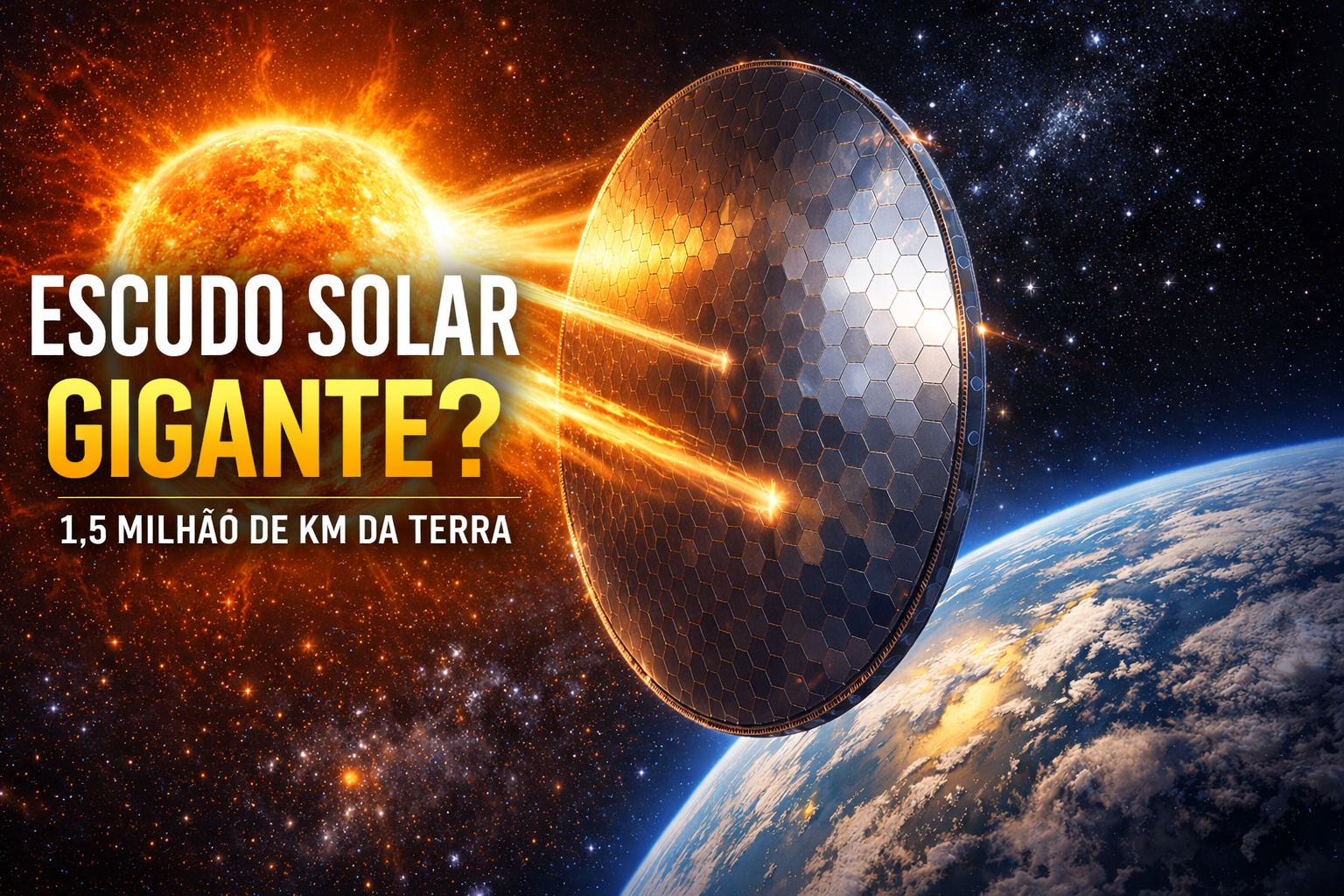
Studies Propose to Position a Solar Shield at the L1 Point, 1.5 Million km from Earth, to Reduce Solar Radiation and Mitigate Global Warming.
The proposal to install a solar shield in space is part of a set of ideas known as Solar Radiation Management (SRM), a branch of climate geoengineering that aims to reduce the amount of solar radiation absorbed by Earth. The central idea is to position a structure between the Sun and the planet to block a small fraction of the incoming solar light. The studies analyze the positioning of the system at the Lagrange Point L1, a gravitationally stable region located approximately 1.5 million kilometers from Earth, in the direction of the Sun. At this point, the gravitational forces of the Earth and the Sun balance each other, allowing an object to remain relatively stable with less energy expenditure for orbital correction.
What Is the Lagrange Point L1 and Why Is It Strategic
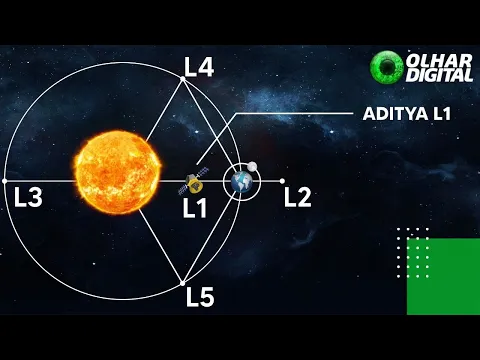
Lagrange points are specific positions in space where the gravitational forces of two celestial bodies balance with the centrifugal force. The L1 point is located between the Earth and the Sun.

Several scientific missions already utilize this strategic position, such as the SOHO (Solar and Heliospheric Observatory) satellite, which monitors solar activity. The choice of L1 for a solar shield occurs because any structure positioned there would intercept the radiation before it reaches Earth.
-
Motorola launched the Signature with a gold seal from DxOMark, tying with the iPhone 17 Pro in camera performance, Snapdragon 8 Gen 5 that surpassed 3 million in benchmarks, and a zoom that impresses even at night.

-
Satellites reveal beneath the Sahara a giant river buried for thousands of kilometers: study shows that the largest hot desert on the planet was once traversed by a river system comparable to the largest on Earth.

-
Scientists have captured something never seen in space: newly born stars are creating gigantic rings of light a thousand times larger than the distance between the Earth and the Sun, and this changes everything we knew about stellar birth.

-
Geologists find traces of a continent that disappeared 155 million years ago after separating from Australia and reveal that it did not sink, but broke into fragments scattered across Southeast Asia.

How a Space Solar Shield Would Work
The studies discuss different configurations:
- A large reflective disk or film
- A cloud of multiple small satellites
- Swarms of microstructures that would act as solar filters
The goal would be to reduce the incoming solar radiation by approximately 1% to 2%, a value considered theoretically sufficient to compensate for part of the warming caused by increased concentrations of carbon dioxide in the atmosphere.
This reduction would be small in absolute terms but significant in the global energy balance.
Scale and Estimated Dimensions
Some academic estimates indicate that to block about 1% of sunlight, a system stretching thousands of kilometers or a massive set of coordinated small elements would be necessary.
Studies published in scientific journals analyze proposals such as:
- Disks with diameters exceeding 1,000 km
- Trillions of small “space flyers”
- Ultralight structures made of microscopically thin materials
The total mass of the system would depend on the chosen design, but the logistical challenges would be considerable.
Estimated Costs and Economic Viability
Preliminary assessments suggest that the implementation of a large-scale solar shield could cost trillions of dollars, depending on the technology used and the launch strategy.
The cost would involve:
- Development of ultralight materials
- Launching components into space
- Assembly in orbit
- Maintenance and position correction
Some studies explore the possibility of partial manufacturing in space to reduce transportation costs from Earth.
Relationship with Solar Radiation Management (SRM)
The space solar shield is one of the most ambitious proposals within the SRM concept. Other discussed approaches include:
- Aerosol injection in the stratosphere
- Marine cloud whitening
- Modification of reflectivity of terrestrial surfaces
The differentiator of the space shield is that it would act before solar radiation enters the atmosphere, directly interfering with the incoming energy flow.
Potential Climatic Impacts
Climate modeling indicates that reducing a fraction of solar radiation could lower the average global temperature.
However, studies also highlight that regional energy redistribution may produce differentiated effects on rainfall patterns, atmospheric circulation, and ocean dynamics.
Most analyses emphasize that any implementation would require constant monitoring and advanced climate modeling.
Technical Limitations and Challenges
Among the identified technical challenges are:
- Long-term orbital stability
- Material degradation from solar radiation
- Risk of collision with space debris
- International governance of intervention
Moreover, the construction of a structure of this magnitude exceeds the scale of any space project previously undertaken.

So far, the space solar shield remains in the theoretical and conceptual realm. There is no government program underway to build such a structure.
The idea is discussed in scientific papers, conferences on geoengineering, and academic analyses on climate mitigation.
The Global Context of Geoengineering
The proposal arises in the context of the continuous increase in atmospheric concentrations of greenhouse gases and the global difficulties in rapidly reducing emissions.
Studies addressing the space solar shield treat it as a technical intervention hypothesis that would require international cooperation and specific regulation before any implementation.
The proposal to install a solar shield at the L1 point represents one of the broadest ideas ever discussed within climate geoengineering. With a strategic positioning 1.5 million kilometers from Earth, the concept aims to reduce part of the incoming solar radiation as a way to alter the planet’s energy balance.
So far, it remains an object of academic research and theoretical modeling, without practical application under development.








-

Uma pessoa reagiu a isso.