





 Portuguese
  English
  Spanish
  3 min of reading
  0 comments


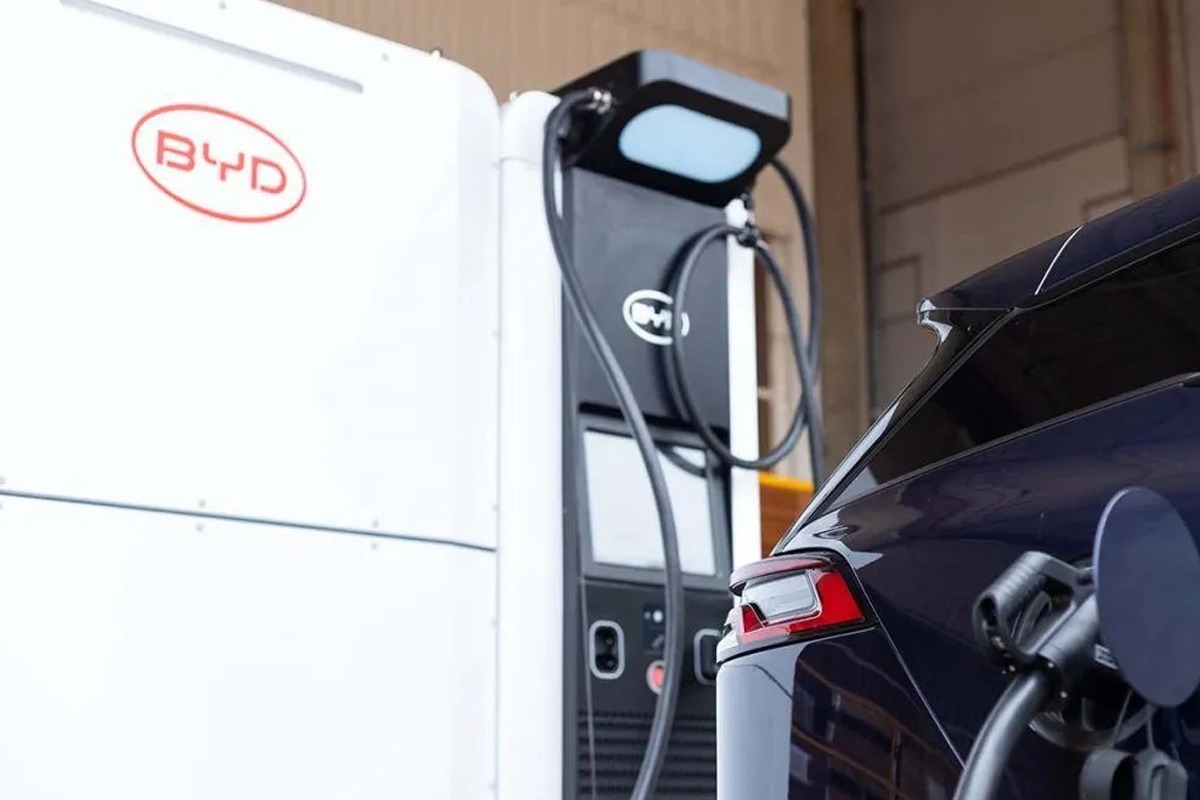
BYD Revolutionizes The Market With New 1,500 kW Charging System. Technology Promises 400 km Of Range In Just 5 Minutes, Surpassing Tesla And Xpeng In 2026. Learn Everything About The New Ultra-Fast Stations
The electric vehicle industry is about to break the traditional “refueling time” barrier. Leaked information and technical reports from China indicate that BYD is finalizing tests of its second-generation megawatt charging system. The specifications are astronomical: the new charger can support up to 1,500 kW of power and 1,500 A of current, a 1.5 times jump compared to the cutting-edge technology launched by the company in early 2025.
Rumors Indicate That BYD Is Preparing 1,500 kW Super Charger
The big promise of this new architecture, nicknamed “10C+ charging” in Chinese tech forums, is the ability to add approximately 400 kilometers of range in just five minutes. To give you an idea of the scale, this performance puts BYD at the top of a global race where brands like Tesla (500 kW) and Xpeng (800 kW) are still trying to reach the first megawatt mark.
The leaked design reveals a high-density “T” shaped station, occupying only 1.5 m², but equipped with ultra-light liquid-cooled cables (weighing only 2 kg). This solves one of the biggest problems with powerful chargers: the excessive weight of the cables, allowing any driver to handle the equipment with ease.
-
Jeep Avenger begins production in Brazil, debuting as the brand’s new entry-level SUV and inaugurating an unprecedented phase by becoming the first national Jeep manufactured outside of Goiana, as part of a R$ 3 billion plan.
-
Costing R$ 12,490, the new Shineray Urban Lite 150 “cheap one” arrives in Brazil with a CVT transmission, digital dashboard, and LED lights, making it more affordable than the Biz and targeting those who want to abandon the bus.
-
Ducati brings to Brazil the Superleggera V4 Centenario: 228 hp that become 247 with a track kit, carbon fiber and carbon-ceramic brakes, estimated price between R$ 1.5 and 2 million, deliveries only in 2027.
-
Used cars with electric steering for R$ 30,000: check out 5 practical and economical options for everyday use.


Network Engineering And Smart Storage
Charging a car at 1,500 kW requires more than just a good cable; it requires impeccable power grid management. BYD’s new system was designed with an input capacity of 2,100 kW, utilizing storage batteries integrated into the station itself.
This energy “buffer” strategy allows the station to consecutively charge more than 20 vehicles without overloading the local transformer. Furthermore, the wide voltage architecture (500 V to 1000 V) ensures that both top-of-the-line models, such as the Han and the Tang, and future models with more advanced battery chemistries can benefit from maximum speed.

The Global Expansion And The Market In 2026
By the end of 2025, BYD had already established a network of over 500 high-capacity stations in 200 Chinese cities. For 2026, the plans are even more ambitious: through strategic partnerships, the goal is to reach 15,000 stations. The company plans a three-tier network model:
- Main Stations: Ultra-high power centers (1,500 kW).
- Satellites: Support stations for medium-distance routes.
- Community Stations: “Youth” versions with power levels between 200 and 600 kW for daily urban use.
The Future Of The Sector
Although BYD has not yet issued an official confirmation about the exact commercial launch date of the 1,500 kW system, the presence of test units already installed in cities like Nanchang suggests that implementation is in an advanced stage. This move not only redefines what’s expected from an electric vehicle but also pressures competitors like Huawei, Zeekr, and Nio to accelerate their own megawatt solutions. In 2026, the consumer question will no longer be “what is the car’s range?” but rather “how many minutes does it take to charge?”
Additional Innovation: Thermal Management And Protection
External research indicates that, to support 1,500 Amperes, BYD has developed a new generation of connectors with silver alloy and thermal monitoring systems using artificial intelligence. The goal is to avoid overheating both the vehicle’s battery and the charging point. The system has an IP55 protection rating, ensuring safe operation in extreme weather conditions, from intense cold to scorching heat, which is crucial for the brand’s expansion into international markets like Europe and Latin America.









Seja o primeiro a reagir!