





 Portuguese
  English
  Spanish
  3 min of reading
  17 comments


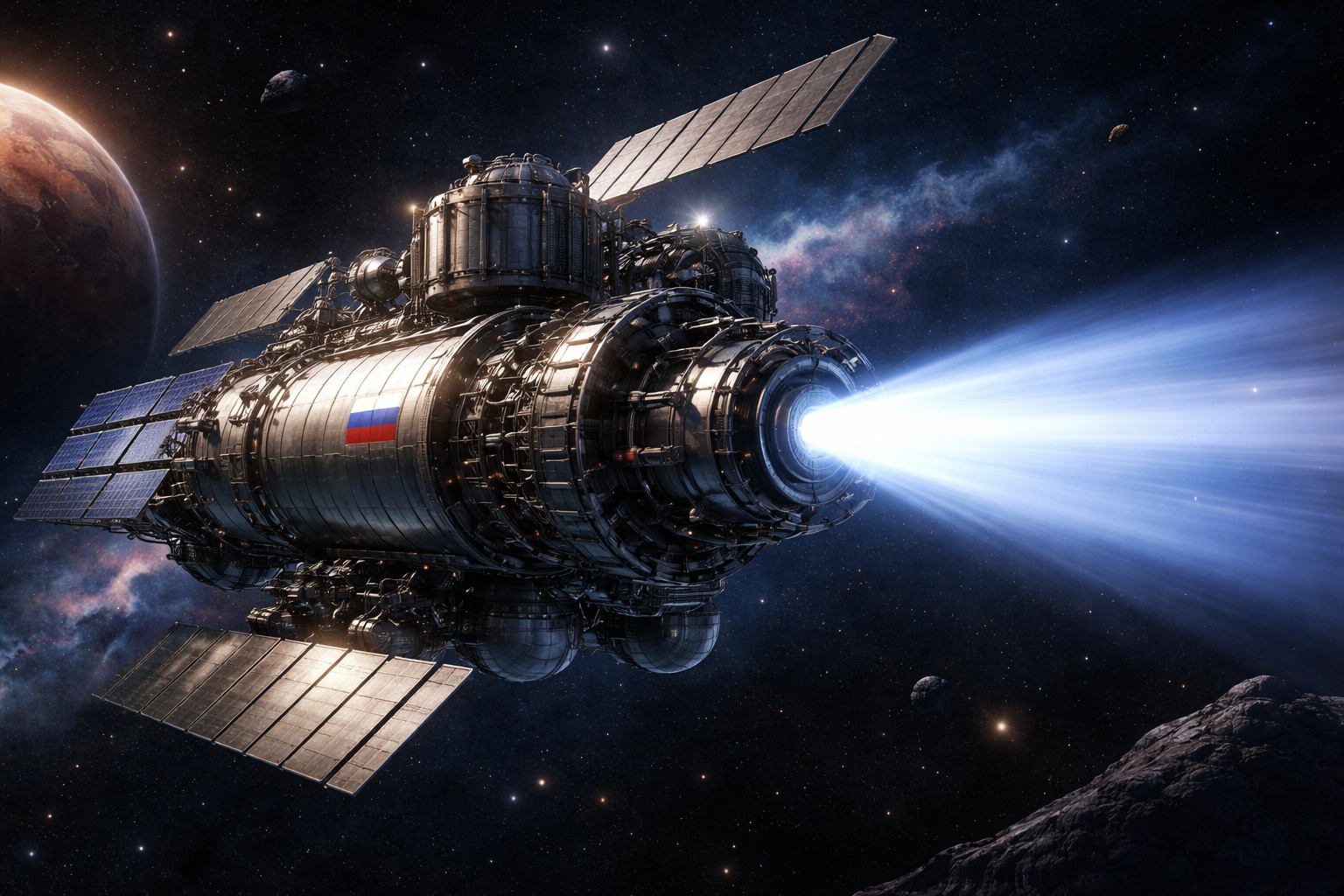


Troitsk Institute Technology Combines Hydrogen and Nuclear Reactor to Achieve 100 km/s in Deep Space
A high-impact scientific technological innovation was recently presented by Russian researchers, attracting attention from the international aerospace sector.
The Troitsk Institute, linked to Rosatom, is developing a plasma engine with an ejection speed of 100 kilometers per second, the equivalent of 360 thousand km/h.
The project was announced in 2024 through the state agency TASS and has already undergone laboratory tests in a controlled environment.
If the announced performance is confirmed under real conditions, the travel time to Mars could be reduced from months to weeks.
This advancement repositions Russia in the debate about advanced space propulsion technologies, traditionally dominated by chemical systems.
Technical Review Reveals Leap in Performance Compared to Chemical Rockets
The new system operates differently from the conventional rockets used by NASA and SpaceX.
While chemical engines burn fuel rapidly to generate initial thrust, the Russian engine uses electromagnetic fields to accelerate charged hydrogen particles.
According to Alexei Voronov, First Deputy Director of Science at the institute, the system accelerates protons and electrons to up to 100 km/s.
In comparison, traditional chemical rockets reach about 4.5 km/s.
This difference alters the efficiency pattern, as higher ejection speed reduces fuel consumption to achieve superior final acceleration.
Additionally, the engine was not designed for launch from Earth.
It is intended to act as a space tug in orbit, providing constant thrust over long periods.
This model favors prolonged interplanetary missions and expands the potential for deep space exploration.
-
Motorola launched the Signature with a gold seal from DxOMark, tying with the iPhone 17 Pro in camera performance, Snapdragon 8 Gen 5 that surpassed 3 million in benchmarks, and a zoom that impresses even at night.

-
Satellites reveal beneath the Sahara a giant river buried for thousands of kilometers: study shows that the largest hot desert on the planet was once traversed by a river system comparable to the largest on Earth.

-
Scientists have captured something never seen in space: newly born stars are creating gigantic rings of light a thousand times larger than the distance between the Earth and the Sun, and this changes everything we knew about stellar birth.

-
Geologists find traces of a continent that disappeared 155 million years ago after separating from Australia and reveal that it did not sink, but broke into fragments scattered across Southeast Asia.

Nuclear Architecture and Hydrogen as Energy Base
The project incorporates a mounted nuclear reactor, as solar panels would not provide enough energy to sustain the system.
The announced power reaches 300 kW in pulsed mode, surpassing current electric propulsion standards.
The chosen fuel is hydrogen, a light and abundant element.
According to researcher Yegor Biryulin, the low atomic mass of hydrogen allows for faster acceleration and lower fuel consumption.
Moreover, the engine avoids extreme heating of the plasma.
Two high-voltage electrodes create a directed flow, which reduces structural wear.
This approach increases durability and improves operational efficiency.
Comparison Between Propulsion Systems
• Classic Chemical Engine
Ejection Speed: ~4.5 km/s
Energy Source: Chemical Combustion
Main Use: Launch
• Current Plasma Engine (like NASA’s Psyche mission, launched in October 2023)
Ejection Speed: 30 to 50 km/s
Energy Source: Solar/Electric
Main Use: Orbital Maintenance and Probes
• New Russian Prototype
Ejection Speed: 100 km/s
Energy Source: Nuclear
Main Use: Intense Interplanetary Travel
Power: 300 kW
Tests, Timeline, and Technical Challenges
The first prototype was tested in a 14-meter vacuum chamber, simulating space conditions.
According to the Troitsk Institute, the engine operated for 2,400 continuous hours, a duration compatible with a mission to Mars.
This result was announced in 2024 and represents a significant stage in development.
However, technical challenges remain.
The use of a nuclear reactor in space requires international agreements and strict safety protocols.
Additionally, thermal control and radiation protection still require further solutions.
If the timeline is maintained, tests under real conditions could occur by 2030.
Until then, technical evaluations and safety reviews will continue to be conducted.
The Future of Interplanetary Propulsion
Experts are monitoring the progress cautiously.
Although the announced performance is impressive, practical application will depend on further validations.
Nonetheless, the concept of nuclear plasma propulsion expands the possibilities for intense interplanetary travel.
In light of this scenario, the question remains: will the next generation of Mars missions be powered by traditional chemical engines or nuclear plasma systems capable of redefining space exploration?








Fora as questões políticas, eu fico impressionado com as surras cotidianas de todos os lados que a coitada da língua portuguesa toma nas mãos do brasileiro. São opiniões mal formuladas, mal redigidas ou até indecifráveis, que empobrecem o discurso e carregam o estigma de serem descartáveis e pouco levadas a sério. No entanto, opina-se sobre qualquer assunto com a empáfia de um catedrático que acha que sabe tudo, mas a sua expressão escrita é de uma precariedade digna do fundamental.
Não Importa quem fez primeiro, no fundo a humanidade acaba se beneficiando….exemplo, falam mão dos americanos, mas acho que querem iphone, possuem Netflix, ficam postando baboseira na internet, utilizam Waze (se possuem carro), ou se acham patrão andando de Uber….
Paremos de inveja e aprendamos a aplaudir quem merece, independente da nação, no final todos seremos beneficiados…
É incrível que ainda existem pessoas torcendo por um país sem liberdade, que têm um ditador que já está no poder há mais de 25 anos e que já mando para a morte nessa guerra contra a Ucrânia, mais de 1 milhão dos seus próprios soldados.