





 Portuguese
  English
  Spanish
  4 min of reading
  2 comments


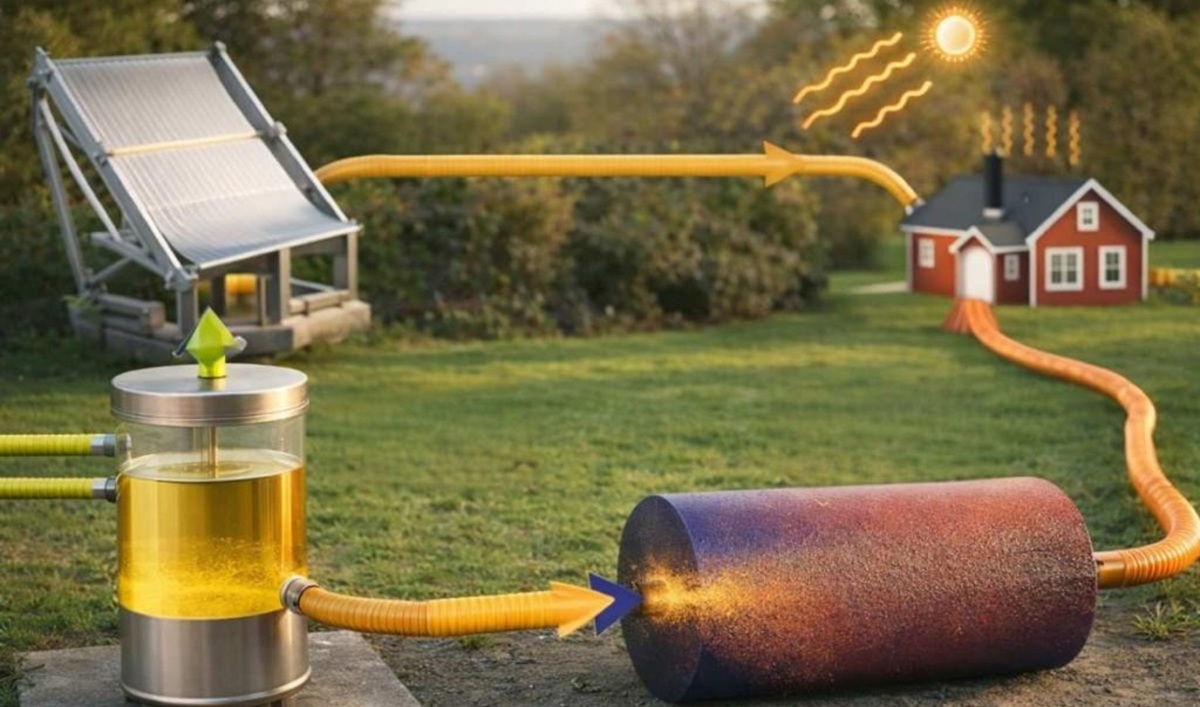


Technology Developed by Researchers at the University of California Uses Reversible Molecules Capable of Storing Solar Energy in Liquid State for Months, Allowing Heat to be Released on Demand Without Batteries, Without Electrical Conversion and With Energy Density of 1.6 MJ/kg, Paving the Way for New Forms of Heating and Thermal Storage
The development of a molecular fluid capable of storing solar energy and releasing it months later as usable heat was presented by researchers at the University of California, Santa Barbara, proposing a direct alternative for storing energy without electrical conversion and without conventional batteries.
For centuries, the idea of capturing natural energy for later use remained a recurring technological ambition.
The new system proposes to store energy directly in molecular bonds, keeping heat trapped without relying on electricity or the circulation of electrons.
-
Motorola launched the Signature with a gold seal from DxOMark, tying with the iPhone 17 Pro in camera performance, Snapdragon 8 Gen 5 that surpassed 3 million in benchmarks, and a zoom that impresses even at night.

-
Satellites reveal beneath the Sahara a giant river buried for thousands of kilometers: study shows that the largest hot desert on the planet was once traversed by a river system comparable to the largest on Earth.

-
Scientists have captured something never seen in space: newly born stars are creating gigantic rings of light a thousand times larger than the distance between the Earth and the Sun, and this changes everything we knew about stellar birth.

-
Geologists find traces of a continent that disappeared 155 million years ago after separating from Australia and reveal that it did not sink, but broke into fragments scattered across Southeast Asia.

The concept stems from a known energy challenge. Solar production occurs during the day, while energy consumption happens at various times.
The proposal aims to store solar energy without using electrical grids or traditional battery-based systems.
Molecular System Created to Store Solar Energy Directly
The team led by Associate Professor Grace Han developed a molecular thermal solar energy storage system known by the acronym MOST. The technology was specifically created to store energy in thermal form, dispensing with batteries.
The fluid contains modified pyrimidine molecules that react when exposed to sunlight.
Upon receiving radiation, each molecule alters its structure, assuming an elongated configuration with higher energy content stored internally.
This molecular transformation works as a reversible mechanism. The energy remains accumulated in the new chemical configuration, allowing energy to be stored without significant losses over time.
The material can remain in this energy state for months and even over a year at room temperature. According to the results presented, no significant losses or self-discharge processes were observed during storage.
Reversible Molecules Allow Energy to be Stored for Long Periods
When heat is needed, the system requires only a specific stimulus. The application of additional heat or an acid catalyst causes the molecule to return to its original form.
In this reverse process, the previously stored energy is released directly as usable heat. After the release, the cycle can be repeated indefinitely, keeping the material reusable.
The operation has been compared to the behavior of photochromic lenses, which change state under solar exposure and return to their initial condition indoors. However, in this case, the goal is to manage thermal energy.
The molecular reversibility allows for control over when to release heat, creating an on-demand heating system independent of the immediate presence of the sun.
Thermal Performance Achieves Energy Density of 1.6 MJ/kg
The developed system showed an approximate energy density of 1.6 megajoules per kilogram. This value corresponds to about double the capacity observed in conventional lithium-ion batteries.
Despite the numerical comparison, the fluid does not function as an electric battery. The system was designed solely to store thermal energy and release heat, eliminating losses associated with the conversion between electricity and chemical energy.
Laboratory tests demonstrated that the released heat was sufficient to boil water under ambient conditions. The experiment served as a practical validation of the amount of energy stored in the molecular fluid.
The result highlights the material’s ability to generate significant heat without combustion and without direct electricity supply.
Liquid Infrastructure Allows for Increased Capacity to Store Energy
One of the central aspects of the system is its liquid form. As it is a pumpable fluid, increasing the storage capacity does not require complex structural changes.
Expansion occurs simply with the addition of a larger volume of the solution. The liquid can flow through pipes, be stored in insulated tanks, and transported using conventional industrial infrastructure.
This feature led to the technical description of the concept as “bottled sun.” The fluid can be charged during the day in solar collectors and stored for later use.
Hours or months later, the accumulated heat can be used for water heating, food preparation, environmental conditioning, or low to medium temperature industrial processes.
Possibility of Storing Solar Energy Between Seasons
Among the applications discussed is the seasonal storage of energy. The system would allow for capturing solar energy during the summer and using it in the winter.
This type of storage presents challenges for electric batteries due to costs and losses over time. The observed molecular stability in the fluid emerges as a fundamental element in this scenario.
Integration with thermoelectric generators or thermal cycles is also being considered. This combination could allow for electric generation only when necessary, regardless of immediate solar incidence.
The model enhances energy flexibility by separating the moment of solar capture from the moment of thermal consumption.
Technology Can Fill Gap in Clean Thermal Storage
If it surpasses the laboratory phase, the system could act as a complementary component within the energy transition. The proposal does not replace electrical grids or conventional storage systems.
The focus is on filling a specific gap related to clean, reusable, and long-lasting thermal energy storage.
In residential applications, the fluid could meet demands related to heating and hot water production.
In industrial settings, the system can contribute to thermal processes where direct electrification presents limitations.
The technology can also operate in conjunction with photovoltaic systems, solar thermal energy, and heat pumps, allowing for better utilization of captured solar energy at different times.
The advancement presented demonstrates a controlled chemical transformation approach to store energy in a stable, reusable, and on-demand activatable manner, utilizing heat directly preserved in molecular bonds.








Tenho
Mais uma ótima alternativa !!!