





 Portuguese
  English
  Spanish
  4 min of reading
  0 comments


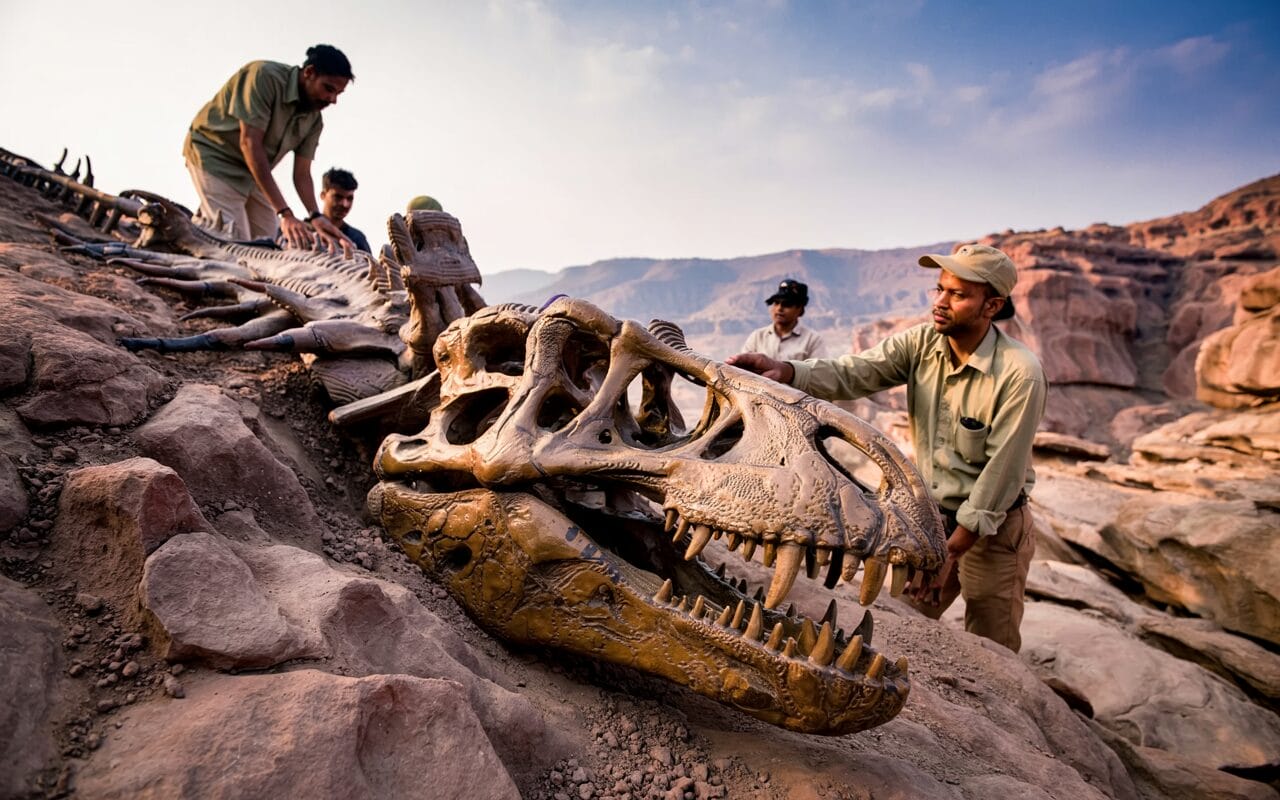
Researchers Discover New Carnivorous Dinosaur Species in India. Understand the Importance of This Discovery to Unravel the Great Mysteries of the Past.
A new species of carnivorous dinosaur has been identified in India and may change the understanding of the evolution of primitive theropods. Named Maleriraptor kuttyi, the species was described by paleontologists based on fossils found in the Andhra Pradesh region, in the central-southern part of the country. The discovery was made by an international team of researchers and published in a prominent paleontology scientific journal, reinforcing India’s relevance as one of the key territories in reconstructing the evolutionary history of dinosaurs.
The fossils revealed a small, bipedal dinosaur with characteristics that position it as an evolutionary link between the herrerasaurids of South America — some of the oldest known dinosaurs — and younger species of theropods found in North America. This finding helps fill a crucial gap in the fossil record of the Triassic period, providing clues about how these animals spread across continents during the fragmentation of the supercontinent Gondwana.
In addition to reinforcing India’s importance in the global paleontological scenario, Maleriraptor kuttyi highlights the role of new excavation technologies and morphological analysis in identifying previously unknown species. The discovery also raises new questions about the migration, diversification, and adaptation of carnivorous dinosaurs during the early chapters of the Mesozoic era.
-
Friends have been building a small “town” for 30 years to grow old together, with compact houses, a common area, nature surrounding it, and a collective life project designed for friendship, coexistence, and simplicity.

-
This small town in Germany created its own currency 24 years ago, today it circulates millions per year, is accepted in over 300 stores, and the German government allowed all of this to happen under one condition.

-
Curitiba is shrinking and is expected to lose 97,000 residents by 2050, while inland cities in Paraná such as Sarandi, Araucária, and Toledo are experiencing accelerated growth that is changing the entire state’s map.

-
Tourists were poisoned on Everest in a million-dollar fraud scheme involving helicopters that diverted over $19 million and shocked international authorities.


Learn More About the New Discovery
The animal lived on the planet about 220 million years ago, during the Upper Triassic period (Norian), in an area that currently corresponds to the central-southern part of India.
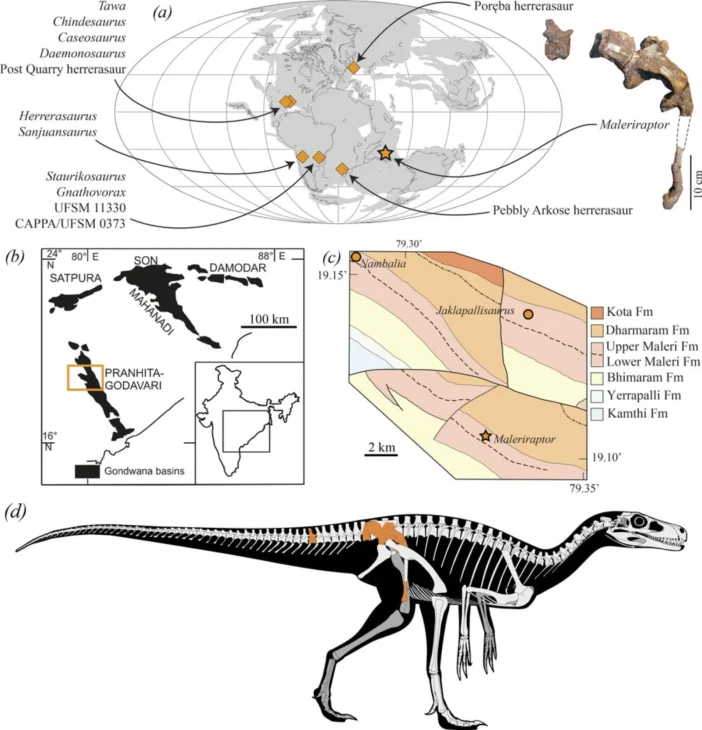
b) Map of the basins of Gondwana in India, highlighting the Pranhita-Godavari valley.
c) Detailed geological map of a portion of the Pranhita-Godavari valley indicating the type localities of the named dinosaurs from the Upper Maleri Formation.
d) Reconstruction of the skeleton of Maleriraptor kuttyi (drawing by M.S.G.) with the preserved bones represented in color.
A key piece of predators, the herrerasaurids are among the first known carnivorous dinosaurs, representing an early formation of bipedal dinosaurs that varied from 1.2 to 6 meters in length.
Until now, their record was primarily restricted to Carnian fossils (233-229 million years ago) found in Brazil and Argentina. According to Dr. Martín Ezcurra, a paleontologist from the Bernardino Rivadavia Argentine Museum of Natural Sciences and one of the study’s authors, herrerasaurids represent the oldest family of predators.
The new species of carnivorous dinosaur in India suggests that this group survived longer than previously thought and had a broader geographical distribution. The species was identified from fossils collected over four decades ago in the Upper Maleri Formation, in the Pranhita-Godavari Valley.
According to the researchers, at that time, the climate in India was more similar to that of the southern United States than to that of South America, which may explain why this species of herrerasaurid, like Maleriraptor and other reptile groups, were more commonly found in these regions.
Brazil and India Had Similar Faunas Millions of Years Ago
The researchers state that the presence of herrerasaurids in early Norian India and not in South America may be linked to the climate.
Paleoclimatic reconstructions indicate that the Asian country had temperatures and precipitation more similar to those of the southern United States. Additionally, the Upper Maleri Formation shows some similarities with fossil deposits in Brazil, suggesting that the two regions had similar faunas about 225 million years ago.
The researchers assert that the new species of carnivorous dinosaur in India shows that these survived in Gondwana at least until the beginning of the Norian, after the extinction of the rhynchosaurs. This partially fills a critical gap in the fossil record of this group.
With new discoveries, paleontologists hope to uncover new species that may clarify how dinosaurs diversified after the Triassic extinctions, paving the way for their dominance in the Jurassic period.
It is worth mentioning that scientists used phylogenetic methods to locate this dinosaur in the evolutionary history. The results indicate a key position, linking geographically different lineages. This discovery fills a temporal gap between the carnivorous faunas of the Norian and Carnian. It shows a persistence of herrerasaurids after the end of the rhynchosaurs, previously dominant herbivorous reptiles.
New Dinosaur Species Was Also Discovered in Mongolia
In addition to this discovery, researchers found a new species with striking claws on two digits, the remains of a previously unknown dinosaur species suggest that it resembled something like a sloth. Paleontologists unearthed the fossil in the Gobi Desert, Mongolia, and the discovery is unique because the sheath of the claw on one of the fingers is still intact.
Made of keratin, the same material as nails, this reveals that the claw was much longer than the underlying bones. Paleontologist Darla Zelenitsky, associate professor at the University of Calgary in Canada and co-author of a study on the discovery published in the journal iScience, says it is nearly foot-sized.
Furthermore, Darla mentions that this is by far the largest preserved claw that has this keratin sheath. The dinosaur is called Duonychus tsogtbaatari, honoring the Mongolian paleontologist Khishigjav Tsogtbaatar. It is noteworthy that this belonged to a group of awkward-looking dinosaurs known as therizinosaurs, which were part of the theropod family that includes Tyrannosaurus rex. Therizinosaurs, however, were herbivores or omnivores, not top of the food chain predators.










-

-

-

-

-

-

394 pessoas reagiram a isso.