





 Portuguese
  English
  Spanish
  5 min of reading
  0 comments


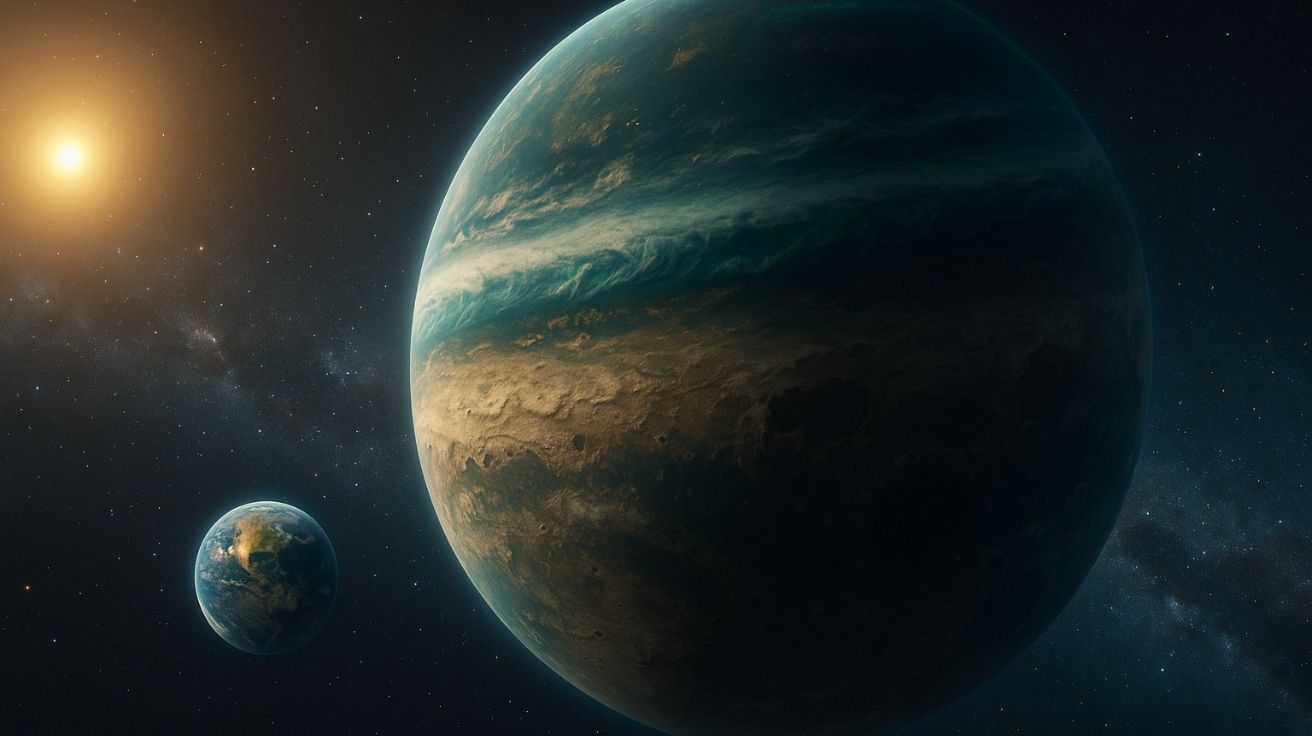
New Exoplanet Detected By Orbital Transit Variation Revolutionizes The Search For Habitable Worlds Around Sun-Like Stars, Challenging The Limits Of Current Astronomy
A new exoplanet nicknamed Kepler-725c, located about 2,472 light-years away from Earth, may be one of the most promising discoveries in the search for a “second home” beyond the Solar System. With approximately 10 times the mass of Earth and orbiting within the habitable zone of its star, this newly identified world presents conditions that may allow the existence of liquid water — essential for life.
The discovery, reported by The Daily Galaxy and detailed in a study published in Nature, was made possible thanks to an innovative technique called transit timing variation (TTV), capable of detecting hidden planets that escape traditional approaches.
What Makes Kepler-725c So Special
Kepler-725c orbits a G9V type star, similar to our Sun, but slightly cooler. Its orbit lasts 207.5 days, placing it within the so-called habitable zone, the region where temperatures allow water to remain in liquid state — one of the main prerequisites for life as we know it.
-
Motorola launched the Signature with a gold seal from DxOMark, tying with the iPhone 17 Pro in camera performance, Snapdragon 8 Gen 5 that surpassed 3 million in benchmarks, and a zoom that impresses even at night.

-
Satellites reveal beneath the Sahara a giant river buried for thousands of kilometers: study shows that the largest hot desert on the planet was once traversed by a river system comparable to the largest on Earth.

-
Scientists have captured something never seen in space: newly born stars are creating gigantic rings of light a thousand times larger than the distance between the Earth and the Sun, and this changes everything we knew about stellar birth.

-
Geologists find traces of a continent that disappeared 155 million years ago after separating from Australia and reveal that it did not sink, but broke into fragments scattered across Southeast Asia.

The distance of the planet from its star is approximately 0.674 astronomical units, exposing it to a solar radiation level 1.4 times greater than that of Earth. Despite this, experts indicate that this amount of energy is still within the tolerable limit for the existence of stable and potentially biocompatible conditions.
With an estimated mass of 10 ± 3 times that of Earth, Kepler-725c falls into the category of super-Earths — planets that, although larger, can maintain similar characteristics to our planet, such as a rocky surface and a dense atmosphere.
The fact that the planet is in an eccentric orbit (e=0.44) indicates that it experiences more intense seasonal variations than Earth. This could strongly influence its climatic dynamics, but does not rule out the possibility of habitability.
The true revolution lies in how the planet was detected. Instead of directly observing its transit, scientists noticed temporal fluctuations in the transits of another planet in the same system, the gas giant Kepler-725b. This anomaly revealed the presence of a hidden body — Kepler-725c.
The TTV technique stands out for allowing precise mass measurements of planets not directly visible, especially in systems with only one planet transiting.
This method considerably increases the number of potential habitable exoplanets, even when there is no ideal alignment for direct observation.
Furthermore, the discovery strengthens the scientific potential of future missions, such as ESA’s PLATO and China’s Earth 2.0, aimed at hunting for Earth-like exoplanets around sun-type stars.
TTV Technique And The Future Of Exoplanetary Exploration
The Transit Timing Variation represents a paradigm shift. It enables the detection and calculation of planetary masses indirectly, observing the gravitational effects they cause on neighboring planets, especially in complex systems.
The advantage is significant: many planets with wide orbits are not detectable by conventional methods, such as transit or radial velocity. But with TTV, even planets with long orbital periods and smaller masses can be accurately identified.
Kepler-725b, a gas giant with a period of 39.64 days, acted as a “gravitational sensor” being influenced by interactions with Kepler-725c. This interaction was meticulously recorded and analyzed by researchers led by Leilei Sun from the Yunnan Observatory.
The detailed study was published in the journal Nature, demonstrating the robustness and reliability of the method. The work showed that even planets with masses similar to Neptune or super-Earths can be revealed without ever being seen.
Another implication is the ability to estimate the composition of these planets more clearly. Knowing the mass and radius (when possible) allows inferring whether the body is predominantly rocky, gaseous, or water-rich.
Computational advances, coupled with the growing volume of astronomical data from missions like Kepler and TESS, exponentially increase the effectiveness of analyses based on TTV.
With tools like the TTVFast code and the NASA Exoplanet Archive repository, astronomers can cross-reference data with extreme speed and accuracy.
The technique also opens the door for using machine learning to predict planetary interactions, automating the recognition of gravitational patterns that indicate the presence of hidden bodies.
In the near future, the combination of TTV, direct imaging, and atmospheric spectroscopy may provide the “complete profile” of an exoplanet: location, mass, composition, and perhaps signs of biological activity.
Habitability, Future Missions, And The Search For A Second Home
The habitability of Kepler-725c is still a mystery, but the clues are promising. Its position in the habitable zone and its mass suggest it may maintain an atmosphere, an essential factor for thermal stability and the presence of liquid water.
However, the eccentric orbit may create climatic extremes. Even so, simulations indicate that such variations do not necessarily prevent habitability — in some cases, they may even favor ecological diversity.
The G9V stellar type also contributes positively: it is stable, with low variability and a long lifespan, ideal attributes for the development of life over billions of years.
Missions like PLATO (ESA), TESS (NASA), and Earth 2.0 (China) focus on finding and studying planets exactly like Kepler-725c: small, rocky, and with the potential to sustain life.
With mass and orbit confirmed, the next step will be to detect atmospheric signatures through spectroscopy. Gases such as water vapor, methane, oxygen, and ozone will be the primary targets.
The discovery reinforces the thesis that many Earth-like exoplanets may be “hidden” in systems that have already been observed. It just takes a different perspective.
Moreover, the analysis of Kepler-725c contributes to the refinement of theoretical models about planet formation and solar system evolution.
The presence of a nearby gas giant (Kepler-725b) and a super-Earth in the same vicinity may indicate that the formation of these worlds occurs in a coordinated manner, challenging theories that pointed to disordered migration as the standard.
Scientists are already considering the existence of other undetected planets in this same system, which reinforces the importance of ongoing TTV studies.
With each new planet identified, the dream of finding an “Earth 2.0” gets closer to scientific reality, and Kepler-725c is, for now, one of the strongest candidates.








Seja o primeiro a reagir!